Why Every Contractor Needs Better Software: The Digital Transformation of Modern Contracting
Published 8/28/2026
document more, communicate better, manage crews, capture field data, produce professional proposals, invoice accurately, and still deliver exceptional work. Yet many businesses continue running on paper forms, spreadsheets, text messages, disconnected apps, and manual processes. Discover why better contractor software is becoming essential—and how an integrated platform like BPMS™ can transform building-performance, HVAC, energy-auditing, and home-performance businesses from the field to the final invoice.
Why Every Contractor Needs Better Software
The Digital Transformation of Modern Contracting
A contractor can perform excellent work and still operate an inefficient business.
The problem may have nothing to do with craftsmanship.
It may be the workflow surrounding the craftsmanship.
A customer calls.
Someone writes down the information.
A technician visits the property.
Photos are taken on a phone.
Measurements are written on paper.
Additional information gets sent through text messages.
Someone creates an estimate later.
Another program generates the proposal.
The customer approves the project.
The office creates an invoice.
Photos remain on somebody’s phone.
Documents live in different folders.
Important information is buried inside email.
And six months later, someone asks:
“Where is the information from that job?”
Everyone starts searching.
This is still how an enormous amount of contracting work gets done.
The individual tools may work.
The contractor may be excellent.
But the system connecting everything together is broken.
Modern contractors need something better.
They need software designed around the way work actually moves:
Customer → Property → Assessment → Field Data → Analysis → Scope → Proposal → Work → Verification → Invoice → Report
That is why better software is becoming more than a convenience.
For many contractors, it is becoming part of the infrastructure required to build a scalable, professional company.
⸻
Contractors Aren’t Just Contractors Anymore
Consider what today’s contractor is expected to manage.
A contractor may need to be:
* A salesperson
* A project manager
* An estimator
* A field technician
* A photographer
* A scheduler
* A customer-service representative
* A documentation specialist
* A compliance manager
* A billing administrator
* A marketing professional
* A business owner
And that is before performing the actual work.
For HVAC, energy-auditing, weatherization, and home-performance contractors, the complexity can be even greater.
These professionals may also need to manage:
* Blower door testing
* ACH calculations
* Building measurements
* Thermal imaging
* HVAC information
* Load calculations
* Energy consumption
* Insulation levels
* Duct systems
* Air leakage
* Home Energy Score data
* HPXML
* Code-compliance documentation
* Retrofit recommendations
* Work scopes
A clipboard was never designed to manage all of this.
Neither was a spreadsheet.
⸻
The Problem Isn’t Necessarily a Lack of Software
Most contractors already use software.
That is part of the problem.
They may have one application for:
Customers
another for:
Scheduling
another for:
Photos
another for:
Calculations
another for:
Proposals
another for:
Invoices
another for:
Accounting
and another for:
Reports.
Individually, each application may work perfectly well.
But the contractor becomes the integration.
Someone must repeatedly copy information from one system into another.
Customer name.
Property address.
Phone number.
Measurements.
Equipment information.
Recommendations.
Pricing.
Again.
And again.
And again.
Every time information is manually transferred, there is an opportunity for:
Delay.
Error.
Duplication.
Omission.
That is the hidden cost of disconnected software.
⸻
What Does Bad Software Actually Cost a Contractor?
The subscription price of software is easy to see.
The cost of inefficient software is much harder to see.
Suppose a company completes five projects every day.
If fragmented administrative processes add just 30 minutes per project, that equals:
2.5 hours every day.
Over 250 working days:
625 hours per year.
That is more than fifteen 40-hour workweeks spent on avoidable administrative friction.
And that doesn’t include:
* Searching for photographs
* Correcting data-entry errors
* Rebuilding lost information
* Following up on forgotten proposals
* Recreating reports
* Tracking down field technicians
* Looking for customer records
The real cost of poor software isn’t the subscription.
It is the time the business loses because information does not flow.
⸻
Contractors Should Ask a Different Software Question
Most businesses ask:
“How much does the software cost?”
A better question is:
“How much does our current workflow cost us?”
If a $300-per-month platform saves 30 hours of administrative labor each month, the conversation changes.
If it allows the company to complete more projects with the same staff, the conversation changes again.
If it helps close additional proposals, the economics change further.
Software should therefore be evaluated as a productivity investment, not simply another monthly expense.
⸻
Better Software Starts With the Customer
Every project begins with a customer.
That customer record should become the foundation of everything that follows.
Ideally, it connects:
Customer
↓
Property
↓
Assessment
↓
Photos
↓
Measurements
↓
Recommendations
↓
Proposal
↓
Invoice
↓
Final Report
The contractor should not have to recreate the same customer five times across five different systems.
The information should follow the project.
⸻
One Customer. One Property. One Record.
Imagine opening a customer’s project two years after completing the work.
Instead of searching through emails and folders, you see:
* Customer information
* Property information
* Original audit
* Photos
* Thermal images
* Equipment
* Measurements
* Test results
* Recommendations
* Work scope
* Proposal
* Invoice
* Final report
That creates something extremely valuable:
A permanent digital history of the building.
For home-performance contractors, that record can become even more important because buildings change over time.
HVAC systems are replaced.
Insulation is installed.
Air sealing is completed.
Windows change.
Solar is added.
A connected record allows the contractor to understand that history.
⸻
Better Software Makes Field Technicians Better
The office cannot manage information it never receives.
This is one of the biggest problems in contracting.
Field technicians collect valuable information every day.
But that information may remain trapped in:
* Notebooks
* Text messages
* Camera rolls
* Personal phones
* Memory
Better software moves structured data collection into the field.
The technician should be able to arrive at the project, open the correct customer record, perform the work, and capture information directly into that project.
No rebuilding the job later.
No guessing which photo belongs to which customer.
No trying to interpret handwritten notes.
⸻
Mobile Software Is No Longer Optional
Contracting happens at the property.
Therefore, contractor software cannot exist only in the office.
A useful platform needs a strong field component.
Technicians should be able to:
* Access projects
* Capture photos
* Record measurements
* Add notes
* Document equipment
* Collect signatures where appropriate
* Upload diagnostic information
* Sync data with the office
The mobile application becomes the connection between the physical building and the digital project record.
⸻
Photos Should Be Project Data
Contractors take enormous numbers of photographs.
Before photos.
After photos.
Equipment labels.
Damage.
Measurements.
Thermal images.
Installation details.
Compliance documentation.
Yet many companies still treat photos like random files.
A better system asks:
What property does this photo belong to?
What project?
What room?
What component?
When was it taken?
Why does it matter?
When photographs become structured project data, they become much more useful.
⸻
Better Documentation Protects the Contractor
Documentation isn’t simply administrative work.
It can protect the company.
Imagine a homeowner says:
“That damage wasn’t there before your crew arrived.”
A documented pre-work photo may answer the question immediately.
Or a building department asks for testing information.
A properly stored report can be retrieved.
Or a customer questions what work was recommended.
The original assessment and proposal are available.
Good documentation creates a record of:
What was observed.
What was recommended.
What was approved.
What was completed.
That is valuable operational protection.
⸻
Better Software Creates Better Proposals
A proposal is more than a price.
It is one of the most important sales documents a contractor produces.
Compare these two approaches.
Contractor A
Sends:
“Insulation job — $6,800.”
Contractor B
Provides:
* Customer information
* Property information
* Existing conditions
* Photographs
* Findings
* Recommended measures
* Scope of work
* Expected benefits
* Professional branding
* Pricing
Which contractor appears more professional?
Which proposal gives the customer more confidence?
Better software helps transform technical findings into a persuasive business document.
⸻
Professional Presentation Builds Trust
Homeowners cannot always evaluate technical workmanship before hiring a contractor.
They therefore evaluate other signals.
Was the contractor on time?
Was communication clear?
Was the assessment professional?
Was the proposal easy to understand?
Were the findings documented?
Did the company appear organized?
Software influences almost every one of those interactions.
A contractor’s digital workflow becomes part of the customer’s perception of the company.
⸻
Better Software Can Help Contractors Close More Work
Imagine an energy auditor discovers:
* Significant attic leakage
* Low insulation
* Duct leakage
* HVAC sizing concerns
The homeowner could receive a technical report containing numbers they do not understand.
Or the contractor could present:
Problem
Thermal image.
Evidence
Blower door result.
Impact
Higher heating and cooling demand.
Recommendation
Air seal attic bypasses and improve insulation.
Proposed Work
Detailed scope.
Price
Professional proposal.
That creates a much clearer path from:
Diagnosis → Understanding → Action
And clarity can improve sales conversations.
⸻
Better Software Reduces the Time Between Inspection and Proposal
Speed matters.
Consider this traditional workflow:
Monday: Technician performs inspection.
Tuesday: Technician sends notes to office.
Wednesday: Office enters data.
Thursday: Estimator creates proposal.
Friday: Customer receives it.
Five days have passed.
Now imagine:
Technician completes field assessment.
↓
Data syncs automatically.
↓
Recommendations populate the project.
↓
Proposal is generated.
↓
Customer receives it the same day.
The contractor reaches the customer while the need is still fresh.
That can matter tremendously.
⸻
Better Software Standardizes Your Company
Imagine having five technicians.
Technician #1 writes detailed notes.
Technician #2 writes almost nothing.
Technician #3 takes 50 photographs.
Technician #4 takes five.
Technician #5 forgets a critical measurement.
Without standardized workflows, the quality of the company’s documentation depends on who performs the job.
Good software can create required processes.
For example:
Customer Information
✓ Complete
Building Information
✓ Complete
HVAC
✓ Complete
Photos
✓ Complete
Testing
⚠ Missing
Now the technician knows the project is incomplete before leaving.
⸻
That Becomes Even More Important as the Company Grows
A one-person contractor can keep a surprising amount of information in memory.
A 20-person company cannot.
As companies grow, institutional memory has to move from:
“Ask John—he remembers that job.”
to:
“Open the project record.”
That transition is essential for scalability.
⸻
Better Software Makes Training Easier
Standardized software creates standardized workflows.
Instead of telling a new employee:
“Just follow Mike around for three months.”
the company can establish a defined process:
Step 1 — Create customer
Step 2 — Select property
Step 3 — Complete assessment
Step 4 — Capture required photos
Step 5 — Enter measurements
Step 6 — Complete diagnostics
Step 7 — Review findings
Step 8 — Generate report
Software can become part of the company’s operating system.
⸻
Better Software Makes Management Better
Owners need visibility.
They should be able to understand:
* How many projects are active
* Which jobs are incomplete
* Which proposals are outstanding
* Which invoices remain unpaid
* Which technicians are completing work
* Which services generate revenue
* Where workflow bottlenecks occur
A business owner should not need to call five employees to understand what happened yesterday.
The system should provide the answer.
⸻
Better Software Creates Better Data
Once the business becomes digital, something powerful happens.
Every project becomes data.
Over time, the company can begin analyzing:
Average project value
Proposal conversion rate
Most common building problems
Most profitable services
Average ACH50
Common HVAC equipment
Geographic service demand
Technician productivity
Customer acquisition
Now the contractor can make decisions based on evidence rather than instinct alone.
⸻
This Is Where Artificial Intelligence Becomes Powerful
AI becomes most useful when the underlying data is organized.
If customer information, photographs, measurements, diagnostics, and recommendations are scattered across different systems, AI has limited context.
But when structured project information exists inside a connected platform, AI can potentially help:
* Review project completeness
* Identify unusual measurements
* Summarize findings
* Draft customer explanations
* Suggest areas requiring professional review
* Analyze historical patterns
* Prepare reports
* Organize recommendations
The professional remains responsible for technical decisions.
But AI can reduce repetitive administrative work.
⸻
AI Should Assist the Contractor—Not Replace the Contractor
A computer cannot physically inspect an attic.
It cannot independently determine every cause of a thermal anomaly.
It cannot understand every unusual construction condition from structured data alone.
And it cannot replace professional responsibility.
The better model is:
Contractor Expertise + Diagnostic Data + Software + AI Assistance
The technology supports the professional.
It does not eliminate the professional.
⸻
Why HVAC Contractors Need Better Software
HVAC contractors increasingly operate at the intersection of equipment and building performance.
A modern HVAC project may involve:
* Equipment information
* Heating and cooling loads
* Duct conditions
* Airflow
* Building-envelope characteristics
* Customer comfort complaints
* Photographs
* Proposals
* Invoices
As heat pumps and high-performance systems become more common, accurate building information becomes increasingly important.
Better software can help connect the equipment decision to the building itself.
⸻
Why Energy Auditors Need Better Software
Energy auditors collect enormous amounts of building information.
A comprehensive audit may include:
* Customer information
* Building geometry
* Utility history
* Insulation
* Air leakage
* HVAC
* Ducts
* Domestic hot water
* Appliances
* Lighting
* Moisture
* Photos
* Thermal images
* Blower door results
* Recommendations
Trying to manage that through paper forms and disconnected spreadsheets becomes increasingly inefficient.
The audit should exist as one structured digital project.
⸻
Why Home-Performance Contractors Need Better Software
Home-performance contractors have an additional challenge.
They don’t simply install one product.
They evaluate interactions between:
Envelope + HVAC + Airflow + Moisture + Ventilation + Energy
That requires more sophisticated documentation.
The software should reflect the fact that the building is a system.
⸻
Why Weatherization Professionals Need Better Software
Weatherization projects can require extensive documentation.
Depending on the program and jurisdiction, professionals may manage:
* Eligibility information
* Audit data
* Health and safety findings
* Energy modeling
* Work scopes
* Contractor information
* Measures
* Testing
* Quality control
* Final verification
Fragmented workflows increase administrative burden.
Connected digital systems can help reduce that burden.
⸻
Why Builders Need Better Building-Performance Software
Builders face increasingly sophisticated energy-code requirements.
They may need documentation involving:
* Blower door testing
* ACH
* Duct testing
* HVAC sizing
* Insulation
* Compliance documentation
Building-performance contractors who can provide these services efficiently become more valuable partners.
Software makes that relationship easier to manage.
⸻
The Building Department Is Becoming Part of the Digital Workflow
Compliance documentation is increasingly digital.
Building departments may request electronic:
* Reports
* Calculations
* Certifications
* Test results
Contractors who can generate professional documents quickly are better prepared for this environment.
The days of handwritten compliance forms are gradually disappearing.
⸻
Better Software Connects the Field to the Office
This may be the most important concept of all.
The field and office should not operate as separate worlds.
The technician sees the building.
The office manages the business.
Software should connect them.
FIELD
Measurements
Photos
Diagnostics
Observations
↓
CLOUD
Customer
Property
Project
Analysis
↓
OFFICE
Report
Work Scope
Proposal
Invoice
↓
CUSTOMER
Clear documentation
Clear recommendations
Professional experience
That is the digital contractor workflow.
⸻
The Problem With Building Your Business Around Ten Apps
A contractor may use separate systems for:
CRM.
Scheduling.
Photos.
Energy auditing.
Thermal imaging.
Load calculations.
Proposals.
Invoices.
Accounting.
Email.
At some point, the company isn’t using software.
The company is managing software.
Employees spend time moving information between applications.
Subscriptions multiply.
Training becomes complicated.
Data becomes fragmented.
A better long-term strategy is consolidation wherever practical.
⸻
One Platform Does Not Mean One Tool Does Everything
Specialized tools will always exist.
Accounting software may remain specialized.
Thermal cameras will have manufacturer applications.
Diagnostic equipment may use proprietary systems.
The goal isn’t necessarily to eliminate every specialized application.
The goal is to create a central operating platform where the contractor’s critical project information comes together.
That is a much more realistic—and powerful—approach.
⸻
The BPMS™ Approach
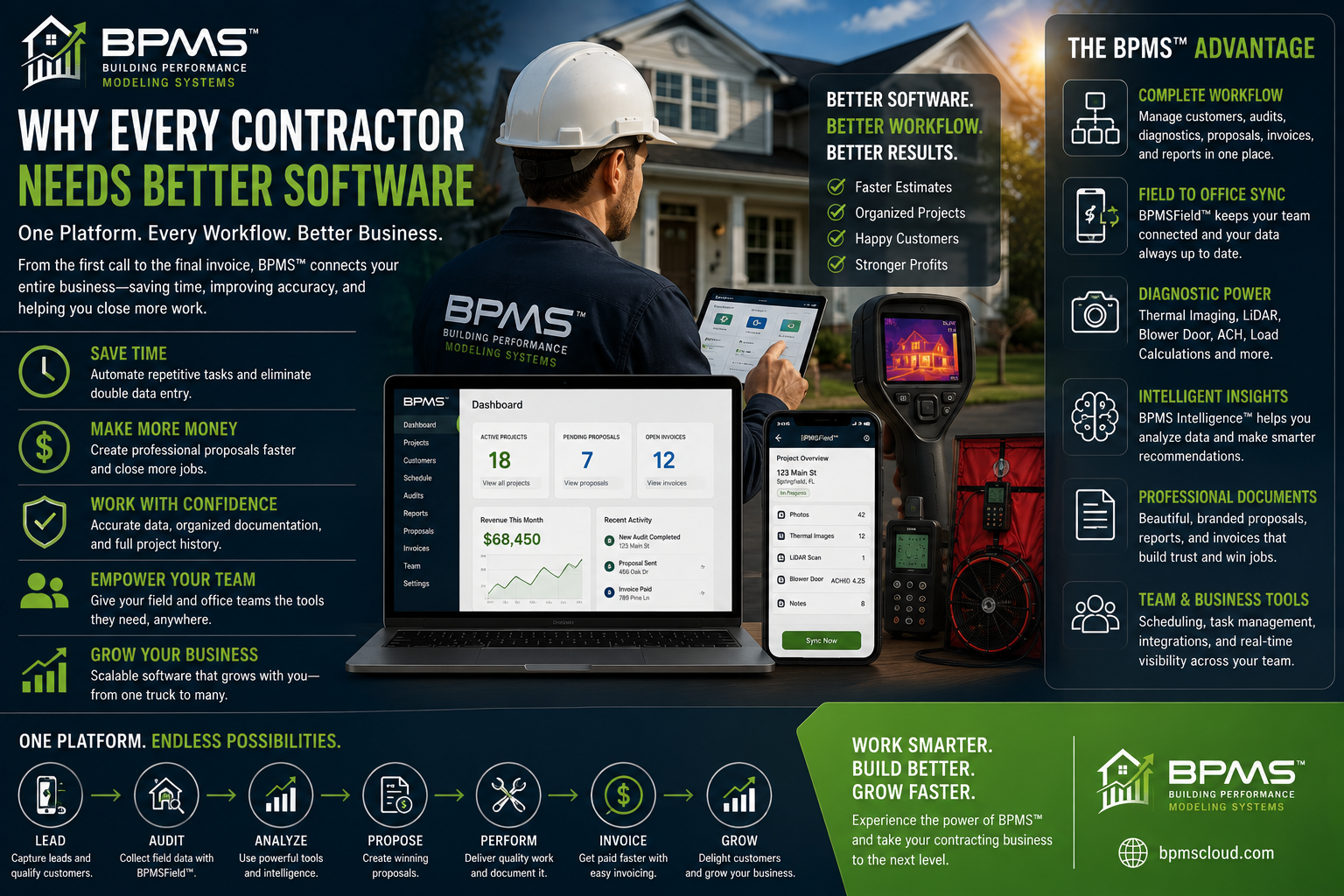
This is the philosophy behind Building Performance Modeling Systems (BPMS™).
BPMS™ is being developed as a connected platform for professionals working across:
* Energy auditing
* HVAC
* Home performance
* Weatherization
* Building science
* Energy efficiency
Instead of treating every function as an isolated application, BPMS™ is designed around the complete building-performance workflow.
⸻
The BPMS™ Workflow
A contractor can begin with:
Customer
Create the customer record.
↓
Property
Connect the building.
↓
Audit
Collect building-performance information.
↓
Field Data
Capture evidence from the property.
↓
Analysis
Evaluate the building.
↓
Recommendations
Identify potential improvements.
↓
WorkScope
Define the work.
↓
Proposal
Present the project professionally.
↓
Invoice
Complete the business workflow.
↓
Report
Deliver professional documentation.
One connected project.
⸻
BPMSField™ — The Contractor in the Field
BPMSField™ extends BPMS™ into the field.
The mobile workflow is designed to help professionals capture project information directly at the building.
This can include:
* Photographs
* Field observations
* Location-related data
* Thermal imagery
* LiDAR information
The objective is simple:
Capture information once and keep it connected to the project.
⸻
BPMS Thermal™ — Turning Thermal Images Into Project Data
Thermal imaging is extremely valuable in building-performance work.
But thermal images should not disappear into a camera folder.
BPMS Thermal™ is designed to associate thermal information directly with the audit.
That means the image can become part of:
Finding → Recommendation → Report
rather than remaining an isolated file.
⸻
BPMS LiDARScan™ — Digitizing Building Geometry
Accurate geometry affects many contractor workflows.
Measurements influence:
* Areas
* Volumes
* Material quantities
* ACH calculations
* HVAC loads
* Energy models
BPMS LiDARScan™ is designed to capture building geometry digitally on compatible devices.
This reduces the gap between physically measuring a building and digitally modeling it.
⸻
BPMS Load CalC™ — Connecting HVAC With the Building
HVAC equipment should be selected based on building loads.
BPMS Load CalC™ helps bring load calculations into the same environment as other building-performance information.
That means envelope characteristics, geometry, infiltration, and HVAC decisions can become part of one connected workflow.
For HVAC contractors, that creates a stronger connection between:
Building → Load → Equipment
⸻
BPMS™ ACH and Blower Door Reporting
Air-tightness testing is becoming increasingly important in both existing-home performance and new construction.
BPMS™ provides workflows for entering blower door information, calculating ACH, and generating professional documentation.
This can help energy auditors and HVAC contractors provide builders and customers with organized testing records.
⸻
BPMS Intelligence™ — The Next Layer
The future of contractor software isn’t simply storing information.
It is helping professionals understand it.
BPMS Intelligence™ is designed to analyze information across the building-performance workflow.
Imagine:
Blower Door Result
Thermal Image
Building Geometry
HVAC Information
Energy Consumption
Field Observations
Instead of treating each as a separate file, the system can help surface relationships between them.
The contractor still makes the professional determination.
But the software becomes more intelligent.
⸻
BPMS FluxSense Analyzer™ — Connecting Physical Measurement to Software
The developing BPMS FluxSense Analyzer™ represents an additional step toward connected building diagnostics.
The concept is to bring direct heat-flux and temperature measurements into the broader building-performance environment.
That represents an important shift.
Contractor software is no longer simply managing office paperwork.
It can increasingly become connected with the physical measurement of the building itself.
⸻
From Contractor Software to Building Intelligence
This is where the industry is heading.
Yesterday’s contractor software:
Customer + Invoice
Today’s contractor software:
CRM + Scheduling + Field Service + Proposals
Tomorrow’s building-performance platform:
Customer
Building
Diagnostics
Geometry
Thermal Data
Energy Data
HVAC
Connected Sensors
AI
The software becomes more than business management.
It becomes a digital representation of how the building performs.
⸻
Imagine the Contractor of the Future
The technician arrives at the property.
The customer record is already available.
BPMSField™ opens the project.
Photographs are captured.
LiDAR measures the building.
Thermal imaging identifies areas requiring investigation.
Blower door testing measures air leakage.
HVAC information is recorded.
BPMS Load CalC™ evaluates loads.
Future connected diagnostic devices provide additional measurements.
BPMS Intelligence™ reviews the project.
Missing information is flagged.
The contractor verifies the findings.
A report is generated.
The recommended work becomes a scope.
The scope becomes a proposal.
The customer approves.
The project becomes an invoice.
One workflow.
That is what better contractor software should ultimately accomplish.
⸻
Better Software Creates a Better Customer Experience
From the customer’s perspective, the difference is dramatic.
Instead of receiving scattered paperwork and confusing information, the customer experiences:
Professional intake
↓
Organized inspection
↓
Visual documentation
↓
Clear findings
↓
Understandable recommendations
↓
Professional proposal
↓
Organized project
↓
Professional final report
The customer doesn’t necessarily know which software created the experience.
They simply know the contractor appears organized.
And organization creates confidence.
⸻
Better Software Helps Small Contractors Compete With Large Companies
This is one of technology’s greatest advantages.
Historically, large companies had access to sophisticated systems because they could afford:
* IT departments
* Custom databases
* Enterprise software
* Administrative staff
Cloud technology changes that.
A five-person contractor can now potentially operate with systems that would once have required a much larger organization.
That allows smaller businesses to compete through:
* Speed
* Professionalism
* Documentation
* Automation
* Customer experience
Technology can become an equalizer.
⸻
Better Software Helps Large Contractors Scale
The opposite is also true.
Once a company reaches dozens or hundreds of employees, standardized systems become essential.
Without them:
Every branch develops different processes.
Every technician documents differently.
Every manager creates their own spreadsheet.
Data becomes impossible to compare.
A centralized platform can help establish consistent operations across the organization.
⸻
The Best Contractor Software Should Disappear Into the Workflow
Great software should not make contractors think about software all day.
It should make the work easier.
A technician should not need to wonder:
“Which application do I use for this?”
The workflow should naturally guide the user.
The best technology becomes almost invisible.
It simply helps the company operate.
⸻
What Contractors Should Look for in Software
Before choosing a platform, contractors should evaluate whether it can provide:
Mobile Capability
Can technicians use it effectively in the field?
Centralized Customer Records
Can all relevant project information remain connected?
Photo Management
Are images associated with the correct project?
Professional Reporting
Can findings become customer-ready documents?
Proposal and Invoice Workflows
Can technical findings move into business processes?
Integrations
Can the platform communicate with important external services?
Team Management
Can multiple employees work within a standardized process?
Security
Is customer and company information appropriately protected?
Scalability
Can the platform support the company as it grows?
Industry-Specific Functionality
Does it understand the contractor’s actual work?
That last point is especially important.
⸻
Generic Software vs. Industry-Specific Software
Generic CRM systems can be excellent at managing customers.
Generic field-service platforms can be excellent at dispatching technicians.
But specialized contractors often require specialized information.
An energy auditor needs:
ACH50
An HVAC contractor needs:
Heating and cooling loads
A home-performance contractor needs:
Envelope diagnostics
A weatherization professional needs:
Energy and building information
Industry-specific software understands the language of the work.
That can make a significant difference.
⸻
The Return on Better Software
The ROI of software should be measured across multiple dimensions.
Does it save administrative time?
Does it reduce duplicate entry?
Does it reduce mistakes?
Does it help technicians complete projects correctly?
Does it improve proposal quality?
Does it accelerate customer follow-up?
Does it improve documentation?
Does it allow the company to complete more projects?
Does it improve customer experience?
If the answer to several of these is yes, the platform is not simply software.
It is business infrastructure.
⸻
The Contractors Who Adapt Will Have an Advantage
The contracting industry is not becoming less digital.
Customers expect online communication.
Building departments increasingly accept digital documentation.
Field technicians use mobile devices.
Diagnostic equipment is becoming connected.
AI is entering business operations.
Buildings themselves are becoming smarter.
The contractor who continues running entirely on:
Paper + Text Messages + Spreadsheets
may still perform excellent craftsmanship.
But operationally, that company may increasingly compete against businesses that can respond faster, document better, analyze more information, and deliver a more professional customer experience.
⸻
The Competitive Advantage Is the Workflow
Software alone does not make a great contractor.
But a great contractor with a great system can become extremely powerful.
The craftsmanship creates the result.
The software creates the consistency.
The combination creates a scalable business.
That is the real opportunity.
⸻
Final Thoughts
Every contractor doesn’t necessarily need more software.
They need better software.
Software that understands the work.
Software that connects the field with the office.
Software that keeps customer information organized.
Software that connects photos with projects.
Software that turns findings into recommendations.
Software that turns recommendations into scopes.
Software that turns scopes into proposals.
Software that turns completed work into invoices and reports.
Most importantly, contractors need technology that gives them back something they can never purchase more of:
Time.
Time to complete another project.
Time to speak with customers.
Time to train employees.
Time to grow the business.
Time to focus on craftsmanship instead of paperwork.
For energy auditors, HVAC contractors, weatherization professionals, and home-performance companies, the next generation of contractor software can go even further—connecting building geometry, blower door testing, thermal imaging, HVAC calculations, energy analysis, field documentation, business operations, and eventually connected diagnostic intelligence.
That is the direction behind BPMS™.
Not another disconnected contractor application.
But an increasingly connected building-performance ecosystem built around the entire professional workflow.
Because the contractor of tomorrow should not spend the day managing paperwork.
The contractor should spend the day understanding buildings, solving problems, serving customers, and growing the business.
The software should handle as much of the rest as possible.
Better Software. Better Workflow. Better Business. Better Building Performance.
BPMS™ — One Platform. Complete Building Performance.
Comments and Reviews
Share what you found helpful and how this article supported your work.
0.0/5from 0 reviews
No reviews yet. Be the first to share your feedback.