What Is Building Performance and Why It Matters: The Foundation of Energy Efficiency, Comfort, and Sustainability
Published 7/20/2026
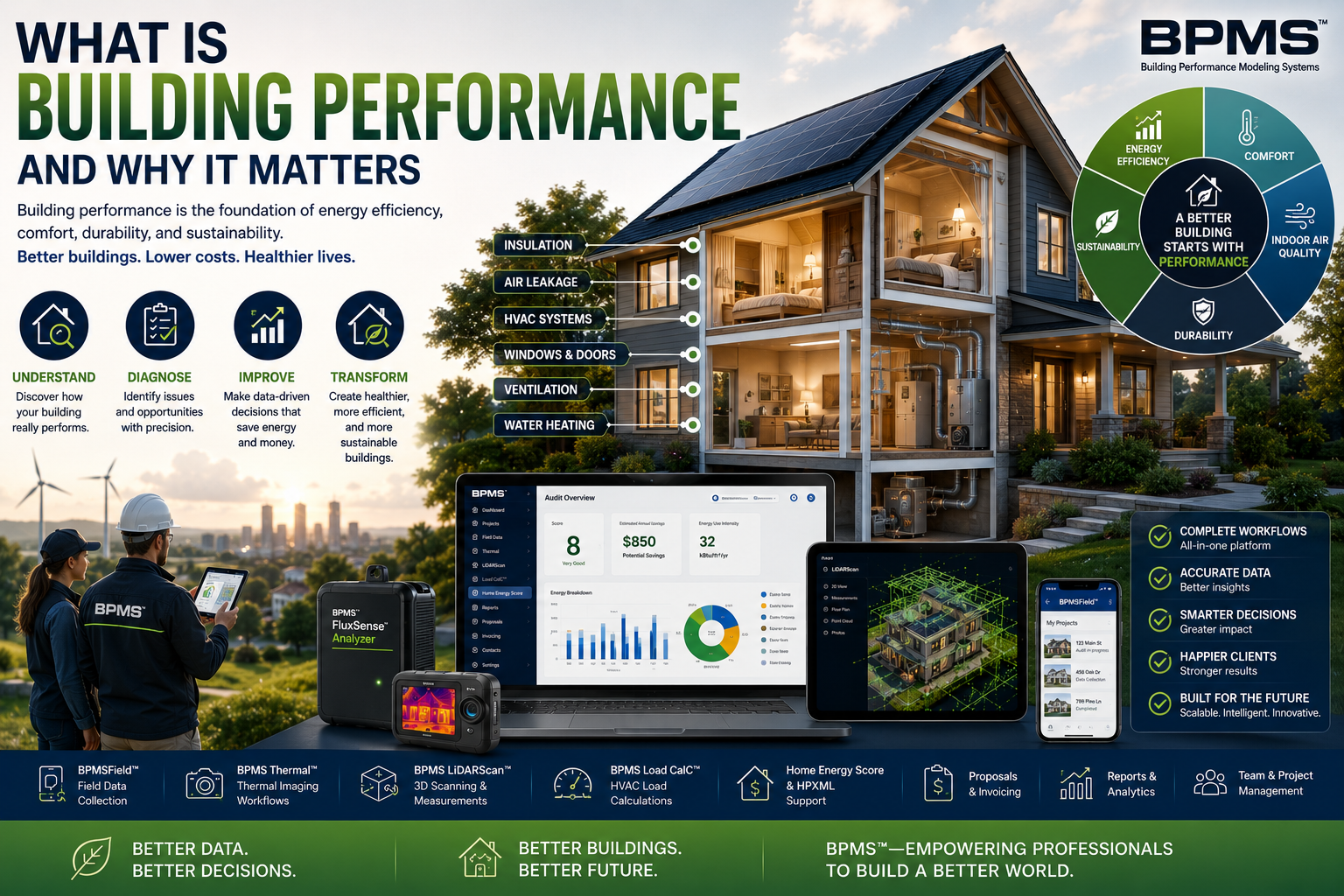
Building performance affects everything from energy bills and indoor comfort to air quality, durability, and environmental impact. Learn what building performance means, why it has become one of the most important concepts in modern construction and energy efficiency, and how technologies like BPMS™, BPMSField™, BPMS Thermal™, BPMS LiDARScan™, and BPMS FluxSense Analyzer™ are helping shape the future of smarter buildings.
What Is Building Performance and Why It Matters
Introduction
Every building tells a story.
Some buildings are comfortable year-round, maintain low utility bills, provide healthy indoor air, and operate efficiently for decades.
Others struggle with:
* High energy costs
* Uneven temperatures
* Drafts
* Moisture problems
* Poor indoor air quality
* Excessive HVAC operation
* Rising maintenance expenses
The difference often comes down to one critical concept:
Building Performance.
Building performance is the science of understanding how a building actually functions in the real world.
As energy costs continue to rise and sustainability becomes increasingly important, building performance has become one of the most valuable tools available to homeowners, contractors, energy auditors, engineers, utility companies, and building professionals.
⸻
What Is Building Performance?
Building performance refers to how effectively a building performs its intended functions.
These functions include:
Energy Efficiency
How much energy is required to heat, cool, ventilate, and operate the building.
Comfort
How consistently the building maintains comfortable indoor temperatures.
Indoor Air Quality
How effectively the building supports healthy living conditions.
Durability
How well the building withstands weather, moisture, aging, and wear.
Safety
How safely building systems operate.
Sustainability
How efficiently the building uses resources and minimizes environmental impact.
A building may look beautiful from the outside but still perform poorly.
True building performance measures what happens behind the walls.
⸻
The Building as a System
For many years, construction professionals viewed building components separately.
A contractor might focus on insulation.
An HVAC contractor might focus on equipment.
A roofer might focus on roofing materials.
Modern building science recognizes that buildings operate as interconnected systems.
Every component affects the others.
Examples include:
* Insulation impacts HVAC performance.
* Air leakage affects comfort.
* Ventilation affects indoor air quality.
* Windows influence heat gain and heat loss.
* Moisture affects durability and efficiency.
Improving one area often affects multiple aspects of building performance.
This systems-based approach has transformed the industry.
⸻
The Five Pillars of Building Performance
1. Energy Efficiency
Energy efficiency is often the most visible aspect of building performance.
Efficient buildings use less energy to provide the same level of comfort.
Benefits include:
* Lower utility bills
* Reduced operating costs
* Smaller environmental footprint
* Increased building value
Energy efficiency is often measured through:
* Energy audits
* Utility bill analysis
* Building modeling
* Performance ratings
⸻
2. Comfort
Many homeowners assume discomfort is normal.
Common complaints include:
* Hot rooms
* Cold rooms
* Drafts
* Temperature fluctuations
Poor comfort is often caused by:
* Air leakage
* Inadequate insulation
* HVAC deficiencies
* Solar heat gain
Improving building performance often leads to significant comfort improvements.
⸻
3. Indoor Air Quality
Indoor air quality has become increasingly important.
Poor indoor air quality may contribute to:
* Allergies
* Respiratory issues
* Excess humidity
* Mold growth
Building performance professionals evaluate:
* Ventilation systems
* Air leakage pathways
* Moisture management
* Filtration systems
Healthy buildings are high-performing buildings.
⸻
4. Durability
Buildings are long-term investments.
Poor performance can lead to:
* Moisture damage
* Mold growth
* Structural deterioration
* Premature equipment failure
Durable buildings are often more efficient and more economical over time.
⸻
5. Sustainability
Buildings account for a significant portion of energy consumption worldwide.
Improving building performance helps:
* Reduce greenhouse gas emissions
* Lower resource consumption
* Support energy independence
* Promote environmental stewardship
Sustainability begins with better-performing buildings.
⸻
Why Building Performance Matters Today
Several factors have made building performance more important than ever.
Rising Energy Costs
Energy prices continue to impact homeowners and businesses.
Improving efficiency helps reduce operating expenses.
⸻
Aging Building Stock
Many homes and commercial buildings were constructed before modern energy codes.
These structures often contain significant opportunities for improvement.
⸻
Electrification
As buildings transition toward electric heating and cooling systems, efficiency becomes increasingly important.
⸻
Renewable Energy Integration
Solar energy systems perform best when paired with efficient buildings.
Reducing energy consumption often provides a greater return on investment than increasing energy production alone.
⸻
Climate and Sustainability Goals
Governments, utilities, and organizations are investing heavily in energy efficiency programs.
Building performance plays a central role in achieving these goals.
⸻
How Building Performance Is Measured
Building performance professionals use a variety of diagnostic tools.
Energy Audits
Comprehensive evaluations of building energy use.
Blower Door Testing
Measures air leakage.
Duct Leakage Testing
Measures HVAC system losses.
Thermal Imaging
Identifies insulation deficiencies and air leakage pathways.
Utility Bill Analysis
Evaluates actual energy consumption patterns.
Home Energy Scores
Provides standardized energy performance ratings.
Building Modeling
Predicts energy performance under various operating conditions.
Together, these tools provide a more complete understanding of how a building functions.
⸻
The Evolution of Building Performance Technology
Ten years ago, many building assessments relied heavily on:
* Paper forms
* Manual measurements
* Spreadsheet calculations
* Standalone software
Today, technology has transformed the industry.
Professionals now utilize:
* Cloud computing
* Thermal imaging
* Mobile applications
* LiDAR scanning
* Artificial intelligence
* Real-time analytics
The result is faster, more accurate, and more comprehensive assessments.
⸻
How BPMS™ Supports Modern Building Performance
Building Performance Modeling Systems™ (BPMS™) was developed to help professionals manage the increasing complexity of modern building analysis.
Rather than relying on multiple disconnected tools, BPMS™ brings critical workflows together into a single ecosystem.
⸻
BPMSField™: Improving Data Collection
Accurate data is the foundation of building performance.
BPMSField™ allows professionals to:
* Collect field information
* Capture photographs
* Upload documentation
* Organize project data
directly from the job site.
⸻
BPMS Thermal™: Visualizing Building Performance
Thermal imaging provides valuable insight into building behavior.
BPMS Thermal™ helps professionals:
* Document thermal anomalies
* Organize thermal imagery
* Improve reporting workflows
Thermal imaging makes hidden performance problems visible.
⸻
BPMS LiDARScan™: Modern Building Measurement
Accurate measurements are critical for energy analysis.
BPMS LiDARScan™ helps:
* Capture building geometry
* Improve measurement accuracy
* Reduce manual fieldwork
* Create digital building models
This supports more reliable assessments and calculations.
⸻
BPMS Load CalC™: Better HVAC Decisions
Heating and cooling systems are heavily influenced by building performance.
BPMS Load CalC™ helps professionals evaluate:
* Heating loads
* Cooling loads
* Building envelope impacts
* HVAC sizing requirements
Accurate calculations lead to better system design.
⸻
The Future of Building Performance
The future of building performance will be increasingly data-driven.
Emerging technologies include:
Artificial Intelligence
AI-assisted diagnostics and recommendations.
Smart Buildings
Real-time monitoring of energy use and comfort conditions.
Digital Twins
Virtual building models that simulate performance.
Continuous Monitoring
Ongoing performance tracking rather than one-time assessments.
Advanced Sensors
Real-world measurement of building behavior.
⸻
BPMS FluxSense Analyzer™: A New Frontier
One exciting development is the BPMS FluxSense Analyzer™.
The patent-pending technology is being developed to help measure actual heat transfer through building assemblies.
Potential future applications include:
* Direct heat flux measurement
* Dynamic thermal analysis
* Building envelope diagnostics
* Performance verification
This represents a significant step toward measuring actual building performance rather than relying solely on assumptions and estimates.
⸻
Why Building Performance Will Matter Even More Tomorrow
The buildings of the future will need to be:
* More efficient
* More sustainable
* More resilient
* More intelligent
Homeowners will increasingly expect:
* Lower utility costs
* Greater comfort
* Better indoor air quality
* Renewable energy compatibility
Governments and utilities will continue emphasizing energy efficiency as a critical strategy for managing energy demand.
Building performance will remain at the center of these efforts.
⸻
Conclusion
Building performance is far more than an industry buzzword.
It is the science of understanding how buildings actually function.
By evaluating energy efficiency, comfort, indoor air quality, durability, safety, and sustainability, building performance professionals help create buildings that are healthier, more comfortable, more efficient, and more valuable.
As technology continues to evolve, platforms such as BPMS™, BPMSField™, BPMS Thermal™, BPMS LiDARScan™, BPMS Load CalC™, and the BPMS FluxSense Analyzer™ are helping transform the way buildings are measured, analyzed, and optimized.
The future of building performance is intelligent, data-driven, and focused on creating better buildings for everyone.
Comments and Reviews
Share what you found helpful and how this article supported your work.
0.0/5from 0 reviews
No reviews yet. Be the first to share your feedback.