Weatherization: Building a More Efficient Future—From the Origins of the Weatherization Assistance Program to Modern Building Performance
Published 7/31/2026
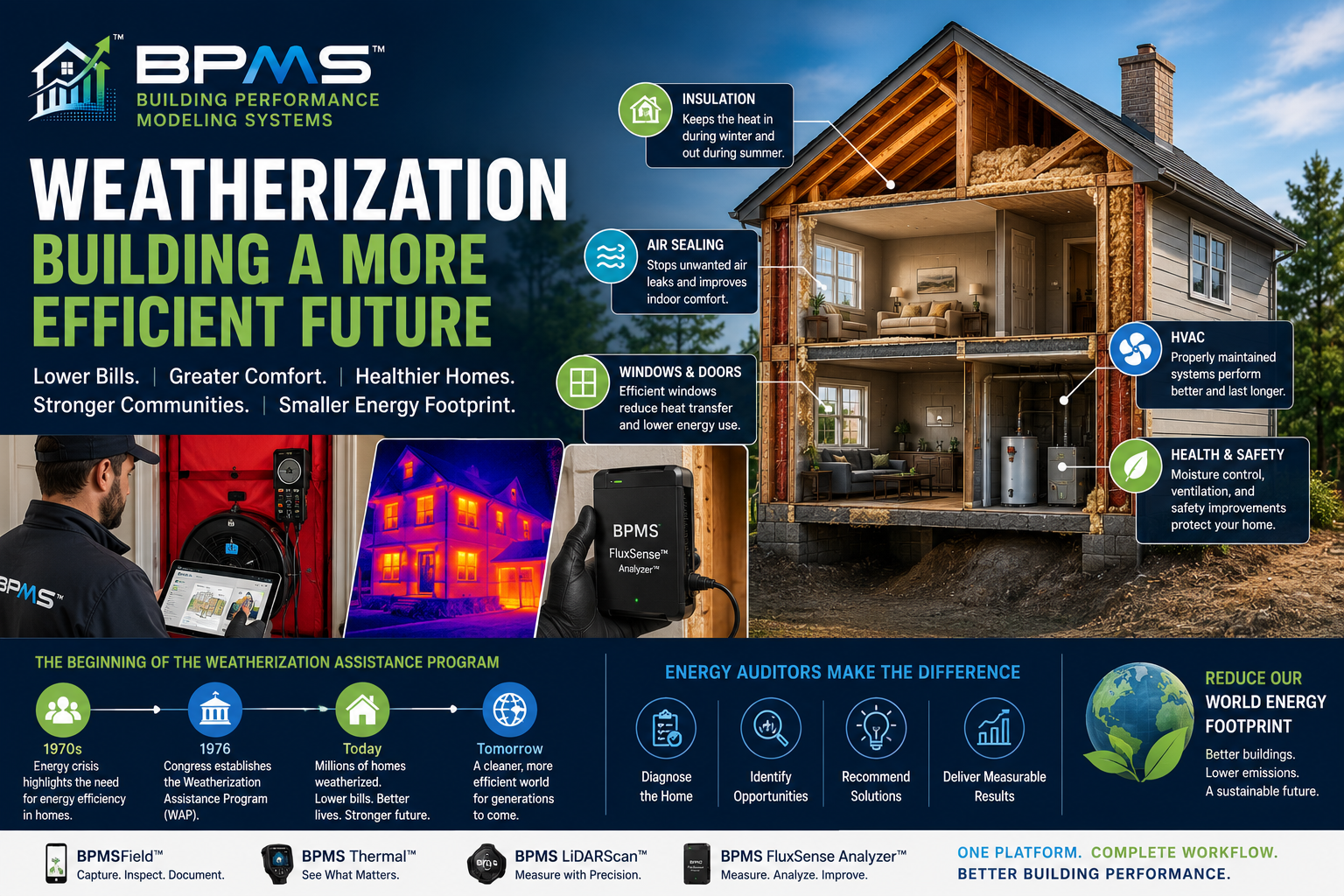
Weatherization has transformed millions of homes by improving energy efficiency, reducing utility costs, and increasing comfort for families around the world. Learn the history of the U.S. Weatherization Assistance Program (WAP), the critical role of energy auditors, modern weatherization technologies, and how building performance professionals are helping reduce the world’s energy footprint through data-driven solutions like BPMS™.
Weatherization: Building a More Efficient Future—From the Origins of the Weatherization Assistance Program to Modern Building Performance
Introduction
Every year, homeowners spend billions of dollars heating and cooling homes that unintentionally waste energy. Air leaks, inadequate insulation, aging HVAC systems, and inefficient building designs increase utility costs while reducing comfort and placing additional strain on our energy infrastructure.
Weatherization addresses these challenges by improving the energy performance of existing homes. It is one of the most effective strategies for reducing energy consumption, lowering utility bills, improving occupant comfort, and decreasing greenhouse gas emissions.
For energy auditors and building performance professionals, weatherization represents far more than installing insulation or sealing air leaks—it is the practical application of building science to improve the way homes perform.
Today, weatherization is supported by sophisticated diagnostic technologies, cloud-based software, and data-driven analysis. As the industry continues to evolve, energy auditors play an increasingly important role in helping homeowners, utilities, and governments reduce the world’s overall energy footprint.
⸻
What Is Weatherization?
Weatherization is the process of improving a home’s ability to resist unwanted heat transfer and uncontrolled air movement while increasing the efficiency of its mechanical systems.
Its primary objectives are to:
* Reduce energy consumption
* Improve occupant comfort
* Lower heating and cooling costs
* Improve indoor air quality
* Increase building durability
* Reduce greenhouse gas emissions
* Improve HVAC system performance
* Enhance overall building performance
Unlike a cosmetic renovation, weatherization focuses on how a home functions as a complete system. Improvements are selected based on diagnostic testing and building science principles rather than appearance alone.
⸻
Common Weatherization Measures
Professional weatherization projects often include:
Air Sealing
Air sealing reduces uncontrolled infiltration by sealing gaps around:
* Windows
* Doors
* Attic penetrations
* Plumbing openings
* Electrical penetrations
* Rim joists
* Recessed lighting
* Chimney chases
Air sealing is frequently one of the most cost-effective weatherization measures because it reduces conditioned air loss and improves the effectiveness of insulation.
⸻
Insulation Upgrades
Improving insulation slows conductive heat transfer through:
* Attics
* Exterior walls
* Floors
* Crawlspaces
* Basements
* Rim joists
Proper insulation helps maintain more stable indoor temperatures and reduces heating and cooling loads.
⸻
HVAC Improvements
Weatherization may include:
* Equipment replacement
* Duct sealing
* Duct insulation
* Airflow balancing
* Filter improvements
* Thermostat upgrades
Improving the building envelope often allows HVAC systems to operate more efficiently and comfortably.
⸻
Window and Door Improvements
Measures may include:
* Weatherstripping
* Caulking
* Storm windows
* High-performance glazing
* Replacement of severely deteriorated units where appropriate
⸻
Moisture Management
Addressing moisture is an essential part of weatherization because water intrusion can reduce insulation performance and affect building durability.
Typical improvements include:
* Vapor barriers
* Drainage corrections
* Crawlspace improvements
* Attic ventilation adjustments
* Air sealing to reduce moisture transport
⸻
The Beginning of the Weatherization Assistance Program
The Weatherization Assistance Program (WAP) was established by the U.S. Congress in 1976 following the energy crisis of the early 1970s.
At that time, rising fuel costs highlighted the need to reduce residential energy consumption, particularly for low-income households that often spent a disproportionate share of their income on utility bills.
The program’s original goal was straightforward:
Help low-income families reduce their energy costs by improving the efficiency of their homes.
Administered by the U.S. Department of Energy, WAP provides funding to states, territories, and tribal organizations, which work through local agencies to deliver weatherization services to eligible households.
Over the decades, millions of homes have received weatherization improvements through the program, including air sealing, insulation, heating-system upgrades, and health-and-safety measures.
⸻
How Weatherization Has Evolved
Early weatherization efforts focused primarily on:
* Adding attic insulation
* Installing storm windows
* Basic caulking
* Weatherstripping
As building science advanced, weatherization became more diagnostic-driven.
Today’s programs often incorporate:
* Blower door testing
* Infrared thermography
* Duct leakage testing
* Combustion safety testing
* Ventilation assessments
* Moisture evaluations
* Building pressure diagnostics
* Health and safety inspections
Modern weatherization is no longer based on assumptions—it is based on measured performance.
⸻
The Role of Energy Auditors in Weatherization
Energy auditors are central to every successful weatherization project.
Their responsibilities extend beyond identifying deficiencies. They evaluate the home as a complete building system, determine the underlying causes of energy loss, and recommend improvements that are technically appropriate, cost-effective, and safe.
Typical responsibilities include:
* Interviewing homeowners
* Inspecting the building enclosure
* Evaluating insulation levels
* Conducting blower door testing
* Performing thermal imaging
* Assessing HVAC systems
* Measuring duct leakage
* Evaluating combustion safety
* Investigating moisture issues
* Preparing professional reports
* Prioritizing recommended improvements
Energy auditors also help homeowners understand why recommended measures matter, turning technical findings into practical guidance.
⸻
Diagnostic Technologies Driving Modern Weatherization
Today’s auditors rely on advanced tools to identify opportunities for improvement.
These include:
* Blower Door Systems
* Infrared Cameras
* Duct Leakage Test Equipment
* Moisture Meters
* Combustion Analyzers
* Airflow Measurement Instruments
* Digital Manometers
* Laser Distance Meters
* LiDAR Scanners
* Drone Imaging Systems
Emerging technologies continue to improve the accuracy and efficiency of building diagnostics.
⸻
The Evolution of Building Performance Software
As weatherization projects have become more comprehensive, software platforms have evolved from basic reporting tools into integrated building performance systems.
Modern platforms help professionals:
* Collect field data
* Organize photographs
* Store thermal images
* Generate reports
* Estimate energy savings
* Create work scopes
* Produce proposals
* Manage projects
* Collaborate with teams
* Maintain documentation
BPMS™ was designed to support this complete workflow by combining diagnostics, documentation, reporting, and project management in a single cloud-based platform.
⸻
BPMS™ and the Future of Weatherization
The next generation of weatherization is data-driven.
BPMS™ supports professionals throughout the audit and weatherization process by integrating advanced technologies into one workflow.
BPMSField™
Enables field staff to capture inspection data, photographs, notes, and documentation directly from the job site.
BPMS Thermal™
Organizes infrared imagery alongside audit data to help professionals communicate findings clearly.
BPMS FluxSense Analyzer™
Designed to directly measure heat flow through building assemblies, providing an additional layer of insight beyond surface temperatures alone.
BPMS LiDARScan™
Captures building geometry to improve documentation and support more accurate measurements.
Together, these tools help weatherization professionals work more efficiently while producing consistent, high-quality reports.
⸻
The Future of the Weatherization Assistance Program
As energy costs rise, climate resilience becomes more important, and building technologies continue to advance, weatherization is expected to remain an important strategy for improving residential energy efficiency.
Future programs are likely to place greater emphasis on:
* Electrification readiness
* Heat pump integration
* Smart-home technologies
* Grid-interactive efficient buildings
* Advanced diagnostics
* Whole-home performance
* Indoor air quality
* Climate resilience
* Digital documentation
* Workforce development
* Data-driven decision-making
Energy auditors will continue to play a key role by evaluating existing homes and helping homeowners prioritize improvements that deliver measurable benefits.
⸻
Weatherization and the World’s Energy Footprint
Buildings account for a significant share of global energy use and associated greenhouse gas emissions. Improving the efficiency of existing homes is one of the most practical ways to reduce overall energy demand without sacrificing comfort.
When multiplied across millions of homes, weatherization can contribute to:
* Lower energy consumption
* Reduced peak electricity demand
* Lower utility costs
* Reduced fossil fuel use where applicable
* Lower greenhouse gas emissions
* Improved grid resilience
* Increased housing affordability
* Better indoor environmental quality
Every weatherized home represents a step toward a more efficient and sustainable built environment.
⸻
Why Every Energy Auditor Matters
Every inspection performed by an energy auditor has the potential to influence a home’s energy use for years to come.
By identifying opportunities to improve insulation, reduce air leakage, optimize HVAC performance, and enhance building durability, auditors help homeowners make informed decisions that benefit both their households and the broader community.
Their work supports not only lower utility bills and improved comfort but also long-term environmental stewardship.
⸻
Conclusion
Weatherization has grown from a response to the energy challenges of the 1970s into a cornerstone of modern building performance. Through the Weatherization Assistance Program and the continued efforts of energy auditors, contractors, utilities, and public agencies, millions of homes have become more comfortable, more efficient, and less costly to operate.
As technologies such as thermal imaging, LiDAR, direct heat-flux measurement, and cloud-based platforms continue to advance, the future of weatherization will become increasingly data-driven and integrated.
For professionals committed to improving building performance, tools like BPMS™, BPMSField™, BPMS Thermal™, BPMS LiDARScan™, and BPMS FluxSense Analyzer™ provide the capabilities needed to document findings, analyze building performance, and deliver actionable recommendations—helping shape a future where every home performs better, every retrofit is guided by data, and every improvement contributes to reducing the world’s energy footprint.
Comments and Reviews
Share what you found helpful and how this article supported your work.
0.0/5from 0 reviews
No reviews yet. Be the first to share your feedback.