Understanding Heat Loss: An Energy Auditor’s Guide to Helping Homeowners Lower Energy Bills and Improve Home Comfort
Published 7/27/2026
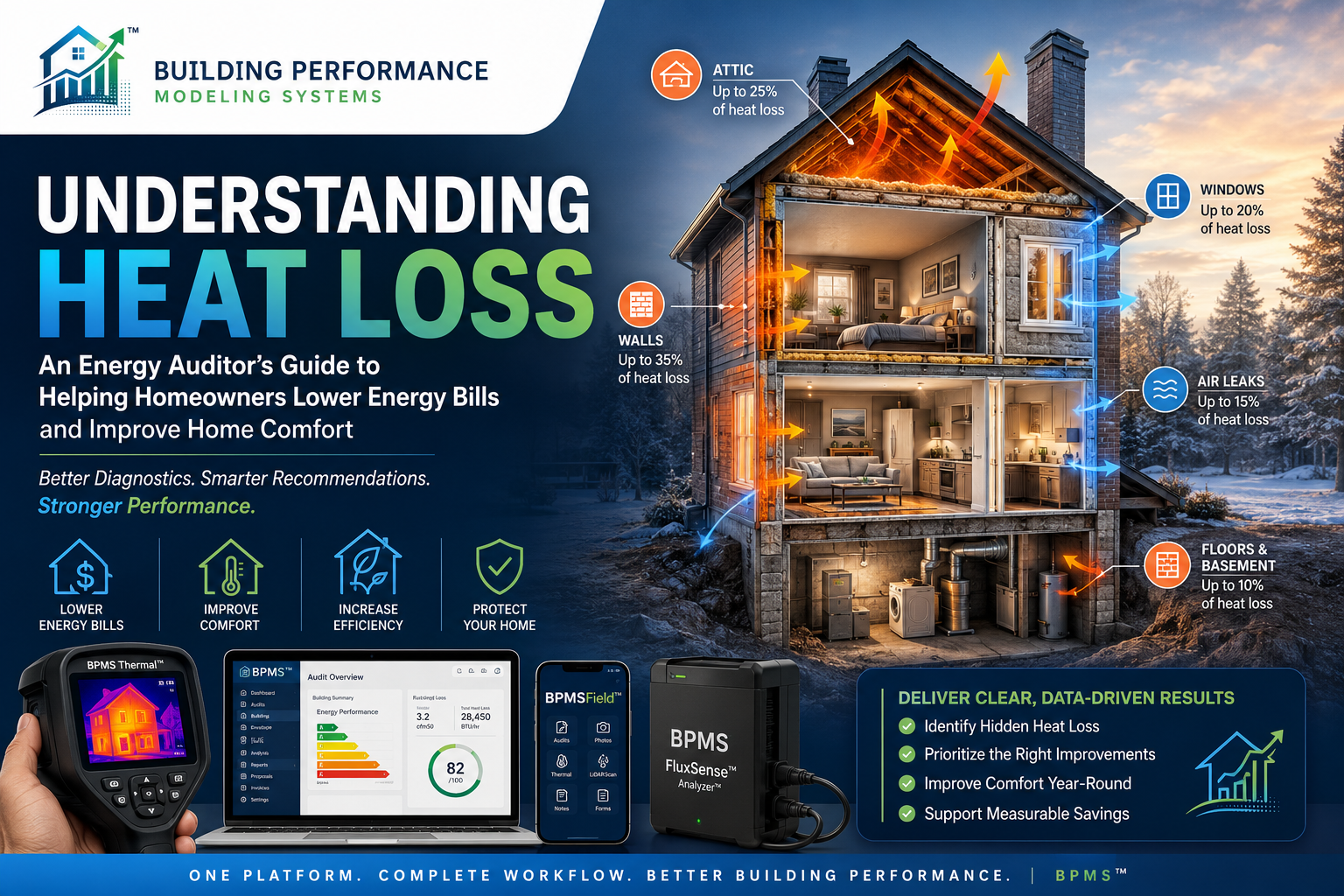
Heat loss is one of the most significant factors affecting a home’s energy efficiency, occupant comfort, and heating costs. This comprehensive guide is designed for energy auditors who want to deepen their understanding of heat transfer, educate homeowners more effectively, and recommend practical solutions that deliver measurable energy savings.
Understanding Heat Loss: An Energy Auditor’s Guide to Helping Homeowners Lower Energy Bills and Improve Home Comfort
Introduction
As an energy auditor, one of your most valuable responsibilities is helping homeowners understand why their home is uncomfortable, why their utility bills continue to rise, and what improvements will provide the greatest return on investment.
Many homeowners believe their heating or cooling equipment is the primary cause of high energy bills. While HVAC efficiency certainly plays an important role, the reality is that the building envelope often has a much greater impact on overall energy consumption.
A home that continuously loses heat forces the heating system to replace that lost energy day after day. The more efficiently you can identify where and why heat is escaping, the better equipped you are to educate your customers and recommend improvements that deliver lasting comfort and measurable savings.
This guide is designed to strengthen your knowledge of heat loss and provide practical talking points you can use during every energy audit.
⸻
Understanding How Heat Moves
Before identifying deficiencies in a home, it is essential to understand the basic principles of heat transfer.
Heat always moves from areas of higher temperature toward areas of lower temperature. During winter, heat flows from the warm interior of a home toward the colder outdoors. During summer, the opposite occurs as outdoor heat attempts to enter the conditioned space.
Heat moves through buildings in four primary ways:
* Conduction
* Convection
* Radiation
* Air Infiltration
Understanding each mechanism allows you to explain to homeowners not only where energy is being lost but also why it is happening.
⸻
Conduction: Heat Moving Through Building Materials
Conduction is the direct transfer of heat through solid materials.
Examples include:
* Exterior walls
* Windows
* Roof decking
* Doors
* Floors
* Concrete slabs
* Foundations
Every building material has a different resistance to heat flow, commonly referred to as its R-value. Materials with higher R-values slow heat transfer more effectively.
When inspecting a home, pay close attention to:
* Missing insulation
* Compressed insulation
* Moisture-damaged insulation
* Thermal bridges created by wood framing or steel components
These conditions allow heat to move rapidly through the building envelope, increasing energy consumption.
⸻
Air Leakage: The Hidden Energy Thief
In many homes, uncontrolled air leakage accounts for a significant portion of heating and cooling losses.
Common leakage locations include:
* Attic penetrations
* Plumbing chases
* Electrical penetrations
* Recessed lighting
* Rim joists
* Window frames
* Door weatherstripping
* Fireplace surrounds
* Crawlspace penetrations
Even small openings collectively can allow substantial conditioned air to escape while drawing unconditioned outdoor air into the home.
One of the most valuable messages you can communicate to homeowners is that air sealing is often among the most cost-effective energy improvements available.
⸻
Convection: Heat Carried by Air Movement
Convection occurs whenever moving air transports heat.
Inside wall cavities or attic spaces, uncontrolled air movement reduces insulation effectiveness.
Within the home itself, convection contributes to:
* Drafts
* Uneven room temperatures
* Cold floors
* Hot ceilings
Understanding convection helps explain why insulation alone cannot solve every comfort issue if significant air leakage remains.
⸻
Radiation: Heat Transfer Without Direct Contact
Radiant heat transfer occurs through electromagnetic waves.
Windows are especially vulnerable because glass transfers radiant heat much more readily than insulated walls.
This is why modern windows often include:
* Low-emissivity (Low-E) coatings
* Multiple panes
* Argon or krypton gas fills
* Warm-edge spacers
These technologies reduce radiant heat transfer and improve overall window performance.
⸻
Why Heat Loss Increases Energy Bills
One of the easiest concepts for homeowners to understand is that every BTU of heat escaping the home must be replaced by the heating system.
When heat loss increases:
* Furnaces run longer.
* Heat pumps operate more frequently.
* Boilers consume more fuel.
* Electric resistance heaters draw more electricity.
* Utility bills rise.
Helping customers connect building deficiencies with higher operating costs builds confidence in your recommendations.
⸻
Common Locations Where Homes Lose Heat
During an audit, pay particular attention to the following areas:
Attics
Because warm air rises, poorly insulated attics often represent the largest source of heat loss.
Inspect for:
* Insufficient insulation depth
* Open attic bypasses
* Missing insulation
* Wind washing
* Attic hatch leakage
⸻
Exterior Walls
Evaluate:
* Insulation quality
* Thermal bridging
* Wall cavity insulation
* Air leakage around penetrations
⸻
Windows
Inspect for:
* Broken seals
* Air leakage
* Poor installation
* Single-pane glazing
* Damaged weatherstripping
⸻
Exterior Doors
Look for:
* Light visible around doors
* Worn weatherstripping
* Threshold gaps
* Warped doors
⸻
Rim Joists
These areas frequently exhibit both conductive heat loss and significant air leakage.
⸻
Crawlspaces and Basements
Assess:
* Insulation
* Moisture
* Air infiltration
* Foundation insulation
⸻
HVAC Ductwork
Leaky duct systems located outside conditioned space can waste conditioned air before it reaches occupied rooms.
⸻
Helping Customers Understand Comfort Problems
Many homeowners describe symptoms rather than causes.
Examples include:
* “My bedroom is always cold.”
* “The upstairs is much warmer.”
* “My floors are freezing.”
* “The furnace never stops running.”
As an energy auditor, your job is to translate those symptoms into building science explanations.
For example:
Cold floors may indicate:
* Poor crawlspace insulation
* Uninsulated slab edges
* Air leakage
* Thermal bridging
Drafty rooms may indicate:
* Air leakage
* Poor insulation
* HVAC imbalance
This educational approach increases customer confidence and reinforces the value of your expertise.
⸻
Diagnostic Tools Every Energy Auditor Should Master
The best recommendations come from measurements—not assumptions.
Blower Door Testing
Blower doors quantify building air leakage while helping identify hidden leakage pathways.
⸻
Thermal Imaging
Infrared cameras visualize temperature differences that may reveal:
* Missing insulation
* Air leakage
* Moisture intrusion
* Thermal bridges
Always explain that thermal images identify temperature patterns and should be interpreted alongside other diagnostic findings.
⸻
Moisture Meters
Moisture assessments help distinguish between insulation deficiencies and moisture-related issues.
⸻
Combustion Safety Testing
When applicable, verify combustion appliances are operating safely before and after significant air sealing work.
⸻
BPMS FluxSense Analyzer™
Direct heat-flux measurement represents an emerging approach to evaluating building performance.
Unlike surface temperature measurements alone, BPMS FluxSense Analyzer™ is designed to measure heat flow through building assemblies. When combined with indoor and outdoor temperature measurements, these data can help energy professionals estimate thermal performance under real operating conditions and provide clients with a more comprehensive understanding of where energy is being lost.
⸻
Recommended Measures to Reduce Heat Loss
Once deficiencies are identified, prioritize recommendations that provide meaningful improvements.
Air Sealing
Seal:
* Top plates
* Plumbing penetrations
* Electrical penetrations
* Rim joists
* Attic access points
* Window and door gaps
⸻
Increase Attic Insulation
Additional insulation often provides one of the highest returns on investment.
⸻
Improve Wall Insulation
Where feasible, dense-pack or cavity insulation can reduce conductive heat loss.
⸻
Upgrade Windows
Modern energy-efficient windows improve comfort and reduce unwanted heat transfer.
⸻
Replace or Weatherstrip Doors
Reducing air leakage around doors is an inexpensive improvement with immediate benefits.
⸻
Seal HVAC Ducts
Properly sealed ducts deliver conditioned air where it is needed instead of losing it in attics or crawlspaces.
⸻
Improve Foundation Insulation
Proper basement and crawlspace insulation improves comfort while reducing heating demand.
⸻
Explaining the Benefits to Homeowners
Rather than focusing solely on energy savings, explain the broader advantages of reducing heat loss.
Benefits include:
* Lower utility bills
* Improved indoor comfort
* More consistent temperatures
* Reduced HVAC runtime
* Longer equipment life
* Better indoor air quality
* Fewer drafts
* Reduced moisture problems
* Increased home value
* Lower environmental impact
Homeowners are often motivated as much by comfort and durability as they are by energy savings.
⸻
Using Technology to Deliver Better Energy Audits
Modern software has transformed how energy auditors collect data and communicate findings.
With BPMS™, professionals can streamline the entire audit process by combining field observations, photographs, thermal images, and building data into a single workflow.
BPMSField™ enables efficient on-site documentation and photo collection.
BPMS Thermal™ organizes thermal imagery alongside inspection data for clearer reporting.
BPMS FluxSense Analyzer™ is designed to add direct heat-flow measurements, providing another layer of insight into building performance.
Together, these tools help auditors create professional reports that clearly explain problems, justify recommendations, and improve communication with homeowners.
⸻
Final Thoughts
The most successful energy auditors are more than inspectors—they are educators.
Every audit is an opportunity to help homeowners understand how their home performs, why energy is being wasted, and what improvements will provide the greatest long-term benefit.
By mastering the principles of heat transfer, using diagnostic tools effectively, and communicating findings in clear, practical language, you build trust with your customers and help them make informed investment decisions.
As building science continues to evolve, technologies such as thermal imaging, blower door testing, LiDAR, and direct heat-flux measurement will provide increasingly detailed insights into building performance. Energy auditors who embrace these advancements will be better equipped to deliver exceptional service, improve customer satisfaction, and contribute to more energy-efficient homes for years to come.
Comments and Reviews
Share what you found helpful and how this article supported your work.
0.0/5from 0 reviews
No reviews yet. Be the first to share your feedback.