Understanding Air Changes Per Hour (ACH): The Complete Guide for Energy Auditors
Published 8/3/2026
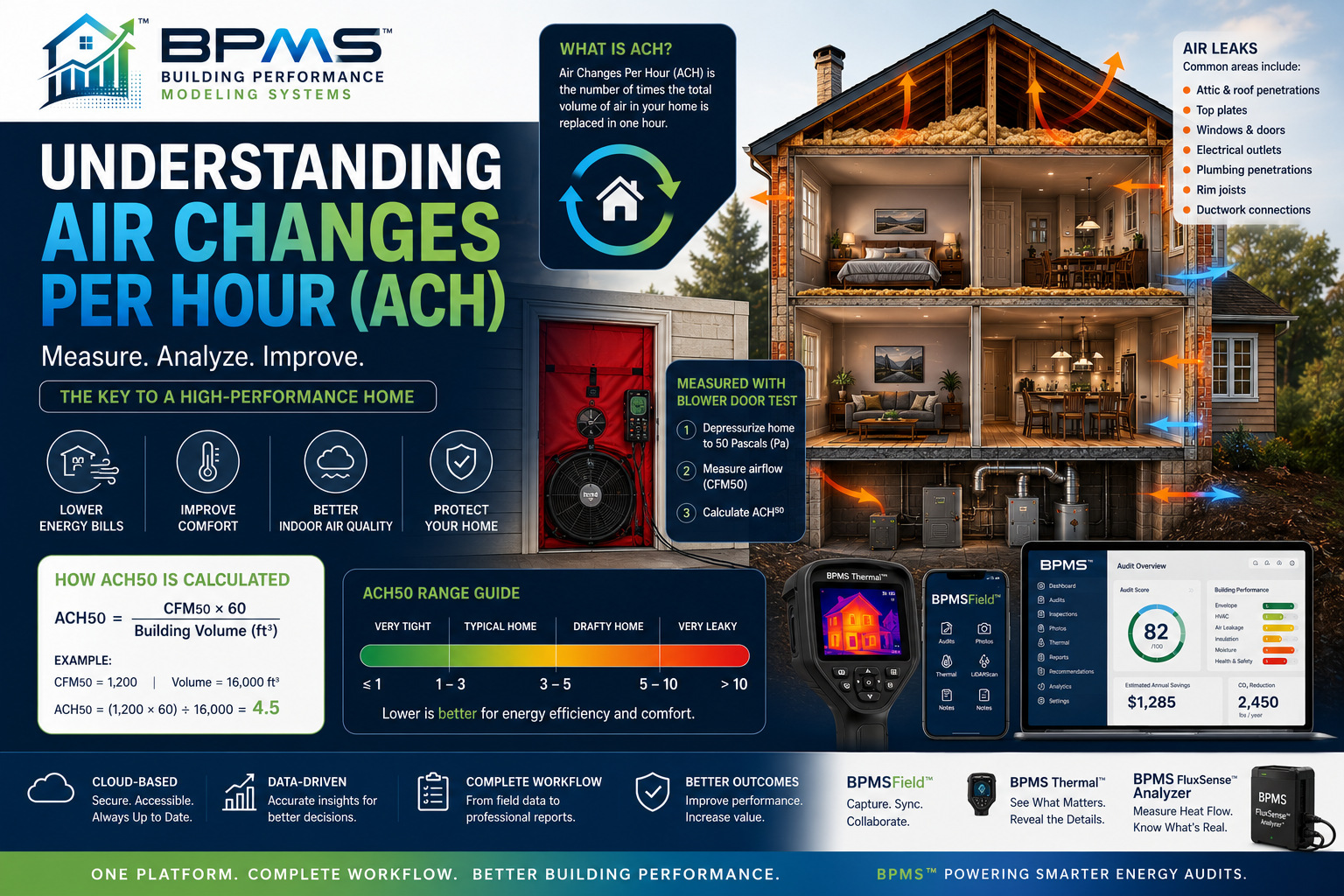
Air Changes Per Hour (ACH) is one of the most important measurements in residential building performance. It tells energy auditors how often the total volume of air inside a home is replaced over the course of one hour and provides valuable insight into air leakage, energy efficiency, comfort, indoor air quality, and HVAC performance. This guide explains what ACH is, how it is measured, how it is calculated, applicable standards, and how energy auditors use ACH results to develop meaningful recommendations.
Understanding Air Changes Per Hour (ACH): The Complete Guide for Energy Auditors
Introduction
Few measurements tell an energy auditor more about the performance of a home than Air Changes Per Hour (ACH). While homeowners often notice symptoms such as drafty rooms, uneven temperatures, high utility bills, or HVAC systems that seem to run constantly, ACH provides a way to quantify one of the underlying causes—uncontrolled air leakage.
ACH is far more than a number in an energy audit report. It represents how effectively a building envelope controls the movement of air. Too much uncontrolled air exchange wastes energy, reduces comfort, and can introduce moisture and outdoor pollutants. Too little air exchange, on the other hand, can reduce indoor air quality if adequate mechanical ventilation is not provided.
For energy auditors, understanding ACH is essential to evaluating a home’s overall performance and recommending appropriate improvements.
⸻
What Is Air Changes Per Hour (ACH)?
Air Changes Per Hour (ACH) is the number of times the total volume of air inside a building is replaced within one hour.
For example:
* 1 ACH means the home’s air volume is replaced once every hour.
* 3 ACH means the air is replaced three times each hour.
* 10 ACH means the home’s air volume is replaced ten times every hour.
It is important to understand that ACH does not necessarily mean every molecule of indoor air is completely replaced. Rather, it is a standardized way of describing the rate of air exchange occurring within the building.
⸻
Why Is ACH Important?
ACH influences nearly every aspect of building performance, including:
* Heating costs
* Cooling costs
* HVAC sizing
* Indoor comfort
* Indoor air quality
* Moisture movement
* Condensation potential
* Mold risk
* Building durability
* Occupant health
For energy auditors, ACH provides a measurable indication of how tightly or loosely a home is constructed.
⸻
Natural ACH vs. ACH50
Energy auditors commonly work with two different values:
Natural ACH
Natural ACH represents the estimated air exchange under normal weather conditions.
It varies continuously based on:
* Wind speed
* Wind direction
* Indoor/outdoor temperature differences
* Building height
* Terrain
* Occupant behavior
Because natural conditions constantly change, it is difficult to measure directly.
⸻
ACH50
ACH50 is measured during a blower door test, where the building is depressurized (or pressurized) to 50 Pascals (Pa).
Using a standard test pressure allows auditors to compare buildings consistently, regardless of outdoor weather conditions.
ACH50 has become the industry standard for evaluating residential air leakage.
⸻
What Is a Blower Door Test?
A blower door test is the primary method used to determine ACH50.
The test consists of:
* An adjustable aluminum door frame
* A calibrated variable-speed fan
* A fabric door panel
* A digital manometer
* Pressure tubing
The fan is installed in an exterior doorway and used to create a pressure difference of 50 Pascals between the inside and outside of the home.
At this pressure, the airflow required to maintain the pressure difference is measured in CFM50 (Cubic Feet per Minute at 50 Pascals).
⸻
Why Is 50 Pascals Used?
Fifty Pascals was selected because it provides a consistent, repeatable pressure difference that exaggerates leakage pathways without damaging the building.
Approximately:
50 Pascals = 0.20 inches water column
or roughly equivalent to a 20 mph wind acting on all sides of a home simultaneously.
This allows leaks that may be difficult to detect under natural conditions to become much easier to locate using:
* Smoke pencils
* Infrared cameras
* Ultrasonic leak detectors
* Hand detection
⸻
Equipment Required to Measure ACH
Professional energy auditors typically use:
* Blower Door System
* Calibrated Fan
* Digital Manometer
* Pressure Tubes
* Smoke Pencil
* Infrared Camera
* Tape Measure or Laser Distance Meter
* Building Geometry Measurements
* BPMSField™
* BPMS Thermal™
⸻
Step 1 – Determine Building Volume
Before ACH can be calculated, the conditioned volume of the home must be determined.
Measure:
* Building length
* Building width
* Ceiling heights
* Basement volume (if conditioned)
* Finished attic volume
* Cathedral ceilings
* Conditioned additions
The total conditioned volume is calculated in cubic feet.
Example
2,000 sq ft home
Average ceiling height:
8 ft
Building volume:
2,000 × 8
= 16,000 cubic feet
⸻
Step 2 – Conduct the Blower Door Test
After preparing the home:
* Close exterior doors and windows.
* Open interior doors.
* Turn off HVAC equipment and exhaust fans.
* Establish a baseline pressure.
* Install the blower door.
* Depressurize the home to -50 Pascals.
* Record the airflow required to maintain that pressure.
Suppose the blower door reports:
CFM50 = 1,200
⸻
Step 3 – Calculate ACH50
The standard equation is:
ACH50 = (CFM50 × 60) ÷ Building Volume
Using the example above:
CFM50 = 1,200
Building Volume = 16,000 cubic feet
ACH50 = (1,200 × 60) ÷ 16,000
ACH50 = 72,000 ÷ 16,000
ACH50 = 4.5
This means that under a 50-Pascal pressure difference, the home’s air volume would be exchanged approximately 4.5 times per hour.
⸻
What Does ACH50 Mean During an Energy Audit?
ACH50 helps an auditor understand the relative airtightness of the home.
High ACH50
Higher values generally indicate:
* Greater uncontrolled air leakage
* Higher heating and cooling costs
* More drafts
* Increased HVAC runtime
* Greater moisture transport
* Reduced comfort
Potential recommendations may include targeted air sealing, insulation improvements, and duct sealing, depending on the overall findings.
⸻
Low ACH50
Lower values generally indicate a tighter building envelope.
Benefits may include:
* Reduced energy loss
* Better temperature stability
* Lower utility bills
* Improved comfort
However, very tight homes may require mechanical ventilation to maintain acceptable indoor air quality, depending on applicable codes and standards.
⸻
Typical ACH50 Values
Approximate ranges often seen in practice include:
Home Type
Typical ACH50
Older home (little air sealing)
10–20+
Typical existing home
5–10
Energy-efficient retrofit
3–5
High-performance construction
1–3
Passive House
≤0.6 at 50 Pa
These are general ranges. Construction methods, climate, and program requirements influence acceptable values.
⸻
DOE Weatherization Perspective
The U.S. Department of Energy’s Weatherization Assistance Program (WAP) does not establish a single nationwide ACH50 requirement for every home.
Instead, local agencies and state programs use diagnostic testing to identify cost-effective air-sealing opportunities while ensuring that improvements do not compromise:
* Indoor air quality
* Combustion safety
* Ventilation
* Moisture management
Post-weatherization blower door testing is commonly used to verify the effectiveness of air-sealing measures.
⸻
State Requirements
There is no single ACH50 requirement that applies to every state.
Requirements vary based on:
* State energy codes
* Utility programs
* Weatherization agencies
* Climate zones
* New construction versus existing homes
* Local adoption of the International Energy Conservation Code (IECC)
For example, many jurisdictions adopting recent IECC editions require blower door testing for new homes, with allowable maximum leakage rates that vary by climate zone. Existing-home retrofit programs and utility incentives may use different targets or performance metrics.
Energy auditors should always verify the current requirements applicable to the program and jurisdiction in which they are working.
⸻
How ACH Influences Energy Modeling
ACH is used in energy models to estimate infiltration loads.
High infiltration increases:
* Heating load
* Cooling load
* HVAC operating costs
Reducing unnecessary infiltration can decrease building loads, although the amount of savings depends on climate, occupancy, and the specific improvements made.
⸻
Common Sources of High ACH
Energy auditors frequently identify leakage at:
* Attic hatches
* Top plates
* Plumbing penetrations
* Electrical penetrations
* Recessed lighting
* Chimney chases
* Rim joists
* Window frames
* Door weatherstripping
* HVAC chases
* Duct penetrations
* Crawlspace access doors
* Garage connections
⸻
Using Thermal Imaging with ACH
Once the blower door is operating, BPMS Thermal™ or another infrared camera can help identify surface temperature patterns that may indicate:
* Air leakage
* Missing insulation
* Thermal bridges
The pressure difference created by the blower door often makes these patterns more visible, allowing auditors to better document potential problem areas.
⸻
BPMS™ and ACH Documentation
BPMS™ streamlines ACH documentation by allowing energy auditors to:
* Record blower door test results
* Store CFM50 and ACH50 values
* Capture field notes
* Attach photographs
* Organize thermal images
* Track air-sealing recommendations
* Generate professional reports
Using BPMSField™, auditors can enter measurements directly from the field, reducing duplicate data entry and improving documentation consistency.
⸻
Explaining ACH to Homeowners
Many homeowners are unfamiliar with ACH, so avoid technical jargon.
A practical explanation is:
“ACH tells us how many times the air inside your home is replaced every hour because of uncontrolled air leakage. If the number is high, your home is losing heated or cooled air more quickly than it should, which can increase utility bills and reduce comfort. Our goal is to reduce unnecessary leakage while maintaining healthy indoor air quality.”
This simple explanation helps homeowners understand why air sealing and diagnostic testing are important.
⸻
Best Practices for Energy Auditors
When interpreting ACH results:
* Verify building volume calculations carefully.
* Record baseline pressure before testing.
* Confirm all exterior openings are closed.
* Follow the blower door manufacturer’s procedures.
* Use thermal imaging and smoke testing to locate leakage pathways.
* Evaluate combustion safety before and after significant air sealing when applicable.
* Consider ventilation needs when recommending tighter building envelopes.
* Document findings thoroughly with photographs and measurements.
⸻
Conclusion
Air Changes Per Hour is one of the most valuable metrics available to an energy auditor because it quantifies how effectively a home controls air movement. When combined with blower door testing, thermal imaging, visual inspection, and building-science principles, ACH provides a clear picture of building performance.
Rather than viewing ACH as a stand-alone number, auditors should interpret it alongside the home’s construction, HVAC system, insulation levels, moisture conditions, and occupant needs. By understanding how ACH is measured, what it represents, and how it influences energy use and comfort, energy auditors can develop well-supported recommendations that improve efficiency, enhance indoor comfort, and help homeowners make informed decisions about their homes.
Modern tools such as BPMS™, BPMSField™, BPMS Thermal™, and BPMS FluxSense Analyzer™ help organize these measurements and observations into comprehensive reports, enabling professionals to communicate building performance clearly and consistently while supporting high-quality, data-driven energy audits.
Comments and Reviews
Share what you found helpful and how this article supported your work.
0.0/5from 0 reviews
No reviews yet. Be the first to share your feedback.