The Energy Auditor’s Software Challenge: Why BPMS™ Is Redefining Building Performance Technology
Published 7/17/2026
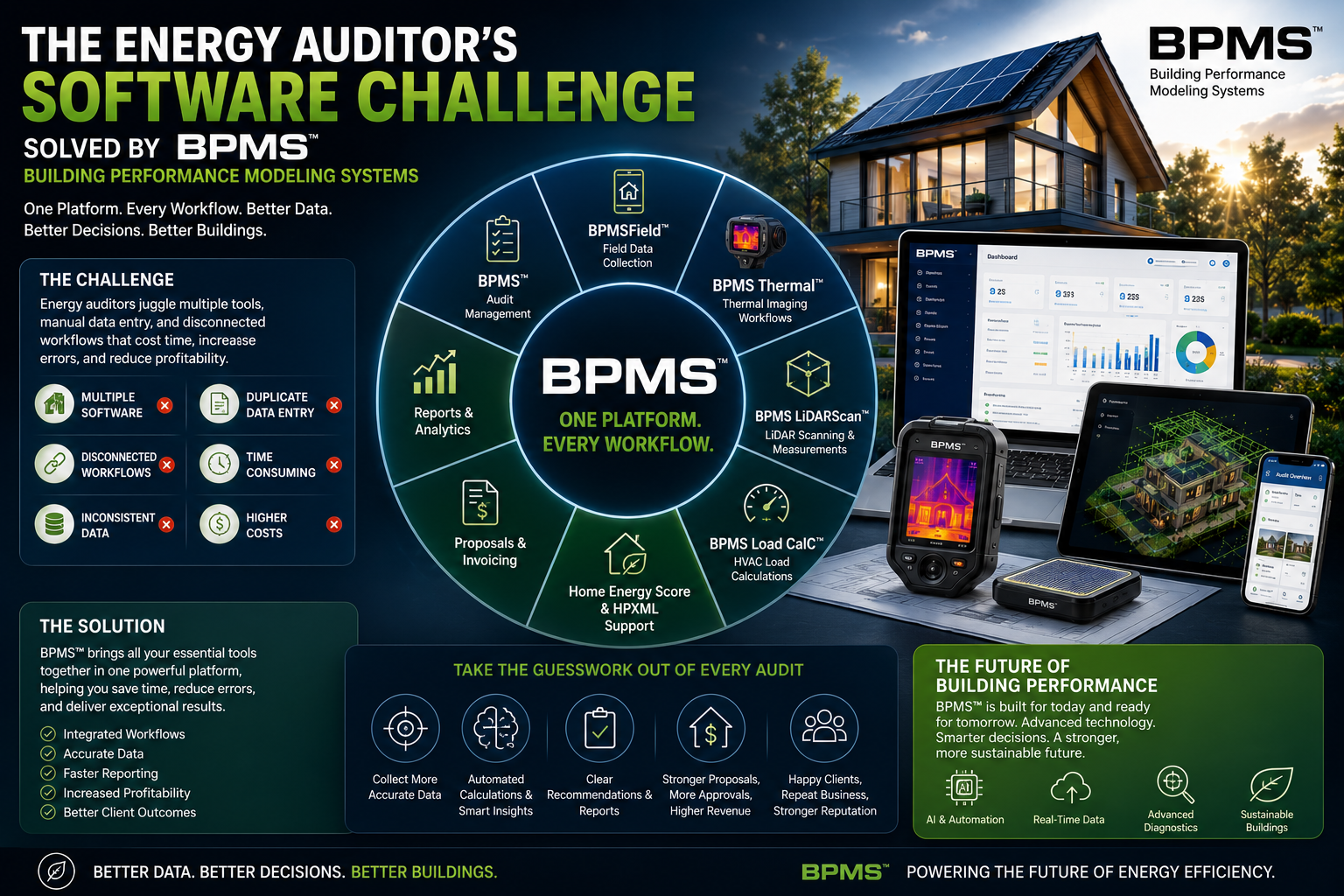
Energy auditors and energy conservation specialists face a growing challenge: managing increasingly complex projects using disconnected software tools. Discover how BPMS™ is helping solve one of the industry’s biggest problems by bringing audits, field data collection, thermal imaging, LiDAR scanning, Home Energy Score workflows, load calculations, reporting, proposals, and business management together into one powerful platform.
The Energy Auditor’s Software Challenge: Why BPMS™ Is Redefining Building Performance Technology
Introduction
The energy efficiency industry has never been more important.
Governments are pursuing ambitious carbon reduction goals.
Utilities are investing billions into energy-efficiency programs.
Homeowners are seeking lower utility bills.
Contractors are helping clients improve comfort and reduce energy waste.
At the center of this transformation are energy auditors and energy conservation specialists.
These professionals provide the data, analysis, and recommendations that drive energy-saving improvements.
Yet despite the industry’s growth, many professionals continue to face a surprisingly common challenge:
Finding software that actually supports the entire workflow.
For years, energy auditors have been forced to piece together multiple tools, spreadsheets, mobile applications, reporting systems, and business platforms just to complete a single project.
As projects become more complex and customer expectations continue to rise, the need for a more integrated solution has never been greater.
This is where BPMS™ (Building Performance Modeling Systems™) is helping reshape the future of building performance technology.
⸻
The Software Fragmentation Problem
Most energy auditors do not struggle because they lack expertise.
They struggle because their workflow is fragmented.
A typical project may require:
* Data collection software
* Audit software
* Thermal imaging software
* HVAC load calculation software
* Proposal software
* Invoicing software
* Customer management software
* Document storage systems
* Utility program platforms
Each system often requires separate logins, separate training, separate subscriptions, and separate data entry.
The result is lost productivity and unnecessary complexity.
⸻
The Hidden Cost of Multiple Systems
Many firms underestimate the true cost of software fragmentation.
The cost is not only financial.
It includes:
Duplicate Data Entry
The same information may be entered multiple times.
⸻
Increased Training Requirements
Employees must learn several systems instead of one.
⸻
Data Inconsistencies
Information entered in one platform may not match another.
⸻
Slower Reporting
Projects take longer to complete.
⸻
Higher Error Rates
Manual transfers increase the likelihood of mistakes.
⸻
Reduced Profitability
Time spent managing software is time not spent serving clients.
⸻
The Growing Expectations of Modern Clients
Today’s homeowners and building owners expect more than basic audit reports.
Clients increasingly want:
* Visual diagnostics
* Thermal imagery
* Detailed recommendations
* Financial analysis
* Energy savings projections
* Professional proposals
* Digital documentation
Meeting these expectations requires powerful tools.
Unfortunately, many legacy software solutions were not designed for today’s demands.
⸻
Where Traditional Energy Audit Software Falls Short
Many software platforms were developed to solve a specific problem.
Some focus primarily on:
* Energy modeling
* Home Energy Scores
* Compliance reporting
* Utility program requirements
* HVAC design
While these tools can be effective within their specific niche, they often leave significant workflow gaps.
Professionals frequently find themselves purchasing additional software to complete the rest of the project lifecycle.
⸻
The Need for a Unified Platform
The building performance industry increasingly requires a connected ecosystem.
Energy auditors need a platform capable of supporting:
Data Collection
Diagnostics
Modeling
Reporting
Proposal Generation
Invoicing
Team Collaboration
Project Management
Customer Communication
The future belongs to platforms that connect these workflows rather than isolate them.
⸻
Enter BPMS™
BPMS™ was developed around a simple concept:
One Platform. Every Workflow.
Rather than forcing professionals to stitch together multiple applications, BPMS™ seeks to centralize the entire building performance process.
The objective is not simply to create another energy audit tool.
The objective is to create a comprehensive operational platform for energy professionals.
⸻
Taking the Guesswork Out of Energy Auditing
One of the biggest challenges auditors face is uncertainty.
Questions such as:
* Did I collect all required information?
* Did I miss an important building characteristic?
* Are my calculations accurate?
* Is my documentation complete?
* Can I justify my recommendations?
often create inefficiencies and risk.
BPMS™ is designed to help reduce that uncertainty through structured workflows and centralized project management.
⸻
BPMSField™: Improving Data Collection
Data collection is the foundation of every audit.
If field data is incomplete, the entire analysis may be compromised.
BPMSField™ helps auditors:
* Collect project information
* Capture photographs
* Upload field documentation
* Associate images with projects
* Synchronize information with the cloud
This creates a more organized and efficient workflow.
⸻
BPMS Thermal™: Adding Diagnostic Intelligence
Thermal imaging has become one of the most valuable diagnostic tools available to energy professionals.
BPMS Thermal™ helps integrate thermal imagery directly into project workflows.
Benefits include:
* Centralized image storage
* Easier documentation
* Improved reporting
* Better organization
Rather than storing images across multiple devices and folders, everything remains connected to the audit record.
⸻
BPMS LiDARScan™: Modern Measurement Technology
Accurate measurements are essential for building analysis.
BPMS LiDARScan™ leverages modern LiDAR technologies to help:
* Capture dimensions
* Measure building geometry
* Improve accuracy
* Reduce manual measurements
This can save significant time while improving consistency.
⸻
BPMS Load CalC™: Supporting Better HVAC Decisions
Heating and cooling systems represent a major portion of building energy use.
BPMS Load CalC™ provides integrated load calculation capabilities that help support:
* HVAC sizing
* Equipment selection
* Building analysis
Because project information already exists within BPMS™, auditors can reduce duplicate data entry and streamline workflows.
⸻
Home Energy Score and HPXML Integration
Energy programs increasingly rely on standardized data formats.
BPMS™ supports workflows related to:
* Home Energy Score assessments
* HPXML generation
* Program compliance
* Data interoperability
This helps professionals manage growing reporting requirements more efficiently.
⸻
From Audit to Revenue
Many software systems stop after the audit report is generated.
The business side of the project often requires additional software.
BPMS™ extends beyond diagnostics into:
Work Scope Development
Proposal Creation
Invoicing
Customer Management
Team Management
This allows firms to move from assessment to implementation using a connected workflow.
⸻
How BPMS™ Compares to Traditional Software Stacks
Many firms currently operate with a technology stack that resembles:
Function Typical Solution
Energy Audit Software A
Field Collection Software B
Thermal Management Software C
Load Calculations Software D
Proposals Software E
Invoicing Software F
BPMS™ aims to consolidate these workflows into a single ecosystem.
While organizations may still choose specialized tools for certain tasks, reducing the number of disconnected systems can significantly improve efficiency.
⸻
Looking Beyond Today’s Industry
The building performance industry is evolving rapidly.
Emerging technologies include:
* Artificial intelligence
* Digital twins
* Smart sensors
* Continuous monitoring
* Predictive analytics
* Automated diagnostics
The software platforms that thrive in the future will be those capable of integrating these innovations into everyday workflows.
⸻
The Future Role of BPMS FluxSense Analyzer™
One example of future-focused innovation is the BPMS FluxSense Analyzer™.
This developing technology is designed to help measure heat transfer through building assemblies using direct heat flux measurements.
Potential future applications include:
* Enhanced diagnostics
* Dynamic thermal analysis
* Building performance verification
* Real-world energy performance assessment
Technologies like these may help move the industry beyond assumptions and toward direct measurement.
⸻
Why This Matters for the Industry
The future of energy efficiency depends on better information.
Better information leads to:
* Better decisions
* Better recommendations
* Better project outcomes
Software should not simply store data.
It should help professionals understand buildings more effectively.
The industry is moving toward a future where building performance is increasingly driven by:
* Data
* Automation
* Analytics
* Measurement
* Intelligence
BPMS™ is being developed with these principles in mind.
⸻
The Future of Energy Auditing
Tomorrow’s energy auditor will look very different from today’s.
Future professionals may utilize:
* AI-assisted diagnostics
* Automated data collection
* Real-time building monitoring
* Advanced thermal analytics
* LiDAR-generated building models
* Direct heat flux measurements
* Cloud-based collaboration
The role of the auditor will evolve from data collector to building performance strategist.
⸻
Conclusion
Energy auditors and energy conservation specialists face increasing demands, tighter timelines, and more complex projects than ever before.
Unfortunately, many are still relying on fragmented software ecosystems that create inefficiencies and unnecessary administrative burdens.
The industry needs platforms that simplify workflows, reduce duplicate effort, improve data quality, and support professionals from field collection through project completion.
BPMS™ was created with this vision in mind.
By combining audit management, field data collection, thermal imaging workflows, LiDAR technology, load calculations, Home Energy Score support, HPXML generation, proposals, invoicing, and project management into a single ecosystem, BPMS™ seeks to help energy professionals spend less time managing software and more time helping clients improve building performance.
As technology continues to advance, the future of energy auditing will belong to professionals equipped with smarter tools, better data, and more integrated workflows.
BPMS™ is designed to help lead that future.
Comments and Reviews
Share what you found helpful and how this article supported your work.
0.0/5from 0 reviews
No reviews yet. Be the first to share your feedback.