The DOE Home Energy Score: Transforming Home Energy Efficiency Today and Shaping the Future of Building Performance
Published 7/15/2026
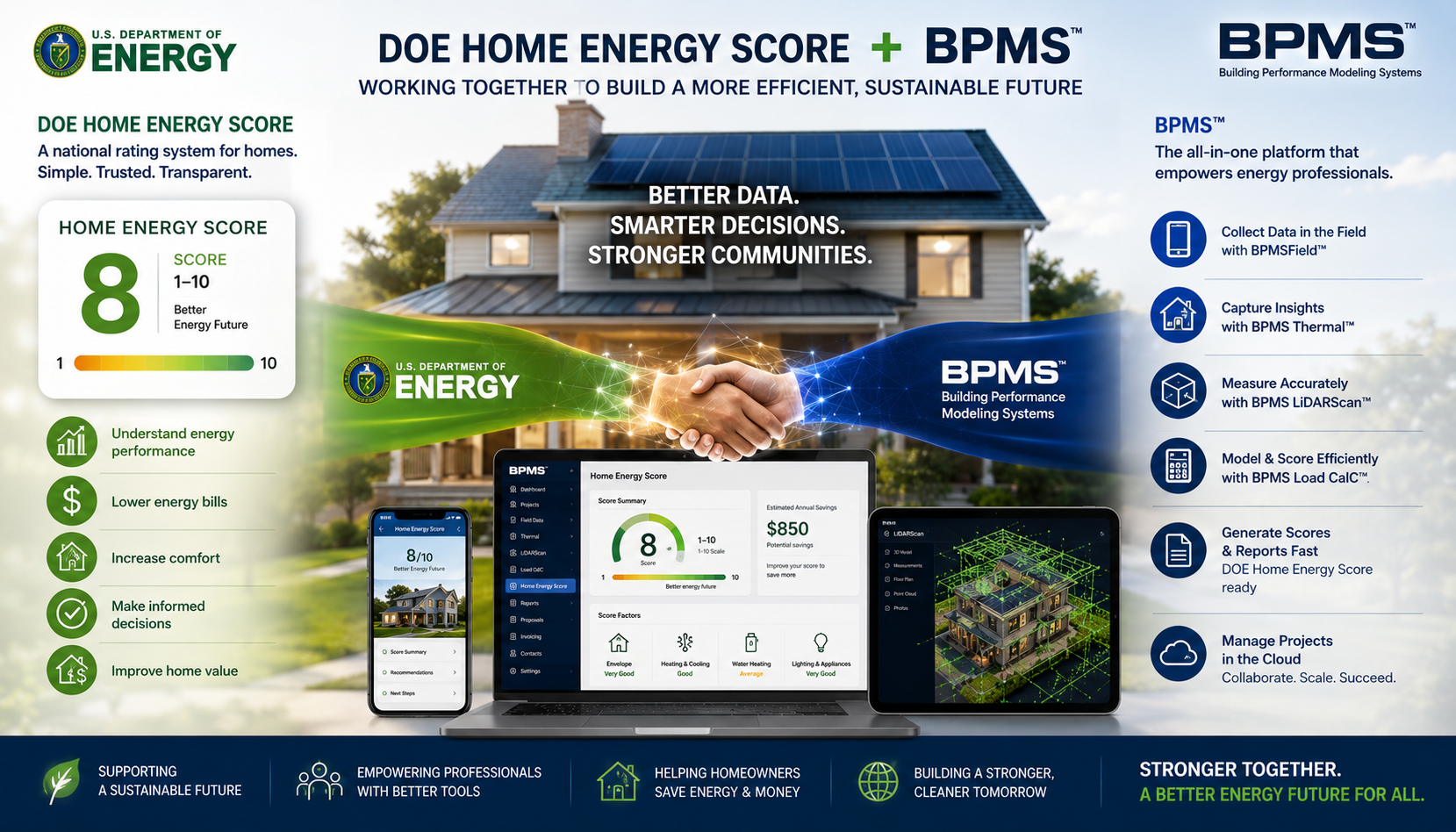
Learn how the U.S. Department of Energy’s Home Energy Score program is helping homeowners understand their home’s energy performance, reduce utility costs, and make smarter efficiency investments. Discover the history of the Home Energy Score, how to become a Home Energy Score Assessor, and how BPMS™ is helping modernize the energy scoring process through advanced technology and workflow automation.
The DOE Home Energy Score: Transforming Home Energy Efficiency Today and Shaping the Future of Building Performance
Introduction
For decades, homeowners have purchased houses based on location, square footage, school districts, and aesthetics. Yet one of the most important characteristics of a home often remained unknown:
How efficiently does the home use energy?
The U.S. Department of Energy (DOE) recognized this challenge and developed a simple but powerful solution known as the Home Energy Score.
Often referred to as a “miles-per-gallon rating for homes,” the Home Energy Score provides homeowners, buyers, sellers, lenders, utilities, and building professionals with a standardized way to understand a home’s energy performance.
Today, the Home Energy Score is helping thousands of homeowners make informed decisions about energy efficiency improvements. Tomorrow, it may become one of the most influential tools in residential real estate, energy policy, and building performance management.
⸻
What Is the Home Energy Score?
The Home Energy Score is a national energy rating system developed by the U.S. Department of Energy.
United States Department of Energy
The program evaluates a home’s physical characteristics and estimates its energy performance.
The score is presented on a scale of:
1 to 10
Where:
* 1 represents lower energy efficiency
* 10 represents higher energy efficiency
The Home Energy Score is designed to provide a simple, consistent method for understanding how efficiently a home is expected to perform.
⸻
Why the DOE Created the Home Energy Score
Historically, homebuyers had limited access to information regarding a home’s energy performance.
While vehicle buyers could compare fuel economy ratings, homeowners often lacked equivalent information.
The DOE recognized that:
* Energy costs significantly impact homeownership
* Efficiency improvements can reduce utility expenses
* Better information leads to better decisions
The Home Energy Score was created to provide transparency and encourage investment in energy-efficient housing.
⸻
The Development of the Home Energy Score
The Home Energy Score program emerged from years of research conducted by the DOE and national laboratories.
The goal was to develop a rating system that would be:
* Consistent
* Affordable
* Scalable
* Easy to understand
* Applicable across diverse housing types
Researchers studied:
* Building science
* Residential energy consumption
* Housing stock characteristics
* Modeling methodologies
The resulting system allows qualified assessors to collect information about a home and generate a score using DOE-approved software tools.
Over time, the program has expanded through partnerships with:
* Utilities
* State agencies
* Local governments
* Nonprofits
* Contractors
* Energy efficiency programs
⸻
How the Home Energy Score Works
A certified assessor evaluates the home’s key energy-related characteristics.
Information collected typically includes:
Building Envelope
* Walls
* Roofs
* Ceilings
* Foundations
* Windows
* Doors
Heating and Cooling Systems
* Furnaces
* Boilers
* Heat pumps
* Air conditioners
Water Heating Equipment
* Tank systems
* Tankless systems
Building Size and Layout
* Conditioned floor area
* Building geometry
The collected information is entered into approved scoring software to generate the final score.
⸻
How Homeowners Benefit from the Home Energy Score
The Home Energy Score provides value in several important ways.
⸻
Understanding Energy Performance
Many homeowners do not know how efficiently their home operates.
The score provides a benchmark that helps homeowners understand their home’s relative performance.
⸻
Lower Utility Bills
The score report includes recommendations that may help reduce energy consumption and utility costs.
⸻
Improved Comfort
Many efficiency improvements also improve:
* Indoor comfort
* Temperature consistency
* Draft reduction
⸻
Better Investment Decisions
Homeowners can prioritize improvements based on potential impact.
⸻
Increased Property Value Awareness
Energy-efficient homes are increasingly attractive to buyers.
A Home Energy Score helps communicate performance information during real estate transactions.
⸻
The Impact of the Home Energy Score Today
The Home Energy Score is influencing the residential energy market in several ways.
Increased Consumer Awareness
Homeowners are becoming more aware of energy performance as part of overall homeownership.
⸻
Utility Program Participation
Many utility programs use Home Energy Scores to support energy-efficiency initiatives.
⸻
Energy Efficiency Financing
Lenders increasingly recognize energy performance as an important factor in home affordability.
⸻
Market Transparency
The score helps create a common language for discussing energy efficiency.
⸻
How the Home Energy Score Will Shape the Future
The importance of residential energy performance is expected to increase significantly over the coming decades.
Several trends are driving this change.
⸻
Building Electrification
As homes transition away from fossil fuels, energy efficiency becomes even more important.
⸻
Carbon Reduction Goals
Governments and organizations are pursuing ambitious sustainability targets.
⸻
Smart Homes
Connected technologies provide greater visibility into energy use.
⸻
Performance-Based Real Estate Markets
Future buyers may evaluate homes based not only on location and aesthetics but also on energy performance.
⸻
Utility Grid Modernization
Utilities increasingly rely on efficiency improvements to reduce system demand.
⸻
The Home Energy Score is well-positioned to support these emerging trends.
⸻
How to Become a Home Energy Score Assessor
The DOE authorizes qualified professionals to perform Home Energy Scores.
Requirements vary by partner organization, but the process generally includes:
⸻
Step 1: Meet Eligibility Requirements
Many assessors come from backgrounds such as:
* Energy auditing
* Building performance
* Home inspection
* HVAC
* Engineering
* Weatherization
⸻
Step 2: Complete Approved Training
Candidates must complete training provided through DOE-approved partners.
Training focuses on:
* Building science
* Data collection
* Home Energy Score methodology
* Quality assurance
⸻
Step 3: Pass Required Examinations
Assessors must demonstrate competency in the scoring process.
⸻
Step 4: Maintain Certification
Many programs require ongoing quality assurance and continuing education.
⸻
Challenges Facing Home Energy Score Assessors Today
While the Home Energy Score is extremely valuable, assessors often face operational challenges.
These include:
* Manual data collection
* Multiple software systems
* Photo management
* Report generation
* Administrative tasks
Many professionals spend substantial time managing information rather than analyzing buildings.
⸻
How BPMS™ Enhances the Home Energy Score Process
BPMS™ (Building Performance Modeling Systems™) was developed to streamline building performance workflows.
Rather than requiring multiple disconnected systems, BPMS™ integrates many of the tools assessors use every day.
⸻
BPMSField™ Improves Field Data Collection
BPMSField™ allows assessors to:
* Collect data in the field
* Capture photographs
* Organize documentation
* Synchronize information with the cloud
This helps reduce administrative burden and improve efficiency.
⸻
Integrated Home Energy Score Workflows
BPMS™ includes dedicated Home Energy Score functionality designed to help assessors manage:
* Building characteristics
* HVAC information
* Envelope data
* Utility-related information
within a unified platform.
⸻
BPMS Thermal™ Adds Diagnostic Intelligence
Thermal imaging can help assessors identify:
* Missing insulation
* Air leakage
* Thermal bridging
BPMS Thermal™ organizes thermal imagery directly within the assessment workflow.
⸻
BPMS LiDARScan™ Improves Building Measurement
Accurate building geometry is critical for many building performance applications.
BPMS LiDARScan™ helps assessors:
* Capture measurements
* Improve accuracy
* Reduce manual data entry
⸻
The Future of Home Energy Scores with BPMS™
As building technologies continue to evolve, BPMS™ aims to support the next generation of Home Energy Score assessments.
Future innovations may include:
* Automated data collection
* AI-assisted validation
* Enhanced reporting
* Digital building models
* Predictive analytics
* Continuous performance monitoring
These advancements could help assessors deliver greater value while reducing administrative effort.
⸻
The DOE and BPMS™: Supporting the Same Industry Goals
While the DOE Home Energy Score program and BPMS™ serve different roles, they support many of the same objectives:
Improve Building Performance
Both initiatives seek to improve residential energy efficiency.
Support Homeowners
Both help homeowners make informed decisions.
Increase Energy Awareness
Both encourage greater understanding of building performance.
Promote Data-Driven Decisions
Both rely on measurable building characteristics and performance indicators.
Advance Industry Innovation
Both contribute to the modernization of the residential energy industry.
BPMS™ is designed to help professionals implement DOE-supported workflows more efficiently by providing modern tools for data collection, analysis, reporting, and project management.
⸻
Why the Home Energy Score Matters
The Home Energy Score is more than a rating.
It is a communication tool.
It helps homeowners understand:
* Energy efficiency
* Comfort opportunities
* Cost-saving improvements
* Building performance
in a simple and accessible format.
As energy costs rise and sustainability becomes increasingly important, tools that provide clear and actionable information will become even more valuable.
⸻
Conclusion
The DOE Home Energy Score has become one of the most important residential energy efficiency initiatives in the United States.
By providing a standardized method for evaluating home energy performance, the program empowers homeowners, supports building professionals, and promotes a more energy-efficient housing market.
As the industry evolves, technology platforms such as BPMS™, BPMSField™, BPMS Thermal™, BPMS LiDARScan™, BPMS Load CalC™, and the future BPMS FluxSense Analyzer™ are helping assessors work more efficiently and deliver greater value to their clients.
Together, energy scoring programs, building science professionals, and advanced software platforms are helping create a future where homeowners have better information, lower energy costs, greater comfort, and more sustainable homes.
Comments and Reviews
Share what you found helpful and how this article supported your work.
0.0/5from 0 reviews
No reviews yet. Be the first to share your feedback.