Introducing BPMS Intelligence™: AI-Powered Building Performance Intelligence for Smarter Audits, Better Decisions, and Stronger Results
Published 7/27/2026
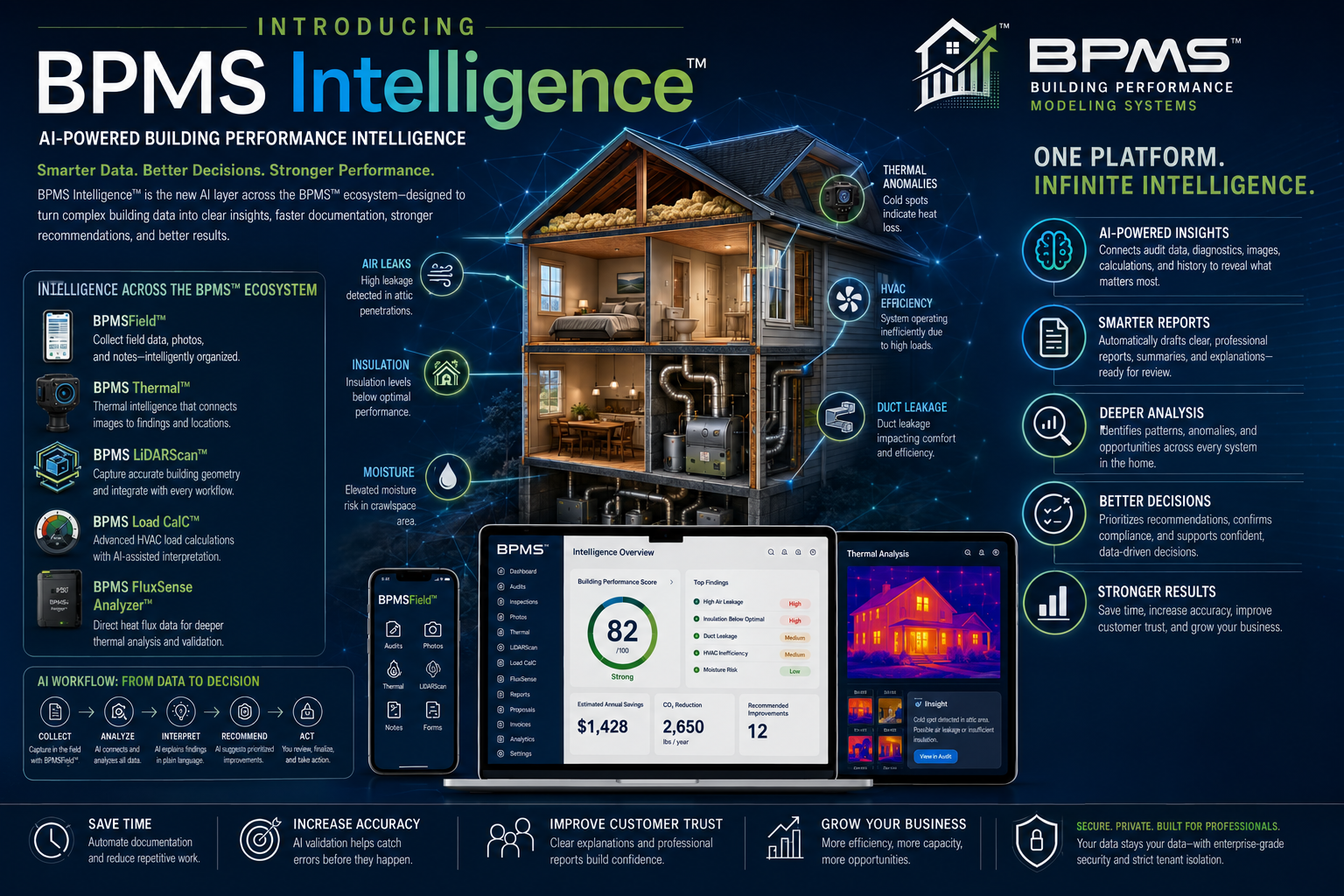
BPMS Intelligence™ introduces an AI-powered intelligence layer across the BPMS™ ecosystem, helping energy auditors, HVAC professionals, weatherization contractors, and building-performance organizations turn complex field and building data into clearer insights, faster documentation, stronger recommendations, and more efficient workflows. Learn how BPMS Intelligence™ is designed to work with BPMSField™, BPMS Thermal™, BPMS LiDARScan™, BPMS Load CalC™, BPMS FluxSense Analyzer™, reporting, work scopes, proposals, and more.
Introducing BPMS Intelligence™: AI-Powered Building Performance Analysis for the Next Generation of Energy Professionals
The building-performance industry has entered a new era.
Energy auditors, HVAC contractors, weatherization professionals, home-performance contractors, utility program administrators, and building consultants now collect more information than ever before.
A single project can contain:
* Customer information
* Building geometry
* Insulation characteristics
* Blower door results
* ACH50
* HVAC equipment data
* Heating and cooling loads
* Thermal images
* Photographs
* Moisture observations
* Duct information
* Utility consumption
* Weather data
* Home Energy Score information
* HPXML data
* LiDAR scans
* Work scopes
* Recommendations
* Proposals
* Invoices
* Eventually, direct heat-flux measurements
The problem is no longer simply collecting data.
The challenge is understanding what all of that data means.
That is where BPMS Intelligence™ comes in.
BPMS Intelligence™ is the AI layer built specifically for building performance.
It is designed to work across the BPMS™ ecosystem to help professionals transform complex project information into useful insights, clearer explanations, stronger documentation, and more informed decisions.
The goal is not to replace the auditor.
The goal is to make the auditor more capable.
Smarter Data. Better Decisions. Stronger Performance.
⸻
What Is BPMS Intelligence™?
BPMS Intelligence™ is the AI-powered analytics, interpretation, and decision-support layer of the BPMS™ platform.
Rather than operating as a generic chatbot disconnected from the audit, BPMS Intelligence™ is designed around the actual structure of building-performance work.
It can help interpret information from:
* BPMS™ audits
* BPMSField™
* BPMS Thermal™
* BPMS LiDARScan™
* BPMS Load CalC™
* BPMS FluxSense Analyzer™
* Customer records
* Reports
* Work scopes
* Proposals
* Invoices
* Other future BPMS™ modules
The long-term objective is simple:
One Platform. Infinite Intelligence.
⸻
Why Building Performance Needs Intelligence
Building performance is complex because buildings are complex.
A high utility bill may not have one cause.
It may result from a combination of:
* Air leakage
* Low insulation levels
* Oversized HVAC equipment
* Duct leakage
* Poor controls
* Window heat transfer
* Occupant behavior
* Extreme weather
* Moisture conditions
* Equipment degradation
Traditional software can store each of these observations.
BPMS Intelligence™ is designed to help professionals understand how they may relate.
For example:
High ACH50
Thermal evidence of attic leakage
Low attic insulation
High heating consumption
Homeowner complaints about cold rooms
can tell a much stronger story together than any of those findings alone.
That is the difference between storing building data and creating building intelligence.
⸻
From Data Collection to Decision Support
The traditional digital audit workflow often looks like this:
Collect → Enter → Calculate → Report
BPMS Intelligence™ expands that process:
Collect
↓
Validate
↓
Analyze
↓
Compare
↓
Interpret
↓
Explain
↓
Recommend
↓
Act
The platform is designed to help professionals move from information to insight without sacrificing professional control.
⸻
BPMS Intelligence™ Is Not “ChatGPT Inside BPMS™”
This distinction matters.
BPMS Intelligence™ is not intended to be marketed as a general-purpose AI chat window attached to the platform.
It is being designed specifically around building-performance workflows.
That means it can be structured to understand the context surrounding:
* Audit measurements
* HVAC information
* Thermal findings
* Blower door data
* Building geometry
* Work scopes
* Reports
* Customer communication
The goal is to make AI relevant to the work being performed—not simply add AI because AI is popular.
⸻
The Energy Auditor Remains in Control
AI can be extraordinarily useful.
But building-performance decisions still require professional judgment.
The auditor remains responsible for:
* Conducting the inspection
* Collecting measurements
* Verifying field conditions
* Operating diagnostic equipment
* Understanding building science
* Reviewing health and safety issues
* Determining whether findings are valid
* Approving recommendations
* Communicating conclusions to the customer
BPMS Intelligence™ is designed as a professional assistant and analytical layer, not a replacement for qualified expertise.
A good intelligence system should help the professional identify what deserves attention.
It should not pretend to know what has never been measured.
⸻
Deterministic Calculations Stay Authoritative
This is one of the most important technical principles behind BPMS Intelligence™.
Some calculations should not be delegated to generative AI.
BPMS™ already contains or is being built around deterministic logic for workflows such as:
* ACH calculations
* HVAC load calculations
* Heat-loss calculations
* Home Energy Score logic
* HPXML validation
* Solar calculations
* SIR
* Pricing
* Other program and engineering formulas
Those calculation engines should remain authoritative.
BPMS Intelligence™ can help:
* Explain the result
* Compare results
* Detect unusual values
* Identify inconsistencies
* Summarize implications
* Draft customer-friendly explanations
But it should not silently invent engineering numbers.
For example:
BPMS Load CalC™ calculates the HVAC load.
BPMS Intelligence™ helps explain what drove the load.
That separation improves reliability and keeps engineering logic transparent.
⸻
Audit Intelligence
One of the first major applications of BPMS Intelligence™ is helping professionals review audit information.
A comprehensive audit may include hundreds of data points.
BPMS Intelligence™ can help surface:
* Missing sections
* Incomplete measurements
* Unusual values
* Conflicting data
* Major findings
* Follow-up items
* Areas requiring professional review
Instead of forcing the auditor to manually scan every audit field before reporting, the system can help highlight areas that deserve attention.
⸻
Example: Connecting Multiple Findings
Consider this project:
* ACH50 is significantly elevated.
* The homeowner reports drafts.
* Thermal imaging shows cold patterns around attic penetrations.
* Attic insulation is inconsistent.
* Winter utility consumption is high.
A conventional system stores those observations in separate sections.
BPMS Intelligence™ can help bring them together and tell the auditor:
The combination of elevated air leakage, attic thermal anomalies, insulation deficiencies, and winter energy consumption suggests that the attic enclosure deserves priority review for targeted air sealing and insulation improvements.
The system isn’t making the final diagnosis.
It is helping the professional see the relationship between the evidence.
⸻
Missing-Data Detection
One of the most practical AI capabilities may also be one of the simplest:
What did we forget?
BPMS Intelligence™ can help identify situations such as:
* Blower door result missing
* Building volume not entered
* HVAC capacity absent
* Equipment photograph missing
* Thermal image not assigned to a location
* Recommendation without supporting evidence
* Audit section incomplete
This becomes especially valuable for larger organizations where audit consistency is important.
⸻
Anomaly Detection
Another important capability is identifying data that appears inconsistent.
Imagine an audit containing:
* 1,200 square feet of conditioned space
* 8-foot ceilings
* Building volume recorded as 96,000 cubic feet
That value deserves review.
Or consider:
* Calculated cooling load: 19,000 BTU/h
* Existing equipment: 60,000 BTU/h
* Homeowner complaint: severe short cycling
The intelligence layer can surface that relationship for professional evaluation.
This kind of anomaly detection can help catch mistakes before they reach the final report.
⸻
BPMSField™ + BPMS Intelligence™
BPMS Intelligence™ can begin helping the professional while the audit is still being performed.
BPMSField™ connects field activity with the BPMS™ platform.
Field professionals can collect:
* Photographs
* Notes
* Audit information
* Thermal data
* LiDAR data
* Other inspection information
BPMS Intelligence™ can add a layer of assistance to that workflow.
Potential capabilities include:
* Summarizing notes
* Identifying incomplete documentation
* Organizing observations
* Suggesting photo categories
* Highlighting missing audit information
* Preparing preliminary findings
The goal is to reduce the amount of administrative work that begins once the auditor returns to the office.
⸻
Intelligent Photo Management
Energy auditors often return from a project with dozens or hundreds of photographs.
Those photos may show:
* Attic insulation
* HVAC equipment
* Water heaters
* Windows
* Crawlspaces
* Duct systems
* Moisture
* Air leakage locations
* Health and safety concerns
Organizing all of these manually takes time.
BPMS Intelligence™ can support intelligent photo workflows such as:
* Suggested classification
* Suggested captions
* Suggested audit-section assignment
* Detection of duplicate images
* Identification of unclear or missing documentation
* Selection of photos relevant to specific findings
The auditor remains responsible for verifying that each image is interpreted correctly.
⸻
BPMS Thermal™ + BPMS Intelligence™
Thermal imaging is powerful because it allows professionals to visualize temperature patterns that cannot be seen with the naked eye.
But a thermal image does not automatically reveal the cause.
A temperature pattern could indicate:
* Air leakage
* Insulation deficiency
* Thermal bridging
* Moisture
* Solar effects
* Material differences
BPMS Intelligence™ is designed to help connect thermal evidence with surrounding information.
For example:
Thermal pattern
Blower door conditions
Moisture reading
Wall construction
Room location
can help the professional develop a more informed interpretation.
⸻
Smarter Thermal Reporting
Thermal findings can also be difficult to explain to homeowners.
A report might currently say:
“Thermal anomaly observed at north exterior wall.”
That is technically correct but not very useful to most customers.
BPMS Intelligence™ could help the auditor produce something clearer:
“Infrared imaging identified a cooler surface pattern along this section of the exterior wall. The pattern may be associated with air leakage, insulation performance, thermal bridging, or another temperature-related condition. Additional inspection should be used to confirm the cause before corrective work is specified.”
This creates a much more professional explanation while avoiding unsupported certainty.
⸻
BPMS LiDARScan™ + BPMS Intelligence™
BPMS LiDARScan™ brings spatial building information into the BPMS™ ecosystem.
Potential data include:
* Rooms
* Walls
* Windows
* Doors
* Openings
* Surface areas
* Room dimensions
* Building geometry
BPMS Intelligence™ can help professionals use geometry as part of a broader analytical context.
Consider:
* Large west-facing glazing area
* High cooling load
* Significant afternoon solar gain
* Homeowner complaint of overheating
Those findings may appear in different parts of a traditional audit.
An intelligent platform can help connect them.
⸻
BPMS Load CalC™ + BPMS Intelligence™
HVAC load calculations require controlled engineering logic.
BPMS Load CalC™ performs those calculations.
BPMS Intelligence™ can help professionals understand the output.
Questions it may assist with include:
* Which rooms contribute the most load?
* Which building-envelope components have the greatest effect?
* Why did the heating load change after an envelope improvement?
* How much does infiltration influence the result?
* Why does one room perform differently than another?
* How should the calculation be explained to the homeowner?
This creates a useful separation:
BPMS Load CalC™ calculates. BPMS Intelligence™ interprets.
⸻
BPMS FluxSense Analyzer™ + BPMS Intelligence™
The developing BPMS FluxSense Analyzer™ introduces direct heat-flux measurement into the BPMS™ ecosystem.
That creates a potentially valuable new dataset.
Information may include:
* Heat flux
* Indoor temperature
* Outdoor temperature
* Time
* Building assembly
* Geometry
* Thermal imagery
* Weather conditions
BPMS Intelligence™ could assist professionals in studying patterns across those measurements.
For example:
* Which assemblies show the greatest heat transfer?
* How does heat flow change as outdoor temperatures change?
* Do thermal and heat-flux measurements support each other?
* Is one reading substantially different from surrounding measurements?
* Which measurements require professional review?
This can help transform raw sensor information into a more usable diagnostic workflow.
⸻
AI-Powered Report Writing
Professional reporting is one of the most time-consuming parts of energy auditing.
Auditors frequently have to turn:
* Measurements
* Photos
* Notes
* Thermal images
* Customer concerns
* Recommendations
into a polished report.
BPMS Intelligence™ is designed to assist with this process.
It can help draft:
* Executive summaries
* Building-envelope findings
* HVAC descriptions
* Air leakage explanations
* Thermal findings
* Moisture findings
* Recommendation descriptions
* Customer education sections
The final report remains subject to auditor review and approval.
⸻
From Technical Language to Customer Language
A major strength of AI-assisted reporting is translation—not language translation, but technical translation.
Consider:
Technical result
8.6 ACH50
A homeowner may have no idea what that means.
BPMS Intelligence™ can help explain it:
“The blower door test indicates substantial uncontrolled air leakage through the home’s enclosure. These leakage pathways can increase heating and cooling demand, create drafts, and reduce comfort.”
The number doesn’t change.
The communication improves.
⸻
Intelligent Recommendations
Recommendations should always be connected to evidence.
BPMS Intelligence™ can help structure that relationship.
Finding
High attic leakage.
Evidence
Blower door testing and thermal imaging show likely leakage around attic penetrations.
Condition
Attic insulation is inconsistent.
Potential measure
Targeted attic air sealing followed by appropriate insulation improvements.
This creates a stronger audit trail between:
Observation → Evidence → Analysis → Recommendation
⸻
Prioritizing Recommendations
Customers often receive multiple recommendations.
They need to know what should happen first.
BPMS Intelligence™ can help organize findings around priorities such as:
1. Health and safety
2. Moisture
3. Building durability
4. Air leakage
5. Insulation
6. HVAC
7. Duct systems
8. Comfort
9. Energy opportunities
10. Renewable energy
The final order still depends on the property and the professional’s judgment.
But intelligence can help make the prioritization process more consistent.
⸻
From Audit to Work Scope
Once the customer approves improvements, audit findings must become actionable work.
BPMS Intelligence™ can help organize information such as:
Finding
↓
Location
↓
Evidence
↓
Recommended measure
↓
Work-scope language
This helps connect the diagnostic stage with production.
For contractors and weatherization companies, that continuity can significantly reduce repetitive administrative work.
⸻
Proposal Intelligence
The same project information can support proposal development.
Suppose the audit identified:
* Significant attic bypass leakage
* Low insulation
* Comfort complaints
The technical measure may be:
Air seal attic penetrations and install additional insulation to the specified project requirement.
BPMS Intelligence™ can help create the customer-facing explanation:
“This improvement is intended to reduce uncontrolled air movement through the attic and improve the thermal performance of the ceiling assembly, helping reduce drafts and heating and cooling demand.”
Pricing remains controlled by the company’s deterministic pricing and proposal logic.
AI supports the explanation.
⸻
Intelligence Across Proposals and Invoices
BPMS™ extends beyond the audit itself.
Because proposals and invoices are part of the same platform ecosystem, BPMS Intelligence™ can eventually help organizations understand the entire customer journey.
Potential insights include:
* Recommendations most frequently converted into proposals
* Common project combinations
* Proposal follow-up requirements
* Workflow delays
* Project activity summaries
This extends intelligence beyond building analysis into operational intelligence.
⸻
Quality Assurance
Quality assurance becomes increasingly important as organizations grow.
A solo auditor may personally remember every detail of every project.
A company with dozens of auditors cannot.
BPMS Intelligence™ can help support quality-control workflows by flagging:
* Missing measurements
* Incomplete photos
* Unusual data
* Conflicting values
* Missing recommendation support
* Inconsistent report language
* Incomplete required fields
Instead of manually reviewing every data point with equal attention, managers can focus more effort on projects that actually require review.
⸻
Benchmarking
A single audit explains one building.
A large portfolio reveals patterns.
With properly structured and appropriately protected information, BPMS Intelligence™ can help organizations benchmark performance.
Examples include:
* Air leakage across similar homes
* HVAC loads by building type
* Common envelope deficiencies
* Recurring moisture problems
* Average audit findings by region
* Retrofit outcomes
* Team performance
This can create valuable operational and building-performance insights.
⸻
Trend Analysis
Building information becomes even more valuable when observed over time.
BPMS Intelligence™ can support trend analysis involving:
* Utility consumption
* Audit findings
* Building performance
* Equipment performance
* Project results
* Heat-flux readings
* Company operations
Historical information helps professionals move beyond a single snapshot.
⸻
Predictive Analytics
The next step beyond trend analysis is prediction.
As BPMS™ accumulates more structured building-performance information, predictive analytics may help identify:
* Unusual energy consumption
* Potential equipment performance problems
* Recurring building-envelope deficiencies
* Areas requiring additional investigation
* Patterns associated with project outcomes
Predictive insights should always communicate uncertainty appropriately.
They should help professionals investigate—not pretend to guarantee future outcomes.
⸻
BPMS Intelligence™ for Weatherization
Weatherization programs involve extensive documentation, quality assurance, and program requirements.
BPMS Intelligence™ can support professionals by helping with:
* Audit completeness
* Documentation review
* Measure organization
* Report drafting
* Quality-control workflows
* Portfolio analysis
* Field-to-office communication
It is important that program-specific calculations, eligibility decisions, approved tools, and compliance rules remain controlled by the applicable program requirements.
BPMS Intelligence™ should help professionals follow those rules, not replace them.
⸻
BPMS Intelligence™ for HVAC Contractors
HVAC contractors increasingly need to understand the building around the equipment.
BPMS Intelligence™ can help connect:
* Air leakage
* Insulation
* Windows
* Orientation
* Building geometry
* Load calculations
* Existing equipment
* Comfort complaints
This can produce a better customer conversation.
Instead of:
“Your system is old.”
the contractor can explain:
“Here is how your building envelope, heating and cooling loads, and existing equipment are interacting.”
That is a more complete building-performance approach.
⸻
BPMS Intelligence™ for Energy Auditors
For auditors, the most immediate benefit may simply be time.
Auditors spend countless hours:
* Organizing field notes
* Sorting photographs
* Writing similar explanations
* Reviewing audit completeness
* Preparing reports
* Drafting recommendations
BPMS Intelligence™ is designed to help reduce those repetitive tasks.
That gives professionals more time for the work AI cannot replace:
* Inspection
* Diagnostic testing
* Building-science analysis
* Customer education
* Professional judgment
⸻
BPMS Intelligence™ for Business Owners
BPMS Intelligence™ can also help owners and managers understand business operations.
Potential areas include:
* Audit completion
* Team workload
* Project trends
* Proposal activity
* Workflow bottlenecks
* Reporting consistency
* Customer activity
This creates a powerful combination:
Building Intelligence + Business Intelligence
inside the same platform ecosystem.
⸻
Performance Dashboard
A major component of BPMS Intelligence™ is the concept of an intelligent performance dashboard.
Instead of simply showing stored information, the dashboard can help surface what deserves attention.
Potential categories include:
* Audit status
* Diagnostic findings
* Performance indicators
* AI insights
* Alerts
* Trends
* Project completeness
* Portfolio benchmarks
This changes the dashboard from a storage interface into a decision-support environment.
⸻
AI Insights & Alerts
One of the most useful features may be proactive alerts.
Examples could include:
Audit is missing a blower door reading.
HVAC capacity appears substantially larger than the calculated load.
Thermal photo has no associated location.
Building volume appears inconsistent with the entered geometry.
Recommendation does not contain supporting evidence.
Energy consumption appears unusually high compared with similar projects.
The goal is not to bombard the user with warnings.
The goal is to surface meaningful information at the right time.
⸻
Custom Reports
Different users need different forms of intelligence.
An energy auditor may care most about field findings.
An HVAC contractor may focus on equipment and load analysis.
A weatherization agency may focus on quality control.
An enterprise organization may want portfolio-level performance.
BPMS Intelligence™ can help generate summaries and analytical views based on the user’s role and workflow.
⸻
AI Should Be Able to Say “I Don’t Know”
One of the most important characteristics of trustworthy AI is uncertainty.
If BPMS Intelligence™ does not have enough information, the right response is not to guess.
It should say:
Additional information is required.
If measurements conflict:
Review the underlying field data.
If a thermal condition cannot be conclusively identified:
Additional diagnostic confirmation is recommended.
That is especially important in building science, where several different physical mechanisms can produce similar symptoms.
⸻
Secure, Controlled Access to BPMS™ Data
BPMS Intelligence™ is designed around controlled access to platform information.
Rather than allowing an AI model unrestricted access to the BPMS™ database, the intelligence layer can interact through approved BPMS™ tools and services.
This architecture can help maintain:
* Tenant separation
* Authorization
* Controlled data access
* Auditability
* Predictable AI actions
AI becomes a controlled platform capability rather than an unrestricted database user.
⸻
Human-in-the-Loop AI
The BPMS Intelligence™ workflow can be summarized as:
AI analyzes
↓
AI surfaces insight
↓
AI explains
↓
Professional reviews
↓
Professional approves
This is particularly important for:
* Engineering conclusions
* Health and safety
* Code issues
* Program compliance
* Recommendations
* Pricing
* Customer-facing reports
AI supports the professional.
The professional remains accountable.
⸻
Automation vs. Intelligence
There is an important difference between automation and intelligence.
Automation follows a predefined formula.
For example:
CFM50 + Building Volume → ACH50
Intelligence interprets context.
For example:
“ACH50 is elevated, and field documentation identifies several attic bypasses. Review the attic enclosure before finalizing the air-sealing recommendation.”
BPMS™ combines both.
Deterministic engines perform controlled calculations.
BPMS Intelligence™ helps users understand what the results mean.
⸻
From One Home to an Entire Portfolio
The long-term potential becomes especially powerful at scale.
One project produces observations.
Thousands of projects produce patterns.
With appropriate privacy and data controls, organizations can begin asking questions such as:
* What deficiencies occur most frequently?
* Which building types show the greatest leakage?
* Which retrofit measures are most commonly recommended?
* Which regions experience recurring performance problems?
* Which project types require the most rework?
* Which crews consistently achieve strong results?
That is where BPMS Intelligence™ can become valuable at an organizational level—not only at the individual audit level.
⸻
From Energy Audit Software to Building Intelligence
Traditional energy-audit software answers:
Where do I enter the audit data?
BPMS™ expands that question:
How do I connect the entire building-performance workflow?
BPMS Intelligence™ adds the next question:
What is all of this information telling me?
This is the progression:
Energy Audit Software
↓
Building Performance Platform
↓
Building Intelligence Platform
That is the larger direction behind BPMS Intelligence™.
⸻
The BPMS Intelligence™ Ecosystem
BPMS Intelligence™ is designed to work across the entire BPMS™ environment.
BPMS™
The central cloud platform connecting audits, projects, customers, reports, work scopes, proposals, invoices, and building-performance information.
BPMSField™
Field data collection and mobile documentation.
BPMS Thermal™
Integrated thermal-imaging workflows.
BPMS LiDARScan™
Digital building-geometry capture.
BPMS Load CalC™
Controlled heating and cooling load analysis.
BPMS FluxSense Analyzer™
Developing direct heat-flux measurement and building-performance sensing technology.
BPMS Intelligence™
The analytical layer designed to help connect, interpret, explain, and surface insights across all of them.
⸻
One Platform. Infinite Intelligence.
The larger vision is not simply to add more features.
It is to make each feature more valuable because it can interact with the others.
A thermal image becomes more useful when it is connected to the exact building location.
A load calculation becomes more useful when it can be interpreted alongside air leakage and insulation.
Heat-flux data becomes more useful when it can be correlated with geometry, weather, and thermal imagery.
A recommendation becomes more useful when it is connected to field evidence.
A report becomes more useful when the data behind it can be traced.
That is the foundation of the BPMS Intelligence™ concept.
⸻
The Future of BPMS Intelligence™
As the platform evolves, BPMS Intelligence™ has the potential to support increasingly advanced capabilities, including:
* More sophisticated visual analysis
* Predictive building-performance insights
* Portfolio benchmarking
* Automated quality assurance
* Intelligent report preparation
* Field assistance
* Advanced workflow automation
* Connected sensor analytics
* Building-performance trend analysis
* Enterprise dashboards
The objective remains the same:
Help professionals understand buildings better.
⸻
The Future Still Belongs to the Professional
Artificial intelligence will change the way energy audits are performed.
It will likely make reporting faster.
It will make data easier to organize.
It will help identify patterns.
It may eventually identify problems before they become obvious.
But it will not change the basic physics of buildings.
Heat will still move.
Air will still respond to pressure.
Moisture will still move through physical mechanisms.
HVAC systems will still need proper sizing.
Measurements will still require competent technicians.
And recommendations will still require professional judgment.
BPMS Intelligence™ is being developed with that reality in mind.
It is not intended to replace expertise.
It is intended to make expertise more powerful.
⸻
Final Thoughts
The building-performance industry does not need another generic AI chatbot.
It needs intelligence designed around how energy auditors, HVAC professionals, weatherization contractors, and building-performance organizations actually work.
That is the purpose of BPMS Intelligence™.
BPMS Intelligence™ is being developed as the AI-powered building-performance analysis layer connecting the BPMS™ ecosystem.
It brings together the information collected through:
BPMS™
BPMSField™
BPMS Thermal™
BPMS LiDARScan™
BPMS Load CalC™
BPMS FluxSense Analyzer™
and the broader project workflow.
It helps transform raw data into understandable information.
It helps transform individual measurements into connected findings.
It helps transform findings into stronger recommendations.
And it helps transform a traditional energy-audit platform into something larger:
A building-performance intelligence ecosystem.
BPMS Intelligence™
Smarter Data. Better Decisions. Stronger Performance.
One Platform. Infinite Intelligence.
Comments and Reviews
Share what you found helpful and how this article supported your work.
0.0/5from 0 reviews
No reviews yet. Be the first to share your feedback.