How to Become an Energy Auditor: The Complete Guide to Building a Successful Energy Auditing Career and Business
Published 7/13/2026
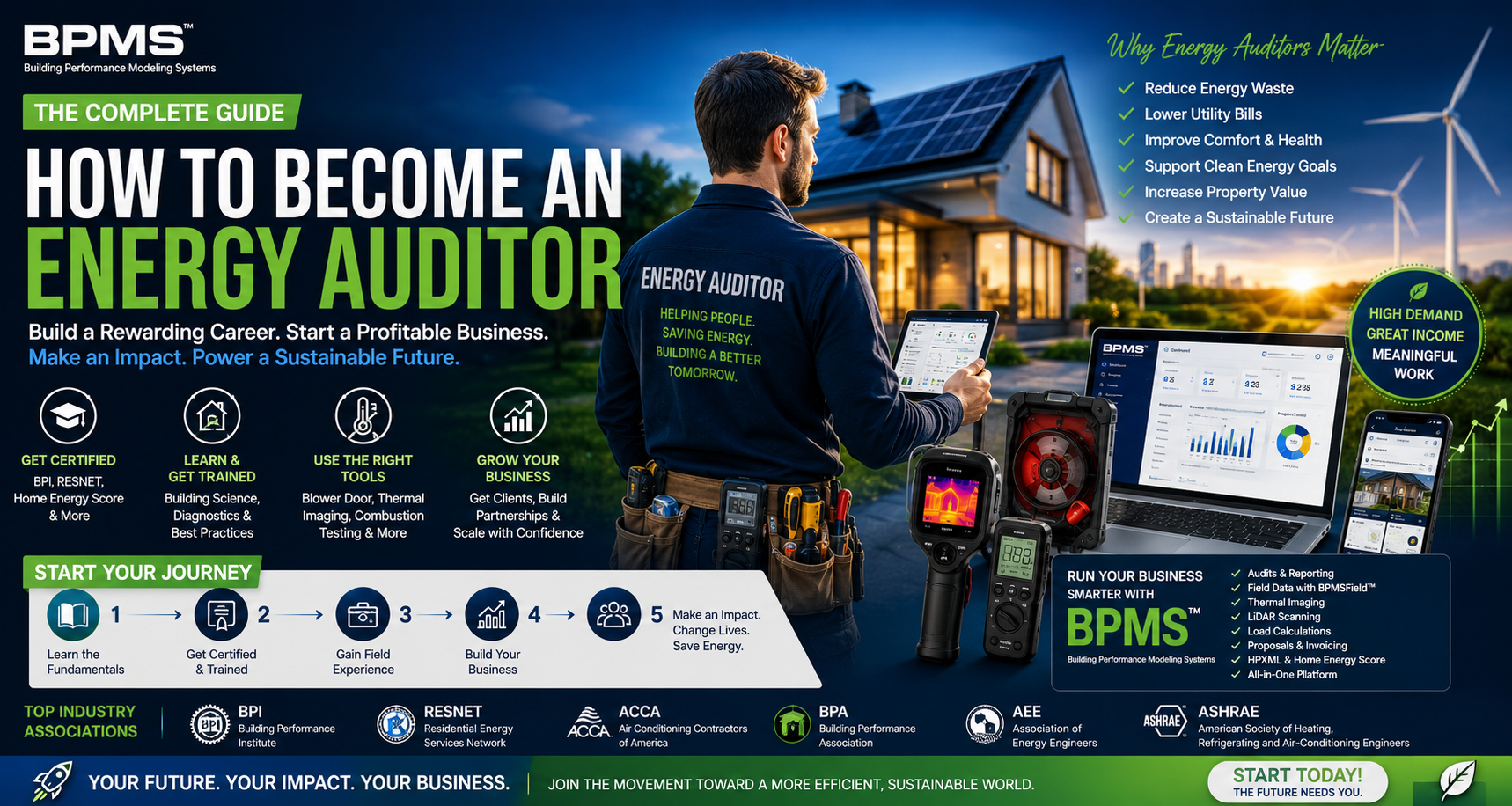
Thinking about becoming an energy auditor? Learn the education, certifications, tools, software, business strategies, and industry associations that can help you build a successful career in energy auditing. Discover why energy auditors are becoming increasingly important in the future of energy efficiency and how platforms like BPMS™ are transforming the industry.
How to Become an Energy Auditor: The Complete Guide to Building a Successful Energy Auditing Career and Business
Introduction
As energy costs continue to rise and governments, utilities, businesses, and homeowners focus on reducing energy consumption, energy auditors have become one of the most important professionals in the building performance industry.
Energy auditors help identify:
* Energy waste
* Comfort problems
* Indoor air quality issues
* HVAC inefficiencies
* Insulation deficiencies
* Air leakage pathways
* Opportunities for renewable energy integration
Their work helps clients save money, improve comfort, reduce environmental impact, and make smarter investments in their homes and buildings.
Whether you’re considering a new career or looking to start your own business, energy auditing offers tremendous opportunities today—and even greater opportunities in the future.
⸻
What Is an Energy Auditor?
An energy auditor is a trained professional who evaluates how energy is used within a building.
The auditor analyzes:
* Building envelope performance
* Insulation levels
* Air leakage
* HVAC systems
* Water heating systems
* Lighting
* Appliances
* Ventilation systems
* Occupant behavior
The goal is to identify opportunities to improve efficiency while maintaining or improving comfort, health, and safety.
⸻
Why Energy Auditors Matter Today
Energy auditors play a critical role in helping society address some of its biggest challenges:
Rising Energy Costs
Homeowners and businesses want lower utility bills.
Aging Building Stock
Many buildings were constructed before modern energy codes.
Electrification
Buildings are transitioning toward electric heating, cooling, and transportation systems.
Utility Programs
Utilities increasingly rely on auditors to identify energy-saving opportunities.
Sustainability Goals
Governments and organizations are setting ambitious carbon reduction targets.
Without accurate building assessments, energy efficiency improvements become much more difficult to implement successfully.
⸻
Why Energy Auditors Will Be Even More Important in the Future
The demand for energy auditors is expected to continue growing due to:
Building Decarbonization
Reducing carbon emissions starts with understanding building performance.
Net-Zero Buildings
Future buildings will require detailed performance verification.
Solar and Battery Integration
Auditors help determine whether buildings are ready for renewable energy systems.
Smart Buildings
As buildings become more connected, auditors will increasingly analyze data from sensors and monitoring systems.
Building Performance Standards
Many cities and states are implementing performance-based regulations.
Energy auditors will play a key role in helping building owners comply.
⸻
Step 1: Learn Building Science Fundamentals
Before pursuing certifications, it is important to understand building science.
Core concepts include:
* Heat transfer
* Air movement
* Moisture movement
* Combustion safety
* HVAC systems
* Building envelopes
* Insulation systems
* Ventilation
Recommended resources include:
* DOE Building America
* Building Science Corporation
* Energy Vanguard
* ACCA training materials
A strong foundation in building science is essential for long-term success.
⸻
Step 2: Obtain Industry Certifications
Certifications help establish credibility and open opportunities for employment and utility program participation.
Popular certifications include:
BPI Building Analyst Professional
Offered by Building Performance Institute
Focuses on:
* Whole-house performance
* Blower door testing
* Combustion safety
* Building diagnostics
⸻
Home Energy Score Assessor
Offered through programs supported by the United States Department of Energy
Allows professionals to provide DOE Home Energy Scores.
⸻
RESNET HERS Rater
Offered through Residential Energy Services Network
Focuses on:
* Energy ratings
* New construction
* Code compliance
* Energy modeling
⸻
HVAC Certifications
Additional certifications from organizations such as Air Conditioning Contractors of America can strengthen technical expertise.
⸻
Step 3: Learn Diagnostic Testing
Energy auditors commonly perform:
Blower Door Testing
Measures building air leakage.
Duct Leakage Testing
Measures HVAC distribution losses.
Thermal Imaging
Identifies:
* Missing insulation
* Air leakage
* Moisture issues
Combustion Safety Testing
Evaluates fuel-burning equipment.
Practical field experience is invaluable.
⸻
Step 4: Gain Real-World Experience
Many successful auditors begin by working for:
* Home performance contractors
* Weatherization agencies
* Energy consulting firms
* Utility programs
* HVAC contractors
Hands-on experience accelerates learning and builds confidence.
⸻
Step 5: Invest in Professional Equipment
Typical equipment includes:
Entry-Level
* Moisture meter
* Infrared thermometer
* Combustion analyzer
* Inspection camera
Intermediate
* Blower door
* Duct tester
* Thermal camera
Advanced
* Drone thermal imaging
* LiDAR scanning tools
* Heat flux measurement systems
* Data collection platforms
⸻
The Pros of Becoming an Energy Auditor
Meaningful Work
You help people reduce energy waste and save money.
Growing Industry
Demand continues to increase.
Strong Earning Potential
Experienced auditors can earn competitive incomes.
Business Ownership Opportunities
Many professionals eventually launch their own firms.
Technology-Driven Career
The field continues to evolve with exciting new technologies.
⸻
The Cons of Becoming an Energy Auditor
Training Requirements
Building science has a significant learning curve.
Equipment Costs
Professional diagnostic equipment can be expensive.
Travel Requirements
Many auditors spend substantial time in the field.
Physical Demands
Attics, crawlspaces, and mechanical rooms can be challenging environments.
Weather Conditions
Fieldwork may occur in extreme temperatures.
⸻
Starting an Energy Auditing Business
Many professionals choose to build their own energy auditing company.
The basic steps include:
Create a Business Entity
* LLC
* Corporation
* Sole Proprietorship
Consult legal and accounting professionals as appropriate.
⸻
Obtain Insurance
Typical policies include:
* General liability
* Professional liability
* Workers compensation (if applicable)
⸻
Acquire Equipment
Begin with the tools necessary to serve your target market.
⸻
Build a Website
Your website should include:
* Services
* Certifications
* Service area
* Testimonials
* Contact information
⸻
Establish Utility Relationships
Many programs require approved contractors.
Program participation can provide consistent lead opportunities.
⸻
How to Get Clients for an Energy Auditing Business
Many new auditors struggle with marketing.
The most successful firms typically use multiple channels.
⸻
Google Business Profile
A well-optimized Google Business Profile can generate local leads consistently.
⸻
Search Engine Optimization (SEO)
Publishing educational content helps attract potential customers.
Examples:
* Energy audit benefits
* Home energy scores
* Insulation upgrades
* HVAC efficiency
⸻
Utility Programs
Partnering with utility programs often provides high-quality referrals.
⸻
HVAC Contractors
HVAC companies frequently encounter clients who need energy assessments.
Strategic partnerships can be mutually beneficial.
⸻
Realtors and Home Inspectors
Energy audits can provide additional value during real estate transactions.
⸻
Social Media
Regular posting on:
* Facebook
* LinkedIn
* Instagram
* Google Business Profile
helps increase visibility.
⸻
The Best Software for Running an Energy Auditing Business
The software you choose can significantly impact productivity.
A complete platform should support:
* Audit management
* Field data collection
* Thermal imaging
* Load calculations
* Reporting
* Proposals
* Invoicing
* Team collaboration
⸻
Why BPMS™ Is Positioned to Lead the Next Generation of Energy Audit Software
BPMS™ (Building Performance Modeling Systems™) was designed to address many of the challenges faced by modern energy auditors.
The platform combines:
Audit Management
Create and manage projects from start to finish.
BPMSField™
Collect data directly from the field.
BPMS Thermal™
Organize thermal imaging workflows.
BPMS LiDARScan™
Capture measurements using LiDAR technology.
BPMS Load CalC™
Perform residential load calculations.
Home Energy Score Support
Streamline DOE Home Energy Score workflows.
HPXML Generation
Support data interoperability and program compliance.
Proposals and Invoices
Convert audit findings into revenue-generating opportunities.
Team Management
Scale operations efficiently.
Rather than relying on multiple disconnected tools, BPMS™ aims to provide a unified ecosystem for energy auditing businesses.
⸻
Industry Associations Energy Auditors Should Join
Professional associations provide education, networking, and business opportunities.
Recommended organizations include:
Building Performance Institute
Training and certifications.
Residential Energy Services Network
Energy ratings and HERS programs.
Air Conditioning Contractors of America
HVAC standards and education.
Building Performance Association
Industry advocacy and networking.
Association of Energy Engineers
Advanced energy management education and certifications.
ASHRAE
Industry standards and technical resources.
⸻
What the Future Looks Like
The next decade will likely bring major changes to the industry.
Expect continued growth in:
* Artificial intelligence
* Building analytics
* Thermal diagnostics
* LiDAR scanning
* Digital twins
* Smart building integration
* Renewable energy systems
* Continuous monitoring technologies
Innovations such as the BPMS FluxSense Analyzer™ may further enhance the ability of auditors to measure actual building performance rather than relying solely on modeled estimates.
⸻
Conclusion
Energy auditing is more than a career—it is an opportunity to help shape the future of energy efficiency.
As buildings become smarter, more connected, and more energy-conscious, the demand for qualified energy auditors will continue to grow.
Whether you plan to work for an established company or launch your own business, success depends on a combination of:
* Building science knowledge
* Industry certifications
* Practical experience
* Marketing expertise
* Professional tools
* Modern software platforms
For professionals looking to build a scalable and technology-driven energy auditing business, platforms such as BPMS™, BPMSField™, BPMS Thermal™, BPMS LiDARScan™, and BPMS Load CalC™ represent the next evolution in building performance technology.
The future of energy auditing is data-driven, technology-enabled, and filled with opportunity—and there has never been a better time to get started.
Comments and Reviews
Share what you found helpful and how this article supported your work.
0.0/5from 0 reviews
No reviews yet. Be the first to share your feedback.