How to Become a Home Energy Score Assessor: The Complete Step-by-Step Career Guide
Published 8/31/2026
Becoming a U.S. Department of Energy Home Energy Score Certified Assessor™ can open a valuable new pathway for energy auditors, home inspectors, HVAC professionals, and building-performance specialists. This complete guide explains what the Home Energy Score is, who qualifies, prerequisite credentials, how to join an approved Partner, complete DOE’s Simulation Training and Test, perform your mentored first Score, conduct professional assessments, build a business around the service, and use modern building-performance technology such as BPMS™ to create a more connected assessment workflow.
How to Become a Home Energy Score Assessor
The Complete Step-by-Step Guide to Entering One of Building Performance’s Most Valuable Professional Services
A homeowner walks into a car dealership and immediately understands one important number:
Miles per gallon.
It provides a simple way to compare the expected fuel efficiency of one vehicle with another.
But what happens when someone buys a house?
Two homes can look nearly identical.
They can have similar square footage.
Similar bedrooms.
Similar kitchens.
Similar selling prices.
Yet one could require substantially more energy to operate than the other.
That difference may be hidden inside the building itself:
Insulation.
Windows.
Air leakage characteristics.
Heating and cooling equipment.
Duct systems.
Water heating.
Building geometry.
And other energy-related characteristics.
The U.S. Department of Energy created the Home Energy Score™ to make residential energy performance easier to understand.
DOE describes it as similar to a vehicle’s miles-per-gallon rating: a standardized assessment produces a 1-to-10 Score, with 10 representing the most energy-efficient homes. The report also estimates energy use and provides recommendations for cost-effective improvements.
And somebody has to evaluate the home and collect the information used to produce that Score.
That professional is a:
Home Energy Score Certified Assessor™
For energy auditors, home inspectors, and other residential energy professionals, becoming an Assessor can add a nationally standardized DOE-backed service to an existing business.
This guide explains exactly how the current process works.
⸻
First: What Is the DOE Home Energy Score?
The Home Energy Score™ was developed by the U.S. Department of Energy and its national laboratories to give homeowners, buyers, and renters credible, comparable information about a home’s expected energy performance.
Think of the Score as a standardized energy-performance snapshot of the home.
The basic scale runs:
1 → 10
where:
1 = lower energy performance
and
10 = higher energy performance.
But the Home Energy Score is more than the number.
The report can provide information about estimated energy use, associated costs, and recommended energy-efficiency improvements. DOE also calculates a “Score with Improvements” representing the expected rating if recommended cost-effective upgrades are implemented.
That gives homeowners something especially useful:
Current Performance
Where does my home stand today?
Improvement Opportunities
What could I improve?
Potential Future Performance
What could the home look like after those improvements?
That turns an abstract subject—energy efficiency—into something homeowners can understand.
⸻
Why Home Energy Score Matters
Most homeowners do not speak the language of building science.
Terms such as:
R-value.
U-factor.
SHGC.
AFUE.
SEER.
HSPF.
ACH50.
Envelope assemblies.
Conditioned floor area.
may mean very little to the average homeowner.
But:
Your home scores 4 out of 10 for energy performance.
is immediately understandable.
And:
These improvements could move the home’s expected performance higher.
creates an actionable conversation.
That simplicity is one of the program’s strengths.
⸻
How Large Has the Program Become?
The program is no longer simply an experimental concept.
As of July 19, 2026, DOE’s Home Energy Score site reported:
307,113 Home Energy Scores completed.
That represents hundreds of thousands of residential assessments and a substantial body of standardized building-performance information.
For professionals considering becoming Assessors, it also demonstrates that Home Energy Score has developed into an established national program.
⸻
Who Can Become a Home Energy Score Assessor?
DOE specifically identifies residential professionals such as:
Energy auditors
Home inspectors
and other qualified residential energy professionals as candidates for becoming Home Energy Score Certified Assessors™.
However, you cannot simply register online, watch a short video, and immediately begin issuing official Scores.
There is a defined qualification process.
At a high level, the current pathway is:
Qualifying Credential
↓
Home Energy Score Partner
↓
DOE Simulation Training & Test
↓
Mentored First Score
↓
Home Energy Score Certified Assessor™
↓
Begin Scoring Homes
Let’s examine every step.
⸻
STEP 1 — Build Your Foundation in Building Science
Before thinking about software or scoring homes, understand what you are evaluating.
A Home Energy Score Assessor should be comfortable examining residential energy-related systems and characteristics.
That means developing knowledge of areas such as:
Building Envelope
Understand walls, ceilings, floors, foundations, attics, insulation, and the boundaries separating conditioned and unconditioned space.
Windows
Understand basic window characteristics, glazing, frames, orientation, shading, and energy performance.
HVAC
Know how to identify heating and cooling systems and relevant equipment characteristics.
Duct Systems
Understand where ducts are located and how distribution systems relate to conditioned space.
Domestic Hot Water
Be able to identify common water-heating equipment and relevant characteristics.
Building Geometry
Understand conditioned floor area, number of stories, and other physical characteristics needed for an accurate assessment.
This knowledge becomes especially important because incorrect field observations can produce incorrect model inputs.
⸻
STEP 2 — Obtain an Accepted Prerequisite Credential
This is one of the most important requirements.
DOE currently requires prospective Assessors to hold an accepted prerequisite credential demonstrating a baseline understanding of homes and residential systems.
The official DOE list currently includes qualifying credentials from several organizations, including credentials associated with organizations such as the American Society of Home Inspectors, Passive House Institute US, the Texas Real Estate Commission, and U.S. Green Building Council. DOE’s official page should always be checked before choosing a credential because accepted qualifications can change.
This means your first practical question should be:
Do I already hold a credential DOE currently accepts?
If yes, move to the next step.
If not, determine which qualifying pathway makes the most sense for your profession.
View DOE's current Home Energy Score Assessor requirements
⸻
What If Your Credential Isn’t Listed?
Don’t automatically assume you are ineligible.
DOE’s current Assessor page specifically provides a process for inquiries involving credentials from other organizations.
The important point is:
Verify with the official program before investing time or money based on an old training article, blog post, or outdated credential list.
Home Energy Score requirements have evolved over time.
Always use the current DOE requirements.
⸻
STEP 3 — Find a Home Energy Score Partner or Remote Service Provider
This step is frequently misunderstood.
Individual Assessors operate through the Home Energy Score program structure.
DOE states that Assessors can only score homes by working through an official Home Energy Score Partner. Interested candidates should contact a local Partner or Remote Service Provider regarding participation.
The Partner plays an important role in the ecosystem.
Partner organizations help manage:
* Assessor onboarding
* Training
* Mentoring
* Quality assurance
* Program implementation
DOE works with these organizations so individual Assessors don’t operate completely independently from the program’s quality-control structure.
⸻
What Is a Home Energy Score Partner?
Partners can include organizations such as:
* State and local governments
* Utilities
* Trade associations
* Nonprofit organizations
* Other organizations capable of administering the program
DOE requires Partners to manage participating Assessors, support mentoring, conduct quality assurance, participate with DOE, and help deploy Home Energy Score within their markets.
This structure is important because Home Energy Score is intended to remain a credible national rating system.
Consistency matters.
⸻
STEP 4 — Join the Partner’s Program
Once you identify an appropriate Partner or Remote Service Provider, contact them about joining.
The Partner may have its own:
* Application process
* Participation agreement
* Administrative requirements
* Training schedule
* Fees
* Mentoring arrangements
* Local program requirements
This is an important distinction:
DOE’s Simulation Training itself is free.
DOE describes its Simulation Training and Test as free online training, but a Partner or other organization may have separate fees or program requirements associated with onboarding, mentorship, administration, or services.
Therefore, ask the Partner for a complete explanation of its requirements before enrolling.
⸻
STEP 5 — Gain Access to the DOE Simulation Training
After joining a Home Energy Score program, candidate Assessors gain access to DOE’s:
Home Energy Score Simulation Training & Test
This is commonly referred to as the Sim.
DOE uses the simulation to teach prospective Assessors how to collect and enter the information required to produce a Home Energy Score.
This is not simply a passive video course.
Candidates work through virtual homes and encounter different situations that may appear during real assessments.
⸻
How Long Does the Simulation Training Take?
DOE currently states that the Simulation Training and written exam generally require approximately:
8–12 hours
of a candidate’s time.
It can be completed at the candidate’s pace or coordinated with group training when offered through a Partner.
The goal isn’t simply to memorize terminology.
The simulation is preparing you to correctly observe a house and translate those observations into the standardized Home Energy Score methodology.
⸻
What Should You Learn During the Simulation?
Treat the Sim as professional training rather than a box you need to check.
Focus on understanding:
What information must be collected?
How should the information be interpreted?
How should unusual building conditions be handled?
Which spaces count as conditioned?
How should systems be classified?
How do incorrect inputs affect the Score?
One particularly important example is conditioned area.
DOE notes that the Home Energy Score definition of conditioned floor area may not always match public records. For example, the presence of duct registers or radiators can affect whether a space is treated as conditioned under the program methodology.
That illustrates why professional observation matters.
You are not simply copying property records.
You are evaluating the actual home.
⸻
STEP 6 — Pass the Simulation and Written Exam
The candidate must successfully complete the required simulation training and testing.
DOE’s quality-assurance framework requires all Home Energy Score Assessors to complete the standardized Simulation Training and Test.
This ensures Assessors across different markets receive standardized instruction before issuing official Scores.
When preparing, don’t focus only on passing.
Focus on becoming consistent.
The quality of the Home Energy Score program depends on two qualified Assessors evaluating the same home in substantially the same way.
⸻
STEP 7 — Complete Your First Score With a Mentor
Passing the simulation does not complete the process.
There is another critical step.
Every new candidate Assessor must conduct the first Home Energy Score with a qualified mentor.
DOE currently states that this mentored first Score must be completed within six months of passing the Simulation and written exam.
This moves the candidate from:
Virtual House
to:
Real House.
And that transition matters.
⸻
Why Mentoring Is Important
A simulation can teach methodology.
A real building introduces complexity.
You may encounter:
* Unusual additions
* Multiple HVAC systems
* Partially conditioned basements
* Difficult-to-identify insulation
* Equipment with missing labels
* Complex geometry
* Mixed construction types
* Inaccessible areas
The mentor helps ensure you understand how the standardized methodology applies when the building doesn’t look like a textbook example.
⸻
Mentoring Can Take Different Forms
DOE’s program supports several mentoring pathways, depending on the Partner and approved arrangements.
These can include:
In-Field Mentoring
The mentor observes and assists the candidate during the assessment.
Group Mentoring
Candidates participate in an in-field mentoring format organized as a group.
Remote Mentoring
Under approved arrangements, the mentor can review data inputs and photographs remotely, typically using video communication.
DOE notes that only select organizations are approved to provide remote mentoring.
Your Partner will help determine the appropriate pathway.
⸻
STEP 8 — Become an Active Home Energy Score Assessor
Once you have successfully completed the required:
Prerequisite credential
Partner onboarding
Simulation Training
Testing
Mentored Score
you are ready to begin providing Home Energy Scores through the program.
DOE states that after completing training and mentoring, Assessors can begin offering Scores to customers, with Partner and DOE support including technical resources and program materials.
Now the career opportunity begins.
⸻
STEP 9 — Learn the Real-World Assessment Workflow
Certification gets you into the field.
Professionalism determines what happens afterward.
A strong field workflow begins before you arrive.
Review:
* Customer information
* Property address
* Available building records
* Assessment purpose
* Relevant Partner requirements
Prepare your equipment.
Confirm access.
Understand the property.
Then conduct the assessment systematically.
⸻
What Information Does the Assessor Evaluate?
Home Energy Score is an asset-based rating.
The assessment focuses on physical characteristics of the home rather than attempting to grade the lifestyle of the current occupants.
That distinction is important.
Two families can live in identical homes and have dramatically different utility bills because of:
* Thermostat settings
* Occupancy
* Appliance use
* Hot-water consumption
* Work-from-home patterns
* Electric vehicles
* Personal behavior
The Home Energy Score instead creates a standardized way to compare the energy-related assets of homes.
That makes comparisons more meaningful.
⸻
Think of the Home as a System
A professional Assessor should never see the house as a collection of unrelated components.
The building is a system.
Consider:
Roof / Attic
↓
Insulation
↓
Walls
↓
Windows
↓
Foundation
↓
HVAC
↓
Ducts
↓
Water Heating
↓
Building Geometry
Each component affects overall performance.
The Home Energy Score converts those characteristics into a standardized assessment.
⸻
STEP 10 — Enter the Data Accurately
This may sound obvious.
It isn’t.
Data quality determines Score quality.
If the Assessor incorrectly identifies:
* Conditioned floor area
* Insulation
* Window characteristics
* HVAC equipment
* Foundation
* Building geometry
the resulting model may not accurately represent the house.
Professional Assessors therefore develop a disciplined process:
Observe
↓
Document
↓
Verify
↓
Enter
↓
Review
Do not rush data collection simply to produce a Score faster.
Accuracy is the product.
⸻
STEP 11 — Generate the Home Energy Score
Once the required information has been entered correctly, the Home Energy Scoring Tool calculates the rating.
The homeowner receives a score on the:
1–10 scale
along with additional energy-performance information and improvement recommendations.
This is where the Assessor becomes more than a data collector.
The Assessor becomes an educator.
⸻
STEP 12 — Explain the Score to the Homeowner
Never assume the homeowner understands the report.
Walk them through it.
Explain:
Current Score
Where the home currently stands.
Estimated Energy Performance
What the model indicates.
Major Building Characteristics
What influences the result.
Recommendations
Which improvements may help.
Score With Improvements
How the home’s expected rating could change after recommended improvements.
The homeowner should leave understanding the building better than before you arrived.
That is the real value of the assessment.
⸻
Don’t Turn the Score Into a Sales Pitch
This is particularly important for contractors who also sell improvements.
Your credibility depends on the homeowner trusting the assessment.
Separate:
What the data indicates
from:
What you sell.
If the attic is performing well, say so.
If the HVAC system is relatively efficient, say so.
If a proposed upgrade doesn’t make sense, say so.
Trust can become much more valuable than forcing an unnecessary sale.
⸻
STEP 13 — Understand Quality Assurance
Certification does not mean DOE stops checking quality.
Home Energy Score has an ongoing quality-assurance framework.
DOE requires Partner organizations to perform QA review on at least 5% of randomly selected Home Energy Scores each quarter.
This is an important part of the program.
Why?
Because the value of a national scoring system depends on consistency.
A Score of 7 in one market should not be based on completely different field practices from a Score of 7 somewhere else.
Quality assurance helps protect the credibility of the program.
⸻
Your Goal Should Be Repeatability
Imagine two trained Assessors evaluate the same house.
Their observations should produce comparable results.
That requires consistent:
* Measurement
* Interpretation
* Classification
* Data entry
* Documentation
Professional discipline is essential.
⸻
STEP 14 — Build a Field Toolkit
Home Energy Score itself is not the same thing as a comprehensive diagnostic energy audit, so don’t assume every diagnostic instrument is mandatory merely because it is useful in broader building-performance work.
However, professional residential energy work commonly benefits from a well-organized field toolkit.
Depending on the services you offer, that may include:
* Tablet or smartphone
* Tape measure
* Laser distance meter
* Flashlight
* Camera
* Personal protective equipment
* Ladder where appropriate
* Thermometer
* Combustion-safety equipment when your scope requires it
* Blower door for diagnostic auditing services
* Digital manometer
* Infrared camera
* Moisture meter
The key is understanding the difference between:
equipment required for the standardized Home Energy Score assessment
and
additional diagnostic equipment you use for broader energy-audit services.
Do not misrepresent one as the other.
⸻
STEP 15 — Build Home Energy Score Into Your Business
Once qualified, you don’t necessarily need to create an entirely separate company around the Score.
DOE specifically identifies multiple ways Assessors currently offer the service.
It can be:
* Bundled into a standard energy audit
* Included with a home inspection
* Sold as a standalone service
* Used as a lead-generation service
* Offered through utility or solar programs
* Used before and after energy-efficiency improvements
This flexibility is one of the program’s strongest business advantages.
⸻
Business Model 1 — Home Energy Score + Home Inspection
For home inspectors, this is a natural combination.
The buyer already wants to know:
Is the roof damaged?
Does the plumbing work?
Is the electrical system safe?
Now add:
How does this house perform from an energy perspective?
That creates a broader understanding of the property.
⸻
Business Model 2 — Home Energy Score + Energy Audit
For energy auditors, the Score can serve as the standardized starting point.
The workflow can become:
Home Energy Score
↓
Detailed Diagnostics
↓
Blower Door
↓
Thermal Imaging
↓
Energy Analysis
↓
Recommendations
↓
Work Scope
This gives the homeowner both:
A simple rating
and
a deeper diagnostic investigation.
⸻
Business Model 3 — Home Energy Score + HVAC
HVAC contractors can also benefit from understanding the home’s energy characteristics.
Suppose a homeowner wants a heat pump.
Before simply replacing equipment, the contractor can consider:
* Building envelope
* Insulation
* Windows
* Building size
* Existing equipment
* Ducts
* Energy characteristics
The Score can help frame the building-performance conversation.
Additional professional load calculations can then support HVAC equipment selection.
⸻
Business Model 4 — Home Energy Score + Weatherization
Weatherization professionals already work with:
* Insulation
* Air sealing
* HVAC
* Health and safety
* Energy efficiency
Home Energy Score can provide another way to communicate building performance.
The homeowner can understand:
Before improvements
versus potentially:
After improvements.
That can make energy efficiency more tangible.
⸻
Business Model 5 — Real Estate
This may become one of the most interesting markets.
DOE designed Home Energy Score partly to make home-energy information more understandable within real-estate transactions. DOE notes that Score information can support energy information in contexts such as MLS listings, appraisal, and financing initiatives.
Imagine a buyer comparing two similar homes.
Home A
Energy Score: 3
Home B
Energy Score: 8
Suddenly, energy performance becomes another piece of property information.
Just like:
Bedrooms.
Bathrooms.
Square footage.
Year built.
Energy performance can become part of the purchasing conversation.
⸻
Building Relationships With Realtors
A Home Energy Score Assessor can potentially build referral relationships with:
* Real estate agents
* Home inspectors
* Mortgage professionals
* Builders
* HVAC contractors
* Insulation contractors
* Solar companies
* Energy auditors
* Home-performance companies
The strategy is not simply:
“I perform energy scores.”
The stronger message is:
“I help your clients understand the expected energy performance of the home they’re buying, selling, or improving.”
That communicates value.
⸻
STEP 16 — Understand the Difference Between Home Energy Score and a Full Energy Audit
This distinction should be clear in your marketing.
A Home Energy Score provides standardized information about a home’s energy-related assets.
A comprehensive diagnostic energy audit can go much deeper.
Depending on the audit scope, it may include:
* Blower door testing
* Air leakage diagnostics
* Thermal imaging
* Moisture investigation
* Combustion safety
* Duct testing
* Utility analysis
* HVAC load calculations
* Detailed work scopes
Home Energy Score and a comprehensive energy audit can complement each other.
They should not automatically be described as identical services.
⸻
STEP 17 — Create a Professional Digital Workflow
Once you begin completing multiple assessments, organization becomes critical.
Imagine performing:
5 Scores per week
That’s approximately:
260 assessments per year.
At:
10 Scores per week
you’re approaching:
520 assessments annually.
Now consider all the associated:
* Customer records
* Addresses
* Photos
* Equipment data
* Building measurements
* Reports
* Recommendations
* Follow-ups
This quickly becomes a data-management problem.
That is why professional software matters.
⸻
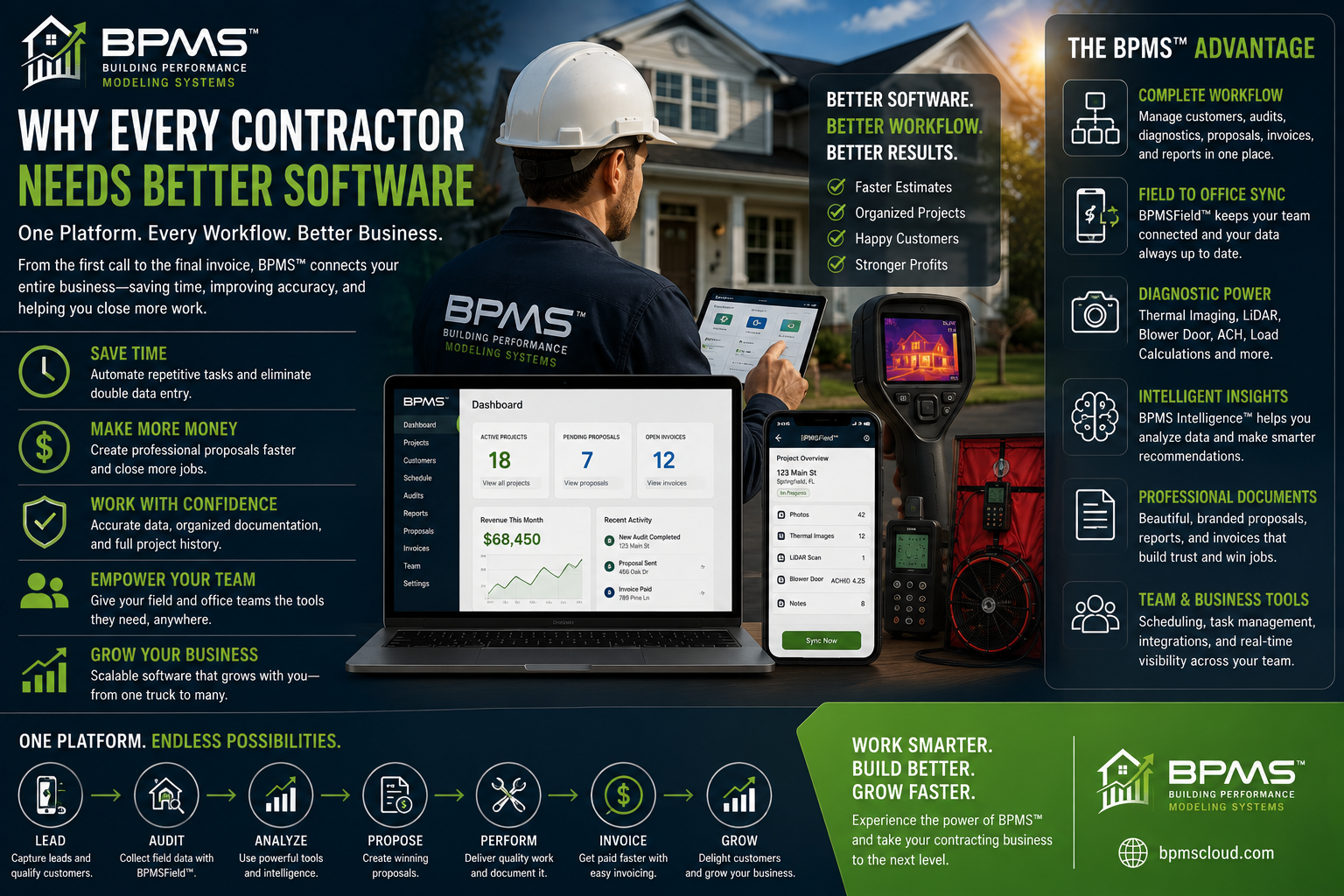
BPMS™ and the Home Energy Score Workflow
This is an area where Building Performance Modeling Systems (BPMS™) can provide a powerful foundation for the broader Assessor workflow.
BPMS™ is designed around the building-performance process rather than treating the Home Energy Score as an isolated event.
A project can connect:
Customer
↓
Property
↓
Audit
↓
Building Data
↓
Envelope
↓
HVAC
↓
Hot Water
↓
Photos
↓
Home Energy Score Data
↓
Recommendations
↓
Professional Reporting
The objective is to reduce fragmented data entry and keep the building record connected.
⸻
Home Energy Score Software Integration Is Possible
There is an especially important opportunity here.
DOE confirms that the Home Energy Scoring Tool supports an API that can integrate with other software tools, allowing information to be entered in one system and transferred rather than requiring duplicate entry, provided the integration correctly translates the required data.
That is significant for platforms such as BPMS™.
Instead of forcing an Assessor to:
Collect data
↓
Enter it into energy-audit software
↓
Re-enter it into another scoring system
the long-term goal of proper integration can be:
Collect once
↓
Validate
↓
Use across connected workflows
That is exactly the kind of efficiency modern Assessors need.
Any production integration must, of course, follow DOE’s current technical and program requirements.
⸻
BPMSField™ — Collecting Data at the Property
The Assessor’s most valuable information originates in the field.
BPMSField™ is designed to help professionals collect project information directly at the building and connect it with the correct audit.
That can include:
* Photographs
* Property observations
* Building information
* Field documentation
* Location-related data
Instead of returning to the office with:
Clipboard + Phone Photos + Notes + Memory
the goal becomes:
Structured digital building record.
⸻
BPMS LiDARScan™ — Building Geometry
Geometry is fundamental to building-performance analysis.
Accurate measurements influence:
* Conditioned floor area
* Wall areas
* Building volume
* Energy models
* HVAC calculations
BPMS LiDARScan™ is designed to use compatible mobile-device LiDAR technology to help capture building geometry.
For an Assessor offering services beyond the Score, this can help create a richer digital representation of the property.
⸻
BPMS Thermal™ — Going Beyond the Score
A Home Energy Score does not replace diagnostic thermography.
But an Assessor who also performs comprehensive energy audits may want to offer thermal imaging as an additional service.
BPMS Thermal™ is designed to keep thermal images associated with the building-performance project.
This allows professionals to connect:
Thermal Image
↓
Observed Condition
↓
Recommendation
↓
Customer Report
That creates a stronger diagnostic service beyond the standardized Score itself.
⸻
BPMS™ Blower Door and ACH Analysis
Likewise, blower door testing can complement a broader energy-audit offering.
An Assessor who also performs diagnostic audits can evaluate:
CFM50
↓
Building Volume
↓
ACH50
↓
Air Leakage Analysis
↓
Air-Sealing Recommendations
This gives homeowners information beyond the asset rating.
The Score provides one perspective.
Diagnostics provide another.
Together, they can create a much richer understanding of the building.
⸻
BPMS Load CalC™ — Connecting the Score With HVAC Analysis
Suppose the Home Energy Score identifies opportunities for:
* Envelope improvements
* Window improvements
* HVAC upgrades
Now the homeowner asks:
“What size HVAC system does my house actually need?”
That requires a different professional analysis.
BPMS Load CalC™ is designed to support heating and cooling load calculations using building information.
That creates a natural progression:
Score
↓
Identify Opportunities
↓
Improve Envelope
↓
Calculate Loads
↓
Select Appropriate HVAC
This is where an Assessor can move from simply providing a rating toward becoming a broader building-performance consultant.
⸻
BPMS Intelligence™ — Helping Organize the Building Story
A sophisticated project can contain a large amount of information.
Imagine:
Home Energy Score: 4
High energy consumption
Older HVAC
Low attic insulation
Thermal anomalies
High measured air leakage from a separate diagnostic audit
Each piece tells part of the story.
BPMS Intelligence™ is intended to help professionals analyze structured building-performance information, identify relationships, flag missing information, and assist with customer-facing explanations.
The professional still makes the final determination.
AI should support professional judgment—not replace it.
⸻
The Future Assessor May Become Much More Than an Assessor
This is where the career becomes especially interesting.
A person may begin by learning to provide a Home Energy Score.
Then add:
Energy Auditing
↓
Blower Door Testing
↓
Thermal Imaging
↓
HVAC Load Calculations
↓
Building Diagnostics
↓
Weatherization Consulting
↓
Home Performance Consulting
The professional eventually becomes more than someone who produces a number.
They become a:
Building Performance Professional
⸻
How Much Can a Home Energy Score Assessor Charge?
There is no universal national price.
Pricing can depend on:
* Geographic market
* Partner/program structure
* Whether the Score is standalone
* Whether it is bundled
* Home size and complexity
* Related services
* Travel
* Local competition
DOE itself notes that Assessors offer the Score through several different business models—including standalone paid services, bundled audit/inspection packages, lead-generation offerings, and utility or solar programs.
Therefore, do not build your business model around an arbitrary nationwide price.
Research your market.
Calculate your time.
Understand Partner costs.
Account for travel.
Account for insurance.
Account for software.
Then price professionally.
⸻
The Bigger Revenue Opportunity Is Often the Ecosystem
Suppose the Score reveals improvement opportunities.
That may lead to additional professional services involving:
* Comprehensive energy auditing
* Air leakage testing
* Thermal diagnostics
* HVAC analysis
* Insulation evaluation
* Retrofit consulting
* Post-improvement verification
Not every Assessor will offer these services.
And professionals should only provide services for which they are appropriately qualified.
But the Home Energy Score can become an entry point into a broader building-performance relationship.
⸻
How to Market Your Home Energy Score Business
A strong marketing strategy should educate rather than simply advertise.
Create content answering questions homeowners already search for:
What is a Home Energy Score?
Is my home energy efficient?
How can I lower my energy bill?
Should I get an energy audit before buying a house?
What should I do before replacing my HVAC system?
How does insulation affect home energy use?
What is a blower door test?
This creates organic educational marketing.
And every article can lead back to:
Schedule a Home Energy Score.
⸻
Build Local SEO Around the Service
If you serve a specific market, create pages such as:
Home Energy Score Assessor in [City]
Home Energy Score in [State]
Home Energy Assessment Near Me
Energy Auditor in [City]
Home Energy Inspection in [City]
Then support those pages with educational content.
This can help potential customers discover the service while researching energy efficiency.
⸻
Partner With Related Professionals
One of the fastest ways to build assessment volume may be through professional relationships.
Consider:
Home Inspectors
Every homebuyer already needs inspection services.
Realtors
They communicate directly with buyers and sellers.
HVAC Contractors
Their customers frequently have comfort and energy concerns.
Insulation Contractors
Their customers are already interested in efficiency.
Solar Contractors
Understanding the building’s energy needs before solar can be valuable.
Builders
Energy-performance documentation is becoming increasingly important.
Utilities
Many operate efficiency programs.
The Home Energy Score can fit naturally into these relationships.
⸻
STEP 18 — Protect Your Professional Reputation
Never treat certification as the finish line.
Treat it as the beginning.
Continue learning:
* Building science
* HVAC
* Moisture
* Airflow
* Insulation
* Energy codes
* Electrification
* Heat pumps
* Solar
* Building diagnostics
Read DOE updates.
Use your Partner’s resources.
Review Assessor guidance.
Participate in quality assurance constructively.
The best Assessor is not the person who produces Scores fastest.
It is the person whose work is consistently accurate and useful.
⸻
Common Mistakes New Assessors Should Avoid
There are several mistakes worth avoiding from the beginning.
Do not rely entirely on public property records.
Evaluate the actual home.
Do not guess when you can verify.
Data quality matters.
Do not confuse Home Energy Score with a full diagnostic audit.
Explain the difference.
Do not rush the field assessment.
A fast inaccurate Score has little value.
Do not ignore Partner requirements.
You operate within the Home Energy Score program structure.
Do not treat recommendations solely as sales opportunities.
Protect your credibility.
Do not stop learning after certification.
Building science evolves continuously.
⸻
Your Step-by-Step Roadmap
The pathway can be summarized as:
1. Learn residential building science
↓
2. Obtain or verify an accepted prerequisite credential
↓
3. Find a Home Energy Score Partner or Remote Service Provider
↓
4. Join the Partner’s program
↓
5. Gain access to DOE Simulation Training
↓
6. Complete the Sim and written exam
↓
7. Complete your first Score with a qualified mentor within the required timeframe
↓
8. Become active within the program
↓
9. Develop a repeatable field-assessment process
↓
10. Produce accurate Scores
↓
11. Explain results professionally
↓
12. Maintain quality standards
↓
13. Integrate the service into your business
↓
14. Build referral relationships
↓
15. Add complementary building-performance services as your qualifications grow
That is the roadmap.
⸻
Where to Start Today
If you are serious about becoming a Home Energy Score Assessor, don’t start by purchasing equipment.
Start by confirming eligibility.
Visit the official DOE program page and review the current prerequisite credentials.
Become a Home Energy Score Assessor — U.S. Department of Energy program page
Then identify the appropriate Partner or Remote Service Provider.
From there:
Credential → Partner → Training → Testing → Mentoring → Scoring
That’s the current path.
⸻
The Future of Home Energy Scoring
The Home Energy Score fits into a much larger transformation occurring in housing.
Homes are increasingly being evaluated not only by:
Location
Square footage
Bedrooms
Bathrooms
but also by:
Energy performance.
At the same time, the building industry is moving toward:
* Electrification
* Heat pumps
* Improved envelopes
* Better ventilation
* Solar
* Energy storage
* Connected equipment
* Digital building models
* Smart diagnostics
That means professionals capable of understanding the relationship between all these systems may become increasingly valuable.
The Home Energy Score can be an entry point into that future.
⸻
BPMS™ and the Future Home Energy Assessor
Imagine the assessment workflow several years from now.
The Assessor arrives.
BPMSField™ opens the property.
Building information is captured.
BPMS LiDARScan™ helps document geometry.
The Home Energy Score workflow organizes required asset information.
If a comprehensive diagnostic audit is also being performed, BPMS Thermal™ captures infrared evidence.
Blower door results are documented.
BPMS Load CalC™ helps evaluate HVAC loads when that service is required.
Future connected building-performance sensors add additional measurements.
BPMS Intelligence™ helps review the complete project.
The professional verifies the information.
Home Energy Score data flows through an authorized integration where applicable.
The homeowner receives not simply a number—but a connected understanding of the building.
That is the larger opportunity.
⸻
Final Thoughts
Becoming a Home Energy Score Assessor is not simply about learning how to generate a score from 1 to 10.
It is about learning how to look at a house differently.
You begin seeing:
The envelope.
The insulation.
The windows.
The equipment.
The ducts.
The foundation.
The geometry.
The relationships between systems.
You stop seeing a collection of rooms.
You start seeing a building that uses energy.
DOE provides the standardized methodology.
The Partner provides the program structure.
Training teaches you how to apply it.
Mentoring connects that knowledge to real buildings.
Quality assurance protects the credibility of the Score.
And your professionalism determines how much value the homeowner ultimately receives.
For an energy auditor, home inspector, HVAC professional, or building-performance specialist, Home Energy Score can become more than another credential.
It can become another door into the rapidly evolving world of residential building performance.
Learn the building. Measure the performance. Explain the opportunity. Help homeowners make better energy decisions.
And as platforms such as BPMS™ — Building Performance Modeling Systems continue connecting field data, building geometry, diagnostics, analysis, reporting, and business workflows, the next generation of Home Energy Score Assessors can become increasingly efficient, data-driven, and valuable to the homeowners they serve.
BPMS™ — One Platform. Complete Building Performance.
Comments and Reviews
Share what you found helpful and how this article supported your work.
0.0/5from 0 reviews
No reviews yet. Be the first to share your feedback.