How Energy Audits Save Homeowners Money: Finding Hidden Energy Waste Before It Reaches Your Utility Bill
Published 8/12/2026
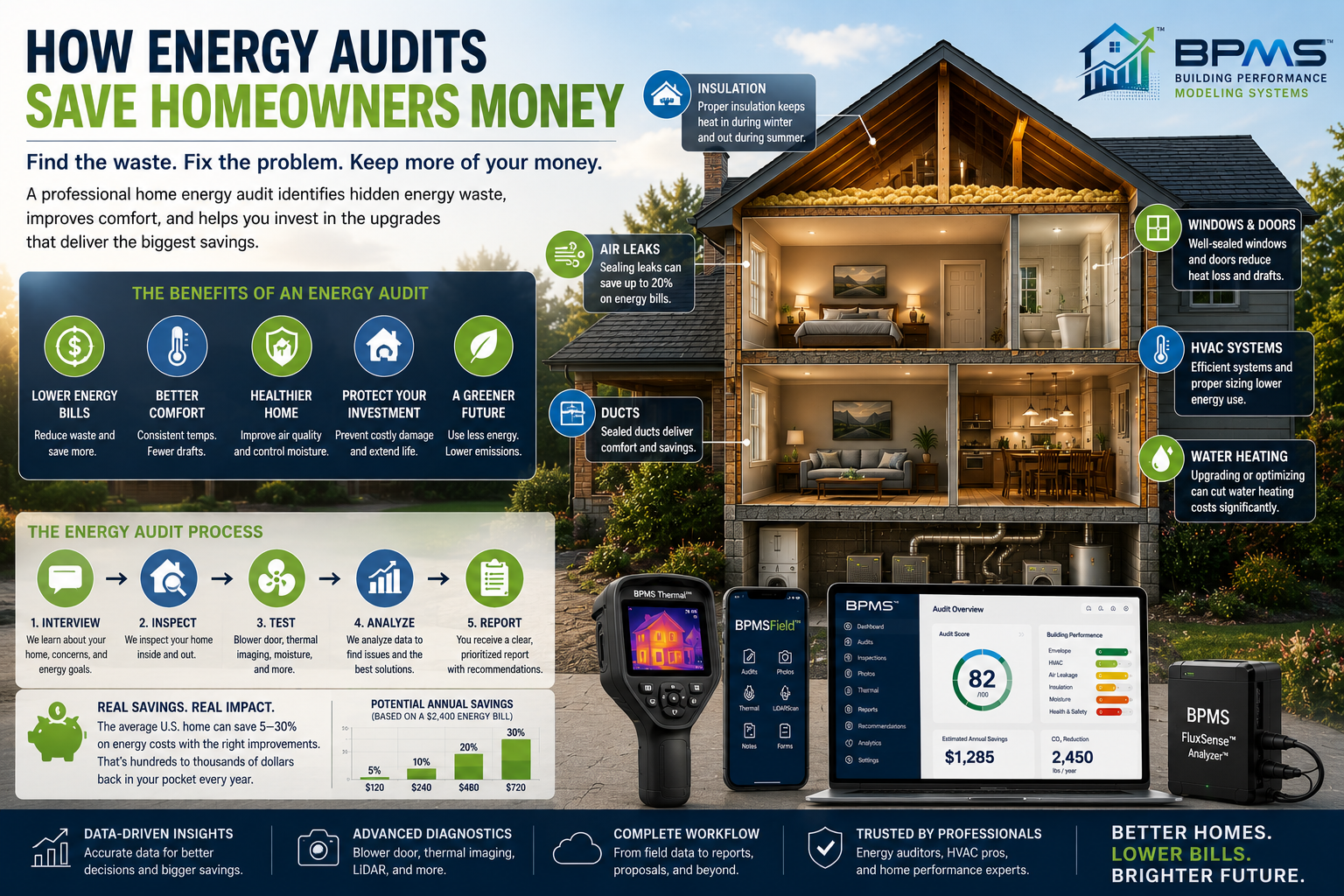
A professional home energy audit can reveal where a house is wasting energy—and where improvement dollars may have the greatest impact. Learn how energy auditors use blower door testing, thermal imaging, insulation inspections, HVAC analysis, duct testing, utility data, and modern building-performance technology to identify opportunities to lower energy costs while improving comfort and home performance.
How Energy Audits Save Homeowners Money: Finding Hidden Energy Waste Before It Reaches Your Utility Bill
Every month, homeowners receive electricity, natural gas, propane, or heating-oil bills telling them how much energy they purchased.
What those bills usually don’t explain is where that energy went.
Was heated air escaping through the attic?
Was an aging HVAC system consuming more energy than necessary?
Were leaky ducts delivering conditioned air into an attic or crawlspace?
Was missing insulation increasing heating and cooling loads?
Were air leaks around plumbing, wiring, windows, doors, and framing allowing outdoor air into the house?
Was the thermostat really the problem—or was the building itself forcing the HVAC system to operate longer?
A professional home energy audit is designed to help answer these questions.
The financial value of an energy audit comes from identifying waste before a homeowner spends money on the wrong improvements.
A good audit doesn’t simply tell someone to buy a new furnace, replace every window, or install more insulation. It uses building science, measurements, diagnostic testing, and professional analysis to determine where opportunities actually exist.
The objective is straightforward:
Understand how the home uses and loses energy, identify the most important opportunities, and help the homeowner invest improvement dollars where they can produce meaningful benefits.
⸻
Your Utility Bill Is the Result—Not the Diagnosis
Suppose a homeowner receives a $400 heating bill.
The bill tells the homeowner the cost.
It doesn’t necessarily explain the cause.
Several factors could be contributing simultaneously:
* Air leakage
* Inadequate insulation
* Inefficient heating equipment
* Duct leakage
* Excessive thermostat settings
* High hot-water consumption
* Poor window performance
* Building-envelope deficiencies
* Occupant behavior
* Extreme weather
Without an audit, homeowners may make decisions based primarily on assumptions.
That can become expensive.
For example, a homeowner might spend thousands of dollars replacing windows because the house feels drafty.
But diagnostic testing could reveal that much of the uncontrolled airflow is actually occurring through attic bypasses, rim joists, plumbing penetrations, or other enclosure defects.
The new windows may still provide benefits, but they may not address the largest source of energy waste.
An energy audit helps turn guesswork into evidence.
⸻
The First Way an Energy Audit Saves Money: Finding the Biggest Problems First
Homeowners typically have limited improvement budgets.
They may be considering:
* New windows
* Insulation
* HVAC replacement
* Air sealing
* Solar panels
* A heat-pump water heater
* New appliances
* Ductwork
* Smart thermostats
The challenge is determining where to start.
A comprehensive energy audit establishes a baseline for the home’s performance and helps prioritize improvements.
Instead of asking:
“What energy-efficiency product should I buy?”
the homeowner can ask:
“Which improvements make the most sense for my particular home?”
That distinction can prevent unnecessary spending.
⸻
Understanding Where the Money Goes
Residential energy consumption varies substantially by climate, building type, equipment, fuel, household behavior, and other factors.
Common energy-consuming systems include:
* Space heating
* Air conditioning
* Water heating
* Lighting
* Refrigeration
* Appliances
* Electronics
* Ventilation
* Dehumidification
* Pool equipment
A professional auditor evaluates the home to determine which categories deserve the most attention.
A home in a cold climate with an inefficient heating system and significant air leakage may have very different opportunities from a newer home in a hot-humid climate with substantial cooling and dehumidification demand.
There is no universal recommendation that fits every building.
That is precisely why an audit matters.
⸻
1. Air Leakage: Paying to Condition Outdoor Air
One of the most common sources of residential energy waste is uncontrolled air leakage.
Homes contain thousands of joints, seams, penetrations, and openings.
Potential leakage locations include:
* Attic hatches
* Plumbing penetrations
* Electrical penetrations
* Recessed lights
* Chimney and flue chases
* Rim joists
* Window frames
* Exterior doors
* Baseboards
* Mechanical chases
* Duct penetrations
* Garage connections
During winter, heated indoor air escaping from the building must be replaced by outdoor air.
During summer, hot and humid outdoor air entering the home can increase cooling and dehumidification loads.
In both cases, the HVAC system has to compensate.
And operating HVAC equipment costs money.
⸻
Blower Door Testing Turns Air Leakage Into a Measurement
A blower door allows the energy auditor to measure building-envelope leakage.
A calibrated fan is installed in an exterior doorway and used to establish a controlled pressure difference between indoors and outdoors.
A commonly used test condition is 50 Pascals.
The airflow necessary to maintain that pressure can be measured as:
CFM50 — cubic feet per minute at 50 Pascals
When building volume is known, the auditor can also calculate:
ACH50 — Air Changes per Hour at 50 Pascals
These values allow the auditor to move beyond statements such as:
“Your home feels drafty.”
Instead, building leakage can be quantified and compared with relevant program criteria, codes, standards, or retrofit goals where applicable.
⸻
Finding the Leaks Can Be More Valuable Than Simply Knowing the Number
A blower door result tells the auditor how leaky the building is.
The next question is:
Where are the leaks?
While the building is depressurized, the auditor can investigate specific leakage pathways using tools such as:
* Smoke
* Infrared thermography
* Pressure diagnostics
* Visual inspection
Once significant leakage locations are identified, air-sealing work can be targeted.
This matters financially because targeted improvements are generally more useful than randomly applying caulk or spray foam throughout the house without understanding the leakage pathways.
⸻
2. Insulation: Keeping Purchased Energy Inside the Home
Homeowners pay to create comfortable indoor temperatures.
During winter, insulation helps slow heat moving from the warm interior toward colder areas.
During summer, it helps slow unwanted heat transfer into conditioned space.
Insufficient or poorly installed insulation increases the amount of heating or cooling the HVAC system must provide.
An energy auditor may inspect insulation in:
* Attics
* Exterior walls where accessible
* Floors
* Crawlspaces
* Basements
* Rim joists
* Kneewalls
* Cathedral ceilings where assessment is possible
But simply finding insulation isn’t enough.
⸻
Installation Quality Matters
Insulation performance can be reduced by:
* Gaps
* Voids
* Compression
* Uneven coverage
* Wind washing
* Moisture
* Poor alignment with the air barrier
* Missing sections
A homeowner may therefore believe:
“My attic already has insulation.”
The auditor may discover that portions of the attic have adequate insulation while other areas have major deficiencies.
Correcting the deficient areas can be more financially sensible than assuming the entire home needs the same treatment.
⸻
3. Thermal Imaging Helps Find Problems You Cannot Easily See
An infrared camera allows trained energy professionals to evaluate surface-temperature patterns.
Under appropriate conditions, thermography may help identify areas that warrant further investigation for:
* Missing insulation
* Insulation voids
* Thermal bridging
* Air leakage
* Moisture anomalies
* HVAC distribution problems
This can save homeowners money because the investigation becomes more targeted.
Instead of opening walls unnecessarily or replacing components based solely on suspicion, the auditor can use thermal patterns together with other diagnostic evidence to narrow down potential problems.
Thermal imaging should not be interpreted in isolation. Surface-temperature differences can have multiple causes, so findings should be corroborated whenever necessary.
⸻
4. HVAC Efficiency Can Have a Major Effect on Operating Costs
Heating and cooling equipment can represent a substantial portion of household energy consumption.
An auditor may evaluate:
* Equipment age
* Fuel type
* Rated efficiency
* Capacity
* Visible condition
* Filter condition
* Controls
* Distribution system
* Ductwork
* Thermostat operation
An older system isn’t automatically a bad system, and a newer system isn’t automatically operating optimally.
The objective is to determine how the equipment is performing as part of the building.
⸻
Bigger HVAC Equipment Isn’t Necessarily Better
Homeowners sometimes assume that larger equipment will heat or cool the home faster and therefore save money.
HVAC sizing is more complicated.
Oversized equipment can contribute to problems such as:
* Short cycling
* Reduced comfort
* Poor humidity control
* Increased equipment wear
* Reduced effective efficiency under some operating conditions
Before replacing equipment, building improvements should also be considered.
If air sealing and insulation significantly reduce heating and cooling loads, the home’s future HVAC requirements may be different from its current requirements.
This is where proper load analysis becomes valuable.
⸻
5. Duct Leakage Can Waste Energy Before It Reaches the Room
Imagine paying to heat air to 110°F and then losing part of that air into the attic before it ever reaches the bedroom.
That is one of the problems duct leakage can create.
Duct systems can leak at:
* Trunk connections
* Branch connections
* Boots
* Plenums
* Air-handler cabinets
* Flex-duct connections
* Return systems
The energy impact can be particularly important when ducts are located outside the conditioned enclosure.
A professional audit can identify visible deficiencies and, where appropriate, incorporate duct-leakage testing.
⸻
Return Leakage Matters Too
Supply leakage loses conditioned air.
Return leakage can pull unconditioned air into the HVAC system.
If return ducts run through a hot attic, vented crawlspace, garage, or other unconditioned location, leakage may increase the load on the equipment and can introduce air-quality concerns depending on the location.
Sealing duct systems can therefore improve both energy performance and comfort.
⸻
6. Windows and Doors: Diagnose Before Replacing
Windows are one of the first things homeowners blame for high utility bills.
Sometimes correctly.
But window replacement can be expensive.
A professional audit helps determine whether the problem involves:
* The glazing
* The frame
* Weatherstripping
* Air leakage around the rough opening
* Solar gain
* Thermal conduction
* Installation defects
* Another part of the building envelope
Sometimes relatively modest air-sealing or weatherstripping work can address part of the problem.
In other situations, replacement may be appropriate.
The audit helps distinguish between them.
⸻
7. Water Heating Can Hide Significant Energy Costs
Domestic hot water is another important residential energy load.
An auditor may evaluate:
* Water-heater type
* Age
* Fuel
* Efficiency
* Storage capacity
* Temperature settings where appropriate
* Distribution piping
* Pipe insulation
* Hot-water usage patterns
* Visible leakage
Potential improvements may include:
* Efficient fixtures
* Pipe insulation
* Distribution improvements
* Equipment upgrades
* Heat-pump water heaters where appropriate
Small improvements across frequently used systems can accumulate into meaningful long-term savings.
⸻
8. Appliances, Lighting, and Plug Loads Add Up
The home energy audit isn’t necessarily limited to the building envelope and HVAC system.
Electricity is also consumed by:
* Refrigerators
* Freezers
* Lighting
* Televisions
* Computers
* Clothes dryers
* Washing machines
* Dishwashers
* Pool pumps
* Dehumidifiers
* Chargers
* Standby electronics
Each individual device may appear insignificant.
Collectively, they can represent a meaningful portion of household consumption.
An audit can help homeowners understand where behavioral changes or equipment upgrades may make sense.
⸻
9. Utility-Bill Analysis Provides Financial Context
A good energy auditor doesn’t simply look at the home.
The auditor can also look at its energy history.
Ideally, approximately 12 months or more of utility consumption can be reviewed when available.
The objective is to identify patterns.
For example:
High winter consumption
may warrant investigation of:
* Heating efficiency
* Air leakage
* Insulation
* Duct losses
* Thermostat behavior
High summer consumption
may warrant investigation of:
* Air-conditioning efficiency
* Solar heat gain
* Air leakage
* Ductwork
* Pool equipment
* Dehumidification
The utility history gives the auditor another layer of evidence.
⸻
10. Energy Audits Can Prevent the Wrong Upgrade
This may be one of the most overlooked financial benefits of an audit.
Consider a homeowner with $15,000 available for energy improvements.
Without diagnostics, the homeowner might spend the entire amount on one visible problem.
But the audit could reveal that the best strategy is actually a combination of:
* Air sealing
* Attic insulation
* Duct repairs
* HVAC optimization
* Targeted window repairs
The exact answer will vary from home to home.
The point is that diagnosis should generally come before investment.
That principle is common in many industries.
You wouldn’t want a mechanic replacing expensive parts before diagnosing the vehicle.
Building performance deserves the same discipline.
⸻
11. Energy Audits Help Prioritize Improvements by Value
A professional auditor should help the homeowner understand which recommendations deserve priority.
A useful decision framework considers:
Cost
How much will the improvement cost?
Energy Impact
How much energy could reasonably be saved?
Comfort
Will the improvement address drafts or uneven temperatures?
Safety
Are there health or safety concerns that take priority?
Durability
Will the measure help address moisture or building-envelope problems?
Equipment Life
Could reducing loads improve HVAC operating conditions?
Interaction With Other Improvements
Should one measure happen before another?
This produces a much more useful improvement plan than simply ranking measures by estimated energy savings.
⸻
Understanding Simple Payback
One way homeowners evaluate improvements is simple payback.
Suppose an efficiency measure costs $2,400 and is estimated to reduce energy expenses by $400 per year.
Simple payback would be:
$2,400 ÷ $400 = 6 years
After approximately six years, the accumulated nominal energy-cost savings would equal the initial cost under those assumptions.
However, simple payback has limitations.
It does not automatically account for:
* Financing costs
* Energy-price changes
* Maintenance
* Equipment replacement cycles
* Incentives
* Comfort improvements
* Home value
* Inflation
* Measure interactions
A good auditor should therefore avoid presenting simple payback as the only measure of value.
⸻
Savings Estimates Are Estimates
This is extremely important when communicating with homeowners.
No professional should imply that every recommended measure will produce an exact guaranteed utility-bill reduction unless a specific performance contract provides such a guarantee.
Actual savings can vary based on:
* Weather
* Utility rates
* Occupancy
* Thermostat settings
* Installation quality
* Equipment operation
* Behavioral changes
* Future renovations
For example, a homeowner may make efficiency improvements and then decide to keep the home warmer during winter because it is now more comfortable.
Energy consumption may still decrease, but not by exactly the amount a simplified model predicted.
Professional reporting should make assumptions clear.
⸻
12. Comfort Improvements Have Financial Value Too
Not every benefit appears directly on the utility bill.
Imagine a homeowner who has been using portable electric heaters in two bedrooms because those rooms remain cold.
If an audit identifies the underlying envelope or HVAC distribution problem, correcting it could:
* Reduce supplemental heater use
* Improve comfort
* Reduce electrical demand
* Eliminate the inconvenience of portable heaters
Similarly, correcting summer comfort problems may reduce reliance on portable air conditioners or excessive thermostat settings.
Comfort and efficiency often reinforce each other.
⸻
13. Better Building Performance Can Reduce HVAC Demand
One of the most powerful concepts in home performance is load reduction.
Suppose a home undergoes significant:
* Air sealing
* Insulation improvements
* Window improvements
* Duct sealing
The amount of heating and cooling required may decrease.
That can influence future HVAC equipment selection.
Rather than installing new equipment sized around the inefficient version of the building, a contractor can evaluate the improved building’s actual load.
This is where technologies such as BPMS Load CalC™ can support a more integrated building-performance workflow.
⸻
14. Energy Audits Can Help Homeowners Evaluate Solar More Intelligently
Solar is another area where an energy audit can provide valuable context.
A homeowner might initially ask:
“How many solar panels do I need?”
A building-performance professional can introduce another question:
“How much energy does the home actually need after reasonable efficiency improvements?”
If the home’s consumption can be reduced cost-effectively before solar installation, the required photovoltaic system may potentially be smaller.
The relationship becomes:
Reduce unnecessary consumption → understand remaining demand → evaluate renewable generation.
Efficiency and solar don’t need to compete.
They can complement each other.
⸻
15. Incentives Can Improve the Economics
Depending on the homeowner’s location and eligibility, energy improvements may qualify for:
* Federal incentives
* State incentives
* Utility rebates
* Weatherization programs
* Financing programs
* Tax credits
Programs change frequently, and eligibility requirements differ.
Energy auditors should avoid promising incentives without confirming current program requirements.
But identifying applicable programs can materially change the financial attractiveness of a project.
⸻
How Much Can a Home Energy Audit Save?
There is no responsible universal dollar amount.
A home with substantial deficiencies may have significant opportunities.
A recently constructed high-performance home may have relatively few.
Potential savings depend on:
* Climate
* Home size
* Existing efficiency
* Fuel type
* Utility rates
* Occupancy
* Existing HVAC equipment
* Recommended improvements
* Installation quality
The value of the audit is therefore not a guaranteed percentage reduction.
Its value is identifying opportunities specific to the individual building.
⸻
A Hypothetical Example
Consider a homeowner spending:
$3,600 per year on household energy.
An audit identifies several potential improvements.
Air sealing and attic work are estimated to reduce annual energy costs by approximately $300.
Duct improvements could potentially save another $150.
HVAC optimization and controls could contribute approximately $100.
Lighting and appliance changes could potentially reduce another $100.
If those modeled estimates were realized, the household could reduce annual energy costs by approximately:
$650 per year.
Over ten years, without considering energy-price changes, financing, maintenance, or other factors:
$650 × 10 = $6,500
This example is illustrative—not a promise of actual savings.
But it demonstrates an important concept:
Small improvements across several systems can accumulate into substantial long-term value.
⸻
Energy Audits Also Help Avoid Unnecessary Spending
Suppose the same homeowner was preparing to spend $18,000 replacing windows solely to reduce energy bills.
The audit reveals that the windows are reasonably functional but significant air leakage exists elsewhere.
The homeowner may still decide to replace the windows for appearance, maintenance, noise reduction, comfort, or other reasons.
But now the decision is informed.
That is financial value too.
Sometimes an audit saves money by identifying what should be done.
Sometimes it saves money by identifying what doesn’t need to be done yet.
⸻
Why Professional Diagnostics Matter
A visual inspection can reveal many problems.
Diagnostic testing can reveal substantially more.
Professional auditors may use:
* Blower doors
* Digital manometers
* Infrared cameras
* Moisture meters
* Combustion analyzers
* Duct testers
* Flow hoods
* Anemometers
* Laser measurement
* LiDAR
* Building-energy software
Each instrument provides another piece of information.
The real value comes from combining them.
⸻
BPMS™ and the Financial Side of Building Performance
A major challenge in professional energy auditing is connecting all of the information gathered during an assessment.
Measurements may exist in one place.
Photos in another.
Thermal images somewhere else.
HVAC calculations in another application.
Recommendations in a report.
Pricing in a spreadsheet.
Proposals in another system.
Building Performance Modeling Systems (BPMS™) is designed around connecting these stages.
The broader workflow can move from:
Customer → Property → Audit → Diagnostics → Analysis → Recommendations → Work Scope → Proposal → Invoice
For the homeowner, this can create a clearer path from identifying energy waste to understanding potential solutions.
For the professional, it reduces fragmented workflows.
⸻
BPMSField™: Capturing the Evidence
BPMSField™ helps professionals collect field information associated with the appropriate audit.
That can include photographic documentation and other inspection information.
Accurate field documentation matters because a recommendation should ideally be supported by evidence.
Instead of simply recommending attic air sealing, for example, the auditor can document the specific areas that contributed to the recommendation.
⸻
BPMS Thermal™: Making Invisible Problems Visible
BPMS Thermal™ is designed to integrate thermal-imaging information into the broader audit workflow.
For homeowners, thermal images can be particularly powerful because they help translate building-science concepts into visual information.
A homeowner may not immediately understand thermal bridging.
But showing a properly interpreted thermal pattern alongside an explanation can make the problem much easier to understand.
⸻
BPMS LiDARScan™: Improving Building Measurements
Accurate geometry is important for:
* Building volume
* Envelope area
* Load calculations
* Energy modeling
* Work scopes
BPMS LiDARScan™ is designed to use compatible LiDAR-equipped devices to capture building geometry and bring that information into the BPMS™ workflow.
Better measurements support better calculations.
And better calculations can support better investment decisions.
⸻
BPMS Load CalC™: Connecting Efficiency and HVAC
When building improvements significantly change heating and cooling loads, HVAC decisions should reflect those changes.
BPMS Load CalC™ is designed to support load-analysis workflows within the BPMS™ environment.
This helps connect the building-envelope conversation with the HVAC conversation.
Rather than viewing them as unrelated projects, the professional can evaluate how one affects the other.
⸻
BPMS FluxSense Analyzer™: Measuring Heat Flow
The developing BPMS FluxSense Analyzer™ is intended to introduce another layer of diagnostic information through direct heat-flux measurement.
Traditional energy auditing frequently evaluates thermal performance through:
* Insulation characteristics
* R-values
* Surface temperatures
* Building construction
* Energy models
Direct heat-flux measurement can provide additional information about heat moving through an assembly under actual conditions.
When combined with temperature data and other diagnostics, this may help building-performance professionals develop a more complete understanding of thermal behavior.
It should be considered a supplemental diagnostic capability rather than an automatic replacement for standardized testing methods or program requirements.
⸻
Turning Audit Findings Into an Improvement Roadmap
The most valuable energy-audit report doesn’t simply contain dozens of deficiencies.
It provides a strategy.
A homeowner should be able to understand:
Priority 1 — What should be addressed immediately?
Safety, moisture, and serious building problems generally deserve attention first.
Priority 2 — Where is significant energy being wasted?
Air leakage, insulation, ducts, and mechanical systems may become priorities depending on the home.
Priority 3 — What improvements work well together?
For example, air sealing and insulation are often coordinated.
Priority 4 — What should happen before equipment replacement?
Envelope improvements may influence HVAC loads.
Priority 5 — What long-term improvements should be considered?
Solar, electrification, equipment replacement, and other investments can then be evaluated within the broader building strategy.
This transforms an audit from a report into a financial and technical roadmap for the home.
⸻
Energy Efficiency Is an Investment in the Building
Homeowners often think about energy improvements only in terms of monthly savings.
That is understandable.
But the value can extend beyond the utility bill.
Depending on the measures and building conditions, improvements may contribute to:
* Better comfort
* More consistent temperatures
* Reduced drafts
* Better moisture management
* Improved HVAC performance
* Reduced equipment runtime
* Improved building durability
* Better understanding of the property
* Lower environmental impact
The strongest projects often solve several problems simultaneously.
⸻
What Homeowners Should Ask Their Energy Auditor
A homeowner should leave an audit understanding more than a list of recommended products.
Useful questions include:
* Where is my home losing the most energy?
* What evidence supports that conclusion?
* Which recommendations should come first?
* Which improvements are primarily for energy savings?
* Which improvements address comfort?
* Are there health or safety priorities?
* Could any recommendations affect ventilation?
* Should envelope improvements happen before HVAC replacement?
* What assumptions were used in savings estimates?
* Are incentives available?
* How should improvements be verified afterward?
A professional auditor should be able to explain the reasoning behind recommendations.
⸻
The Best Energy Audit Is One That Leads to Better Decisions
The purpose of an energy audit isn’t to convince every homeowner to purchase every possible improvement.
It is to provide enough reliable information for the homeowner to make informed decisions.
Sometimes the right recommendation may be extensive.
Sometimes it may be modest.
Sometimes an audit may confirm that a part of the home is already performing reasonably well.
That objectivity is valuable.
A homeowner should not have to spend thousands of dollars guessing what is wrong with a building.
Measure first. Diagnose second. Improve third. Verify afterward.
That is the foundation of professional building performance.
⸻
Final Thoughts
A home energy audit saves homeowners money in two fundamental ways.
The first is obvious:
It can identify opportunities to reduce wasted energy.
Air sealing can reduce uncontrolled infiltration.
Insulation can reduce heat transfer.
Duct sealing can keep conditioned air where it belongs.
HVAC improvements can reduce unnecessary equipment consumption.
Controls, water heating, lighting, appliances, and renewable energy can provide additional opportunities.
But the second form of savings may be equally important:
A professional energy audit can help homeowners avoid spending money on improvements that don’t address the home’s most important problems.
That is why an energy audit should come before major energy-efficiency investments whenever practical.
Modern diagnostics make that analysis increasingly powerful.
Blower doors quantify air leakage.
Thermal cameras reveal temperature patterns.
Moisture instruments identify hidden concerns.
LiDAR can improve building geometry.
Load calculations connect building improvements with HVAC requirements.
And emerging technologies such as direct heat-flux measurement may add another layer of building-performance information.
Platforms such as BPMS™, together with BPMSField™, BPMS Thermal™, BPMS LiDARScan™, BPMS Load CalC™, and the developing BPMS FluxSense Analyzer™, are designed to help professionals bring these sources of information into a connected workflow.
Because saving energy isn’t simply about buying efficient products.
It begins with understanding the building.
And when homeowners understand where their money is going, why energy is being wasted, and which improvements are most appropriate, they can make better decisions about both their homes and their energy dollars.
Comments and Reviews
Share what you found helpful and how this article supported your work.
0.0/5from 0 reviews
No reviews yet. Be the first to share your feedback.