How Energy Audits Save Homeowners Money: Finding Energy Waste and Turning It Into Real Savings
Published 8/19/2026
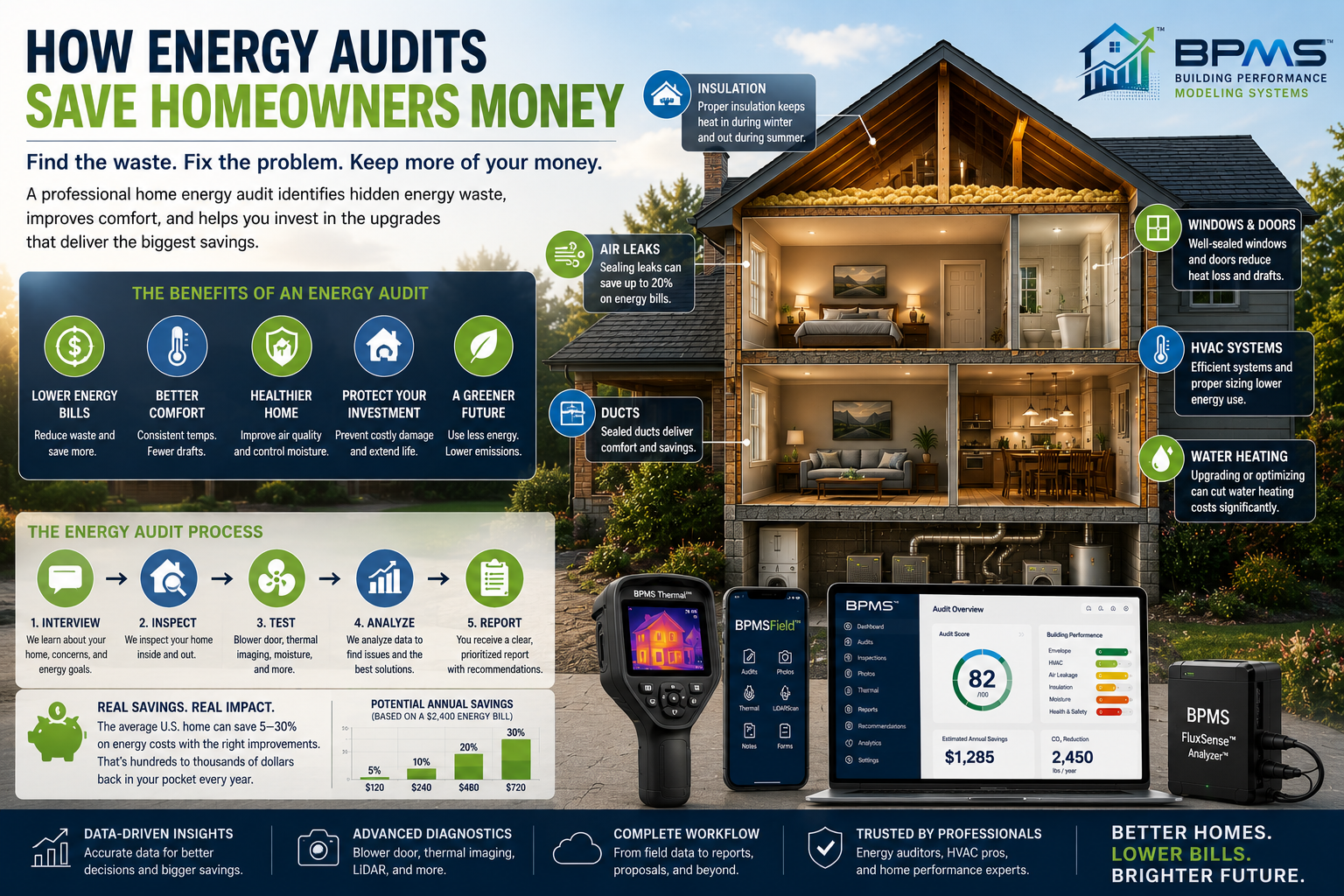
A professional home energy audit can uncover hidden air leakage, insulation deficiencies, HVAC inefficiencies, duct problems, and other conditions that drive up utility costs. Learn how energy auditors use diagnostic testing and building science to identify opportunities for improvement—and how BPMS™ helps professionals turn those findings into clear, actionable recommendations for homeowners.
How Energy Audits Save Homeowners Money: Finding Energy Waste and Turning It Into Real Savings
Every month, homeowners receive an electric or gas bill telling them how much energy they used.
What the utility bill usually doesn’t explain is why they used it.
Why does one room stay uncomfortable?
Why does the air conditioner seem to run continuously?
Why are winter heating bills increasing?
Why is the upstairs hotter than the downstairs?
Why does a recently installed HVAC system still struggle to maintain temperature?
And perhaps the most important question:
Where is the home’s energy actually being wasted?
A professional home energy audit is designed to help answer those questions.
Rather than simply looking at the monthly utility bill, an energy auditor evaluates the building as a complete system. The auditor examines how the building envelope, insulation, air leakage, HVAC equipment, ductwork, windows, appliances, lighting, moisture, ventilation, occupant behavior, and local climate interact.
The objective is not simply to tell a homeowner that their house uses energy.
It is to determine where opportunities exist to reduce unnecessary energy consumption while improving comfort, durability, and overall building performance.
That is why a comprehensive energy audit can be one of the most valuable first steps a homeowner takes before investing in energy-efficiency improvements.
⸻
What Is a Home Energy Audit?
A home energy audit is a systematic evaluation of a home’s energy performance.
A trained energy auditor gathers information about the property, visually inspects building components, reviews mechanical systems, and may perform diagnostic testing.
Depending on the scope of the audit, the auditor may evaluate:
* Exterior walls
* Attics
* Ceilings
* Floors
* Foundations
* Crawlspaces
* Windows
* Exterior doors
* Insulation
* Air leakage
* HVAC equipment
* Duct systems
* Water heating
* Appliances
* Lighting
* Ventilation
* Moisture conditions
* Utility consumption
* Renewable-energy opportunities
Advanced audits may also incorporate blower door testing, infrared thermography, pressure diagnostics, combustion-safety procedures where applicable, LiDAR measurements, and energy modeling.
The result should be more than a checklist.
A quality energy audit helps the homeowner understand how the building performs and where improvements may produce meaningful benefits.
⸻
Energy Waste Is Often Invisible
One reason energy audits are so valuable is that many significant building-performance problems cannot be identified simply by walking through a home.
A wall may look perfectly normal while containing missing insulation.
An attic hatch may appear closed while allowing substantial air leakage.
A duct system may be hidden inside an attic and leaking conditioned air.
An HVAC system may operate normally while being improperly sized for the building.
Windows may receive the blame for drafts actually caused by nearby envelope leakage.
The homeowner sees the symptom.
The energy auditor investigates the cause.
⸻
Where Does the Money Go?
Home energy expenses are generally associated with several major categories:
* Space heating
* Air conditioning
* Water heating
* Appliances
* Lighting
* Electronics and plug loads
The proportions vary considerably by climate, building type, fuel, equipment, and occupant behavior.
In many homes, however, heating and cooling represent a major opportunity for improvement.
Why?
Because HVAC equipment must compensate for the performance of the building surrounding it.
If conditioned air escapes through uncontrolled leakage, the HVAC system has to replace that energy.
If insulation is inadequate, heat transfers more easily through the building envelope.
If ducts leak, some of the conditioned air may never reach the intended rooms.
The homeowner ultimately pays for those losses through increased system runtime and energy consumption.
⸻
1. Air Leakage: Paying to Condition the Outdoors
Air leakage is one of the most common energy-performance issues found in homes.
Uncontrolled air can move through gaps and penetrations around:
* Attic hatches
* Plumbing penetrations
* Electrical penetrations
* Recessed lighting
* Top plates
* Bottom plates
* Rim joists
* Windows
* Doors
* Utility penetrations
* Mechanical chases
During winter, heated indoor air may escape while cold outdoor air enters.
During summer, hot and humid outdoor air can enter while conditioned air escapes.
Either way, the HVAC system must work harder to maintain indoor conditions.
⸻
How an Energy Audit Finds Air Leakage
A visual inspection can identify obvious leakage locations, but diagnostic testing can provide much more useful information.
One of the primary tools is the blower door.
A calibrated fan is temporarily installed in an exterior doorway and used to create a standardized pressure difference between the building and outdoors.
The equipment measures airflow—commonly expressed as CFM50—required to maintain the test pressure.
Using the building’s conditioned volume, the auditor can calculate ACH50, or Air Changes per Hour at 50 Pascals.
This gives the auditor a standardized measurement of building airtightness.
Instead of saying:
“This house seems drafty.”
the auditor has a measurable result.
⸻
Turning Air Leakage Into Savings
Once major leakage pathways have been identified, an air-sealing strategy may include appropriate treatment of:
* Attic bypasses
* Plumbing penetrations
* Electrical penetrations
* Mechanical chases
* Rim and band joists
* Weatherstripping
* Accessible envelope joints
The objective is not to make a house indiscriminately airtight.
The objective is to create a controlled building enclosure while maintaining appropriate ventilation and combustion safety.
When performed correctly, air sealing can help reduce unnecessary heating and cooling loads and improve comfort.
⸻
2. Insulation: Slowing Heat Transfer
Insulation reduces heat transfer through the building envelope.
During winter, it helps reduce heat loss from conditioned spaces.
During summer, it helps reduce heat gain from hot exterior and attic conditions.
An auditor may inspect insulation in:
* Attics
* Walls where accessible
* Floors
* Crawlspaces
* Basements
* Knee walls
* Vaulted ceilings
The auditor considers more than nominal R-value.
Installation quality matters.
⸻
Why Insulation Defects Cost Money
Imagine an attic that appears well insulated.
Most of the attic contains a substantial layer of insulation.
But several areas contain:
* Gaps
* Compression
* Disturbed insulation
* Missing insulation
* Poor coverage around framing
Those areas can become thermal weak points.
The homeowner may believe the attic is properly insulated because insulation is present.
The auditor evaluates whether the insulation is actually performing as intended.
⸻
Thermal Imaging Can Reveal the Difference
Infrared cameras can help auditors identify surface-temperature patterns associated with potential insulation deficiencies, air leakage, thermal bridging, moisture, or other conditions.
Thermal imaging does not automatically determine the cause of an anomaly.
But when combined with:
* Visual inspection
* Blower door testing
* Moisture measurements
* Building geometry
* Knowledge of construction assemblies
it becomes a powerful diagnostic tool.
This is where building science becomes important.
A good energy auditor doesn’t simply take thermal photographs.
The auditor interprets those images within the context of the building.
⸻
3. HVAC Systems: Efficiency Is More Than the Equipment Label
Heating and cooling equipment can represent a substantial portion of residential energy consumption.
An auditor may evaluate:
* Equipment type
* Age
* Rated efficiency
* Capacity
* Condition
* Thermostat operation
* Distribution
* Filter condition
* Maintenance history
* Duct system
* Comfort complaints
One common misconception is that purchasing the highest-efficiency HVAC equipment automatically guarantees low energy bills.
It doesn’t.
The HVAC system operates inside a building.
Its actual performance is influenced by that building.
⸻
The Oversizing Problem
Larger equipment is not necessarily better.
An oversized air-conditioning system may:
* Cycle frequently
* Operate for shorter periods
* Reduce dehumidification performance
* Create comfort problems
* Experience unnecessary wear
A properly performed heating and cooling load calculation helps determine how much capacity the building actually requires under design conditions.
That is why the relationship between energy auditing and HVAC load calculations is so important.
⸻
Energy Improvements Can Change HVAC Requirements
Suppose a homeowner plans to:
1. Air seal the attic.
2. Improve insulation.
3. Seal duct leakage.
4. Replace inefficient windows.
Those improvements may reduce the building’s heating or cooling load.
If the HVAC system is replaced before considering those improvements, the replacement equipment may be sized around the home’s previous performance.
A more integrated approach evaluates the building first.
Then the contractor can make a more informed equipment decision.
⸻
4. Duct Leakage: Energy That Never Reaches the Room
A high-efficiency HVAC system cannot deliver its full potential if the distribution system performs poorly.
Duct problems can include:
* Leakage
* Disconnected sections
* Damaged ducts
* Poor insulation
* Restricted airflow
* Improper sizing
* Poorly sealed connections
Ducts located in attics, crawlspaces, garages, or other unconditioned areas can be particularly important.
If conditioned air leaks into an attic instead of reaching the room, the homeowner paid to heat or cool air that never delivered the intended comfort.
⸻
5. Windows and Doors
Windows often receive a disproportionate amount of blame for energy problems.
Sometimes that blame is justified.
Other times it isn’t.
An auditor evaluates factors such as:
* Glazing type
* Frame condition
* Air leakage
* Solar exposure
* Orientation
* Shading
* Existing condition
Replacing every window can be expensive.
An audit helps determine whether window replacement deserves priority compared with less expensive measures such as air sealing or insulation improvements.
That distinction can save homeowners money before any retrofit begins.
⸻
6. Water Heating
Water heating is another significant household energy use.
An auditor may evaluate:
* Water-heater type
* Efficiency
* Temperature settings
* Distribution piping
* Hot-water usage
* Insulation
* Fixtures
* Recirculation systems
Potential improvements may include appropriate temperature management, efficient fixtures, pipe insulation where useful, or equipment replacement when economically justified.
⸻
7. Lighting, Appliances, and Plug Loads
Not every energy-saving opportunity requires construction.
Auditors may identify opportunities involving:
* LED lighting
* Older refrigerators
* Freezers
* Laundry equipment
* Dishwashers
* Electronics
* Standby loads
* Other plug loads
Individual savings may be smaller than major HVAC or envelope improvements, but multiple smaller measures can add up.
⸻
8. Utility Bill Analysis
A homeowner’s utility history can provide important clues.
An auditor may review:
* Monthly electricity consumption
* Gas consumption
* Seasonal changes
* Peak months
* Base load
* Weather-related patterns
* Changes over time
For example, unusually high summer consumption may suggest cooling-related opportunities.
High winter consumption may direct attention toward heating, insulation, air leakage, or other seasonal factors.
High year-round consumption may indicate significant base loads.
The utility bill becomes part of the diagnostic process rather than simply the amount due.
⸻
9. Moisture and Energy Performance
Energy efficiency cannot be considered independently from moisture.
Improperly planned building-envelope changes can create unintended consequences.
An auditor may evaluate:
* Indoor humidity
* Condensation
* Roof or plumbing leaks
* Crawlspace moisture
* Drainage conditions
* Moisture staining
* Ventilation
This is why professional energy auditing involves more than finding the lowest-cost way to reduce energy consumption.
The objective should be to improve the building as a system.
⸻
10. Ventilation Matters
Air sealing can reduce uncontrolled air leakage.
But occupants still need appropriate indoor air quality.
As buildings become tighter, mechanical ventilation may become increasingly important.
A professional auditor should therefore consider applicable ventilation requirements and the building’s existing conditions when recommending air-sealing measures.
The goal is:
Control air movement rather than depend on random leakage.
⸻
The Financial Power of Prioritization
One of the biggest financial benefits of an energy audit is not necessarily discovering a dramatic problem.
It is helping the homeowner determine what to do first.
Suppose a homeowner is considering:
* $25,000 of window replacements
* Attic air sealing
* Additional insulation
* Duct sealing
* HVAC replacement
* Solar panels
Without an audit, the homeowner may choose based on advertising, appearance, or assumptions.
A professional audit helps create a logical sequence.
For example:
Step 1 — Identify safety and moisture concerns
↓
Step 2 — Measure current building performance
↓
Step 3 — Address uncontrolled air leakage
↓
Step 4 — Improve insulation where appropriate
↓
Step 5 — Correct duct deficiencies
↓
Step 6 — Reevaluate heating and cooling loads
↓
Step 7 — Upgrade HVAC when justified
↓
Step 8 — Evaluate renewable-energy opportunities
The actual order will vary by property.
But the principle is extremely important:
Reduce unnecessary demand before spending money to supply that demand.
⸻
Energy Audits Can Prevent the Wrong Investment
This may be one of the most overlooked financial benefits of an audit.
Saving money isn’t only about lowering utility bills.
It is also about avoiding unnecessary expenditures.
A homeowner may assume they need:
* New windows
* A larger air conditioner
* More insulation everywhere
* An entirely new duct system
The audit may reveal that the real problem is different.
Finding the correct problem before spending thousands of dollars can create immediate financial value.
⸻
Energy Audits and Solar
Solar energy can significantly reduce purchased electricity for suitable properties.
But energy efficiency and solar should be considered together.
Suppose a home is wasting energy because of:
* Significant air leakage
* Poor insulation
* Inefficient HVAC equipment
* High unnecessary electrical loads
Installing solar does not eliminate those inefficiencies.
It helps offset the electricity consumed.
An integrated strategy asks:
Can we reduce the building’s energy demand before determining how much renewable generation it needs?
Reducing consumption may affect the appropriate solar-system size and improve the overall economics of the project.
⸻
From Audit Findings to Financial Decisions
A useful energy audit should help answer:
What is wrong?
Identify performance deficiencies.
Why does it matter?
Explain their effects on energy, comfort, durability, or safety.
What can be done?
Recommend appropriate measures.
What should happen first?
Prioritize improvements.
What might the homeowner gain?
Estimate potential benefits when sufficient data and appropriate calculation methods are available.
This turns the audit from a technical inspection into a decision-making tool.
⸻
Not Every Improvement Has the Same Payback
This is important for homeowners to understand.
Some improvements may offer relatively quick energy savings.
Others may be valuable primarily for:
* Comfort
* Equipment reliability
* Moisture management
* Durability
* Indoor air quality
* Safety
And some improvements may provide several benefits simultaneously.
A professional audit should avoid presenting every measure as though energy savings alone justify the investment.
Instead, homeowners should understand the complete value proposition.
⸻
Rebates, Tax Incentives, and Energy Programs
Depending on location, qualifying homeowners and projects may have access to:
* Utility rebates
* State programs
* Federal incentives
* Weatherization programs
* Financing programs
Program availability, eligibility, and incentive amounts change over time.
Energy professionals can help homeowners identify potentially relevant programs, while current requirements should always be verified with the administering organization before financial decisions are made.
⸻
Measuring Savings After Improvements
The process shouldn’t necessarily end when the work is completed.
Post-retrofit evaluation can help determine whether improvements achieved their intended objectives.
Depending on the project, this might include:
* Blower door retesting
* Duct leakage retesting
* Thermal imaging
* HVAC commissioning
* Utility bill tracking
* Comfort evaluation
This creates a valuable cycle:
Measure
↓
Improve
↓
Verify
Instead of simply assuming the work helped, the contractor can demonstrate measurable improvement where appropriate.
⸻
How BPMS™ Helps Energy Auditors Deliver More Value
The quality of an energy audit depends heavily on the professional performing it.
But the software used to collect, analyze, organize, and communicate building information can significantly affect workflow efficiency.
Building Performance Modeling Systems (BPMS™) is designed to bring the building-performance process into one connected environment.
Rather than forcing auditors to manage information across disconnected applications, BPMS™ can help organize:
* Customers
* Audits
* Building information
* Energy usage
* HVAC
* Domestic hot water
* Appliances
* Lighting
* Photographs
* Thermal images
* Home Energy Score information
* HPXML workflows
* Reports
* Work scopes
* Proposals
* Invoices
The goal is to move the professional from field data to customer action more efficiently.
⸻
BPMSField™: Taking the Audit Into the Field
BPMSField™ extends the workflow to mobile field collection.
Auditors can capture project information where the building is being inspected rather than reconstructing everything later.
The connected workflow can include:
* Field photographs
* Thermal images
* LiDAR information
* GPS-related documentation
* Notes
* Audit data
That reduces duplicate data entry and helps preserve the context surrounding each finding.
⸻
BPMS Thermal™
Thermal imaging can help professionals visualize surface-temperature differences associated with potential building-performance problems.
Within an integrated audit workflow, thermal images become part of the building record rather than isolated camera files.
This makes them easier to connect with:
* Rooms
* Building assemblies
* Recommendations
* Reports
* Customer explanations
⸻
BPMS LiDARScan™
Accurate geometry matters when calculating:
* Areas
* Volumes
* Loads
* Material quantities
BPMS LiDARScan™ is designed to bring spatial information into the audit workflow, reducing reliance on disconnected measurement processes.
⸻
BPMS Load CalC™
Energy improvements can affect heating and cooling loads.
BPMS Load CalC™ helps professionals evaluate those loads within the broader building-performance workflow.
This is particularly important when a homeowner is considering HVAC replacement alongside envelope improvements.
⸻
BPMS Intelligence™
BPMS Intelligence™ adds another layer to the process.
Instead of simply storing audit information, the intelligence layer is designed to help professionals:
* Identify relationships between findings
* Detect potentially missing information
* Highlight unusual values
* Summarize audit results
* Explain technical findings
* Develop customer-friendly recommendations
The auditor remains responsible for validating the information and making the final professional determination.
⸻
Turning Building Science Into Customer Understanding
This may ultimately be one of the most important benefits of BPMS™.
Homeowners don’t necessarily need more technical data.
They need better answers.
They want to know:
Why is my energy bill high?
Why is this room uncomfortable?
What should I fix?
What should I fix first?
How much could it help?
Is the investment worthwhile?
A professional energy auditor uses building science to answer those questions.
BPMS™ is designed to help the auditor collect the evidence, organize the findings, perform appropriate analysis, and communicate those results clearly.
⸻
A Home Energy Audit Is an Investment in Information
Homeowners regularly spend thousands—or tens of thousands—of dollars on:
* HVAC equipment
* Windows
* Insulation
* Roofing
* Solar
* Renovations
* Energy improvements
Making those investments without understanding the building can be expensive.
An energy audit provides something extremely valuable before those decisions are made:
information.
It can reveal where energy is being wasted.
It can identify which systems deserve attention.
It can help prioritize improvements.
It can help prevent unnecessary spending.
And it can establish a baseline against which future improvements can be evaluated.
⸻
The Bigger Picture
Energy efficiency isn’t simply about lowering a utility bill.
A better-performing home may also provide:
* Improved comfort
* More consistent temperatures
* Reduced drafts
* Better humidity management
* Lower HVAC demand
* Improved equipment performance
* Greater building durability
* Reduced energy consumption
Those benefits can continue for years after the audit itself is complete.
⸻
Final Thoughts
Homeowners cannot make informed energy decisions if they don’t know where energy is being lost.
That is what makes professional energy auditing so valuable.
An energy audit transforms a home from a collection of assumptions into a system that can be observed, measured, analyzed, and improved.
The process helps answer three fundamental questions:
Where is energy being wasted?
What should we do about it?
Which improvements deserve our money first?
When those questions are answered correctly, homeowners can move away from guessing and toward informed investment.
For the energy auditor, the opportunity is equally important.
Modern diagnostic equipment combined with comprehensive building-performance software allows professionals to deliver something far more valuable than a basic inspection report.
They can provide a roadmap for better building performance.
And with BPMS™, that roadmap can connect field observations, blower door testing, thermal imaging, LiDAR, HVAC analysis, energy usage, recommendations, work scopes, proposals, and reporting inside one building-performance ecosystem.
Because the smartest way to save energy isn’t simply to use less.
It is to understand where the energy is going first.
BPMS™ — One Platform. Complete Building Performance.
Comments and Reviews
Share what you found helpful and how this article supported your work.
0.0/5from 0 reviews
No reviews yet. Be the first to share your feedback.