The History of Energy Conservation: From Fuel Scarcity to Smart, Data-Driven Building Performance
Published 8/5/2026
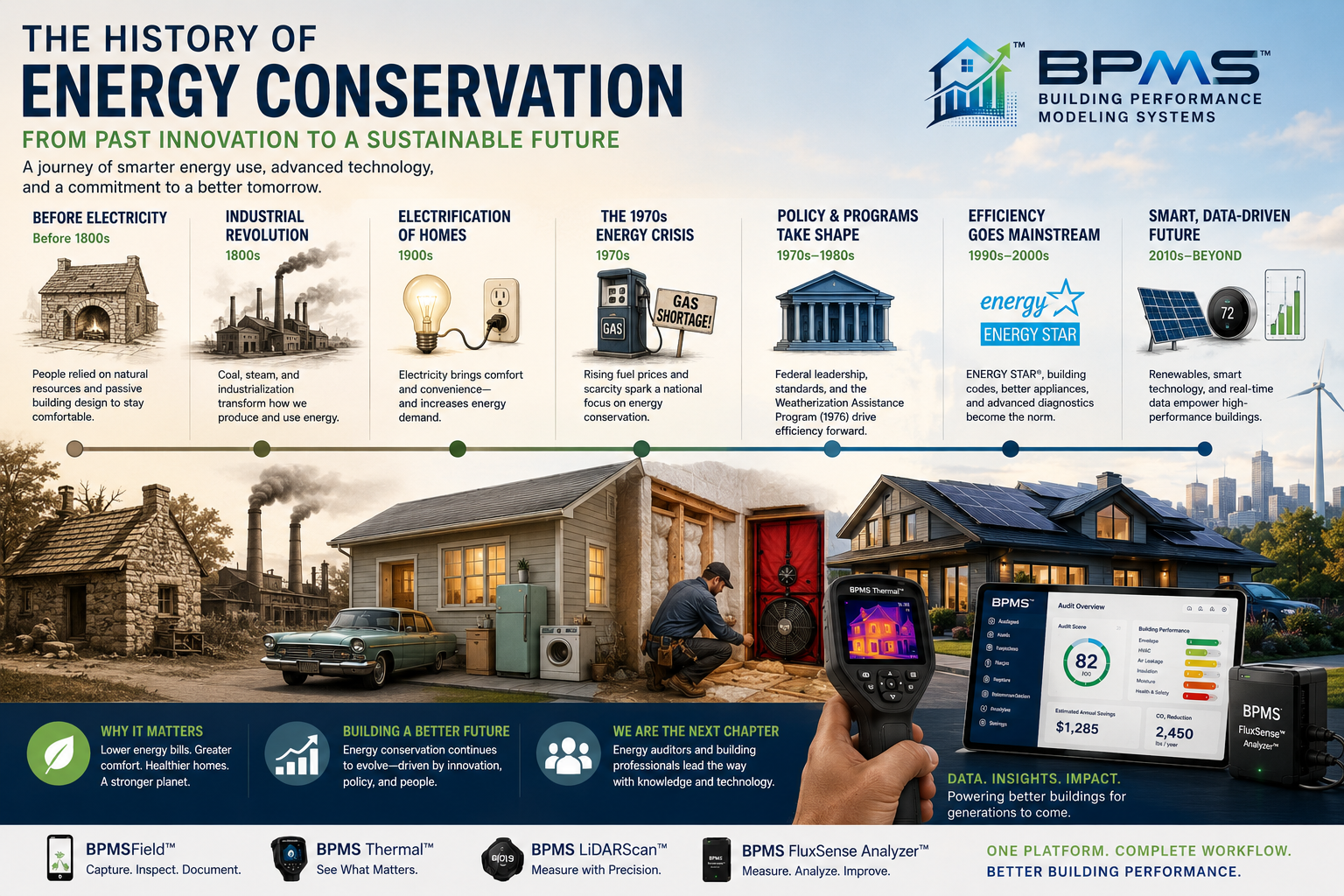
Energy conservation did not begin with solar panels, smart thermostats, or modern energy audits. For centuries, people have adapted buildings and technology to use available energy more effectively. This guide traces the evolution of energy conservation from early passive building practices and industrialization through the 1970s energy crisis, the creation of the U.S. Department of Energy, weatherization, ENERGY STAR®, modern building science, renewable energy, and today’s data-driven building performance technologies.
The History of Energy Conservation: From Fuel Scarcity to Smart, Data-Driven Building Performance
Energy conservation can sometimes feel like a modern idea.
We hear about high-efficiency heat pumps, solar panels, electric vehicles, smart thermostats, energy audits, blower door testing, thermal imaging, net-zero buildings, and sophisticated software capable of modeling how buildings consume energy.
But the fundamental idea behind energy conservation is much older:
How can we accomplish what we need while consuming fewer resources?
Human beings have been answering variations of that question for thousands of years.
What has changed is our ability to measure, understand, predict, and optimize energy use.
The history of energy conservation is therefore more than a history of efficient appliances. It is the story of how society progressed from simply trying to stay warm to scientifically understanding how energy moves through buildings—and ultimately using sensors, software, renewable generation, and building-performance data to make increasingly sophisticated decisions.
For today’s energy auditor, understanding that history provides valuable perspective on why our industry exists and where it may be heading next.
⸻
Before Electricity: Energy Conservation Was Building Design
Long before anyone talked about R-values, ACH50, heat pumps, or kilowatt-hours, builders had to work with their local environment.
There were no central air-conditioning systems capable of correcting a poorly designed building.
Architecture itself had to provide much of the comfort.
Builders used strategies such as thick masonry walls, compact structures, strategically positioned windows, courtyards, shutters, fireplaces, natural ventilation, building orientation, thermal mass, shade, and locally appropriate materials.
In cold climates, buildings often attempted to retain heat.
In hot climates, architecture frequently emphasized shade and natural airflow.
These were early forms of what we now call passive building design.
The fundamental physics haven’t changed.
Modern building science simply gives us much better tools for understanding them.
⸻
The Industrial Revolution Changes Energy Forever
Industrialization dramatically changed humanity’s relationship with energy.
Coal became increasingly important for powering factories, steam engines, transportation, and industrial production.
Later came widespread petroleum use, natural gas, centralized electricity generation, and increasingly sophisticated mechanical systems.
Energy could now accomplish tasks that previously required human labor, animal power, wind, or flowing water.
Buildings changed as well.
Mechanical heating, electric lighting, elevators, appliances, refrigeration, and eventually air conditioning transformed homes and commercial buildings.
Energy consumption became deeply connected with economic development and modern living.
For much of this period, however, the dominant question was:
How can we produce and distribute more energy?
The question of using energy more efficiently would eventually become equally important.
⸻
Electrification Transforms the Home
The expansion of electrical grids fundamentally changed residential life.
Homes gradually gained electric:
* Lighting
* Refrigerators
* Washing machines
* Water heaters
* Cooking equipment
* Fans
* Air conditioners
* Entertainment systems
* Pumps and motors
* Eventually computers and connected devices
These technologies delivered enormous improvements in convenience and quality of life.
But they also created a new challenge.
As homes became increasingly dependent on energy-consuming equipment, the efficiency of that equipment—and the buildings containing it—became economically significant.
⸻
Buildings Become Mechanically Conditioned
Central heating and air conditioning fundamentally changed building design.
Instead of relying entirely on architecture and climate-responsive design, buildings could increasingly create their own indoor environment.
A furnace could compensate for heat loss.
An air conditioner could compensate for solar heat gain.
Mechanical ventilation could move air.
But there was a consequence:
Poor building performance could increasingly be compensated for by consuming more energy.
A leaky building could still remain warm if the furnace was large enough.
An overheated building could remain cool if enough air conditioning was provided.
That approach worked—but it could be expensive and inefficient.
Modern building performance attempts to reverse this logic.
Rather than asking only:
“How large does the HVAC system need to be?”
we increasingly ask:
“How can we reduce the building’s heating and cooling loads first?”
That change in thinking is one of the foundations of modern energy conservation.
⸻
The 1970s: A Turning Point
The energy crises of the 1970s dramatically changed U.S. energy policy.
Oil supply disruptions and rapidly changing energy prices exposed the economic and strategic risks associated with energy dependence.
Energy conservation moved from being primarily an engineering consideration to becoming an issue of national importance.
The federal government expanded energy research, policy development, efficiency initiatives, and conservation programs. DOE’s historical accounts identify the 1970s energy crisis as a major force behind the federal reorganization that ultimately produced today’s Department of Energy.
For Americans, conservation became visible in everyday life.
People increasingly discussed:
* Fuel economy
* Thermostat settings
* Insulation
* Energy-efficient appliances
* Alternative fuels
* Solar energy
* Domestic energy production
The modern energy-efficiency movement was beginning to take recognizable form.
⸻
1975: Energy Efficiency Enters Federal Policy
The Energy Policy and Conservation Act of 1975 (EPCA) was an important milestone.
DOE’s history of appliance standards explains that EPCA established a federal program involving testing procedures, labeling, and energy targets for consumer products. California had already enacted state appliance-efficiency standards in 1974.
This represented an important change.
Efficiency was increasingly becoming something that could be:
measured → compared → standardized → improved
That basic framework remains fundamental to energy conservation today.
⸻
1976: The Weatherization Assistance Program
Another major milestone occurred in 1976 with the establishment of the Weatherization Assistance Program (WAP).
The program was created to help income-eligible households reduce energy costs by improving the energy efficiency of their homes while protecting occupant health and safety.
Since its beginning, DOE reports that WAP has provided weatherization services benefiting more than 7.2 million families.
Weatherization eventually evolved far beyond simple caulking and insulation.
Modern programs may incorporate sophisticated building diagnostics including blower doors, pressure measurements, combustion-safety testing, ventilation assessment, insulation evaluation, and other building-science practices.
This evolution also helped establish the professional role of the modern energy auditor.
⸻
1977: Creation of the U.S. Department of Energy
On August 4, 1977, President Jimmy Carter signed the Department of Energy Organization Act.
The new Department of Energy officially began operations on October 1, 1977.
DOE brought together energy responsibilities that had previously been distributed across numerous federal organizations.
Energy conservation was now part of a much larger national energy strategy involving research, technology, energy security, regulation, data collection, and development.
This institutional framework would influence energy-efficiency technology for decades.
⸻
The 1980s: Efficiency Becomes an Engineering Discipline
During the following decade, engineers, researchers, contractors, utilities, and government programs continued developing more sophisticated approaches to energy conservation.
Buildings increasingly became understood as systems rather than independent collections of components.
Researchers studied interactions among:
* Insulation
* Air leakage
* Moisture
* HVAC equipment
* Duct systems
* Ventilation
* Solar gain
* Windows
* Occupants
* Climate
This helped advance what we now call building science.
The National Appliance Energy Conservation Act of 1987 also established federal minimum efficiency standards for many household appliances and established schedules for reviewing those standards.
Energy conservation was moving beyond simply telling people to consume less.
Increasingly, the goal became:
Make the technology itself perform better.
⸻
The Rise of Diagnostic Energy Auditing
Another major change was occurring inside buildings.
Energy auditors gained access to increasingly sophisticated diagnostic equipment.
Instead of merely inspecting a home visually, professionals could begin measuring how the building actually performed.
One of the most important developments was blower door testing.
A calibrated blower door allows an auditor to create a controlled pressure difference across the building envelope and measure airflow.
From this information, auditors can determine metrics such as:
* CFM50
* ACH50
* Building airtightness
Suddenly, air leakage wasn’t simply:
“This house feels drafty.”
It could be quantified.
That was a major advancement for building performance.
⸻
Thermal Imaging Changes What Auditors Can See
Infrared thermography introduced another major diagnostic capability.
Thermal cameras allow energy professionals to visualize surface-temperature patterns that may indicate:
* Missing insulation
* Insulation defects
* Thermal bridging
* Air leakage
* Moisture-related anomalies
* HVAC distribution problems
When used correctly and under suitable environmental conditions, thermal imaging provides information that cannot be obtained through visual inspection alone.
Combined with blower-door testing, it became an especially powerful diagnostic method.
⸻
1992: ENERGY STAR® Arrives
Another important milestone occurred in 1992, when the U.S. Environmental Protection Agency launched ENERGY STAR.
The program initially focused on computers and displays and later expanded into numerous product categories, homes, commercial buildings, and industrial facilities.
ENERGY STAR helped transform energy efficiency into something consumers could recognize when purchasing products.
Rather than requiring customers to understand complicated engineering specifications, the ENERGY STAR label provided a recognizable efficiency benchmark.
The program subsequently expanded dramatically; EPA reports extensive participation by businesses, utilities, governments, and other organizations.
⸻
The 1990s and 2000s: Efficiency Becomes Mainstream
Energy efficiency continued expanding into virtually every part of the building industry.
Improvements included:
* Higher-efficiency HVAC systems
* Better windows
* Low-E glazing
* Improved insulation systems
* More efficient lighting
* Variable-speed motors
* Better building controls
* Higher-efficiency appliances
* Advanced ventilation
* Improved air sealing
* Building energy modeling
Federal efficiency requirements also continued evolving. The Energy Policy Act of 1992 expanded standards to additional products, while later legislation in 2005 and the Energy Independence and Security Act of 2007 established or updated additional efficiency standards.
Energy efficiency was becoming embedded in product development, construction practices, codes, utility programs, and consumer expectations.
⸻
From Energy Conservation to Building Performance
Eventually, the industry recognized an important limitation.
Replacing individual inefficient components wasn’t enough.
Consider a home with:
* A high-efficiency furnace
* Poor attic insulation
* Significant air leakage
* Leaky ductwork
* Moisture problems
* Poor ventilation
Installing an efficient furnace doesn’t solve the underlying building problems.
The industry therefore increasingly embraced the whole-house approach.
A house is a system.
Changes to one component can affect another.
Air sealing may influence ventilation.
Insulation may change surface temperatures.
Duct sealing may affect pressure relationships.
HVAC replacement may affect combustion safety.
This systems-based understanding is central to modern building performance.
⸻
The Energy Auditor Becomes a Building Scientist
The professional energy auditor evolved accordingly.
Today’s comprehensive residential auditor may need to understand:
* Building enclosure science
* Heat transfer
* Airflow
* HVAC systems
* Combustion
* Moisture
* Ventilation
* Insulation
* Electrical consumption
* Renewable energy
* Building geometry
* Energy modeling
* Indoor environmental quality
Modern auditing is increasingly a diagnostic profession.
Auditors don’t simply look for problems.
They measure building performance.
⸻
Solar Energy Changes the Equation
For much of the history of energy conservation, the primary objective was reducing consumption.
Solar photovoltaic technology introduced another possibility:
Buildings could produce energy as well.
That created two complementary strategies.
Energy efficiency
Reduce the amount of energy the building requires.
Renewable generation
Produce some of the remaining energy requirement locally.
For many buildings, the strongest strategy combines both.
Improve the building first.
Reduce unnecessary loads.
Then evaluate renewable generation against the improved energy demand.
⸻
The Digital Revolution
The next transformation wasn’t primarily insulation, HVAC equipment, or windows.
It was data.
Computers and cloud technology changed how building professionals could analyze energy performance.
Instead of handwritten worksheets and disconnected spreadsheets, professionals gained access to:
* Energy modeling
* Digital audit reports
* Utility analysis
* Automated calculations
* Cloud storage
* Mobile field applications
* Digital photographs
* GPS information
* Customer databases
* Electronic proposals
* Digital work scopes
The energy audit was becoming digital.
⸻
LiDAR and Three-Dimensional Building Data
LiDAR and related spatial technologies have added another layer.
Auditors can increasingly capture building geometry digitally.
Potential applications include:
* Room dimensions
* Wall geometry
* Floor area
* Window and door locations
* Building envelope measurements
* HVAC load calculations
* Digital building models
Accurate geometry matters because building-performance calculations depend heavily on surface areas and volumes.
⸻
Smart Buildings and Connected Devices
Sensors are also changing energy conservation.
Buildings can now collect information about:
* Temperature
* Humidity
* Occupancy
* Electrical consumption
* Equipment operation
* Solar production
* Indoor air quality
* HVAC runtime
* Building pressure
Instead of evaluating performance once, building professionals increasingly have the ability to observe performance over time.
This is an important transition:
Energy auditing is moving from snapshots toward continuous building intelligence.
⸻
Direct Heat-Flow Measurement
Another emerging area is direct measurement of heat transfer through building assemblies.
Traditional energy audits frequently infer thermal performance from known construction characteristics, insulation levels, surface temperatures, and energy models.
Heat-flux sensors offer another source of information by measuring thermal energy flowing through a surface.
This concept is central to the development of the BPMS FluxSense Analyzer™.
The technology is being designed to combine direct heat-flux measurements with temperature and building data so building-performance professionals can analyze how assemblies are performing under actual conditions.
It is important to distinguish this from established code-compliance methods: direct heat-flux measurement is an additional diagnostic input, not automatically a substitute for standardized laboratory R-value testing or program-prescribed procedures.
⸻
The Modern Energy Audit
Today’s comprehensive energy audit may combine information from many sources:
* Visual inspection
* Blower door testing
* ACH50
* Thermal imaging
* HVAC evaluation
* Duct testing
* Combustion testing
* Moisture measurements
* Utility history
* Building geometry
* Insulation assessment
* Solar potential
* Energy modeling
* Photographic documentation
The challenge has therefore changed.
Previously, auditors struggled to obtain enough information.
Today, they increasingly face another problem:
How do we organize all of this information into one useful building-performance model?
⸻
BPMS™ and the Next Generation of Energy Conservation
That challenge is one of the reasons Building Performance Modeling Systems (BPMS™) was developed.
The objective is not simply to digitize an energy-audit form.
It is to create a connected environment in which building-performance professionals can move from:
Field inspection → diagnostics → analysis → recommendations → documentation → project workflow
within a unified platform.
BPMS™ is being developed around this broader vision.
BPMSField™ extends the workflow into the field, allowing professionals to capture building information, photographs, and related audit documentation.
BPMS Thermal™ brings thermal-imaging information into the building-performance record.
BPMS LiDARScan™ is designed to connect spatial building information with the audit workflow.
BPMS Load CalC™ supports building-load analysis.
And the developing BPMS FluxSense Analyzer™ is intended to introduce direct heat-flow measurement into that broader data environment.
The significance isn’t any single technology.
It is the ability to combine multiple forms of building-performance evidence.
⸻
The Future: From Energy Efficiency to Energy Intelligence
The next chapter of energy conservation will likely be less about one revolutionary product and more about connecting technologies that already exist.
Imagine a building-performance system capable of understanding:
Geometry + thermal behavior + air leakage + HVAC performance + weather + utility consumption + renewable production + occupant requirements
as parts of one model.
That is substantially different from the energy audit of decades past.
Software can increasingly identify relationships among measurements, historical consumption, building characteristics, and recommended improvements.
Energy auditors remain critical because data still requires professional interpretation.
Technology should enhance professional judgment—not replace it.
⸻
The Expanding Role of Artificial Intelligence
Artificial intelligence may eventually help building professionals identify patterns across enormous amounts of performance data.
Potential applications include:
* Detecting unusual energy consumption
* Comparing buildings
* Identifying likely efficiency opportunities
* Predicting equipment problems
* Prioritizing retrofit measures
* Evaluating historical utility patterns
* Supporting quality assurance
* Automating repetitive documentation
However, responsible use requires transparent assumptions, reliable data, professional review, and appropriate safeguards.
The future energy auditor may therefore work alongside increasingly sophisticated analytical systems while remaining responsible for understanding the building and validating the conclusions.
⸻
Conservation and the Global Energy Footprint
Energy conservation is no longer only about reducing an individual homeowner’s utility bill.
Buildings collectively represent a major component of global energy demand.
Improving building efficiency can reduce the amount of energy that must be generated, transmitted, purchased, and ultimately consumed.
At scale, efficiency can contribute to:
* Lower household energy expenses
* Reduced peak electricity demand
* Greater grid resilience
* Reduced fuel consumption
* Better housing comfort
* Improved energy security
* More effective integration of renewable energy
Energy conservation has therefore evolved from a household practice into an important component of energy strategy.
⸻
A Timeline of Modern U.S. Energy Conservation
A few milestones help show just how dramatically the industry has evolved:
1974 — California establishes early state appliance-efficiency standards.
1975 — The Energy Policy and Conservation Act establishes a federal framework involving consumer-product testing, labeling, and energy targets.
1976 — The Weatherization Assistance Program begins.
1977 — The U.S. Department of Energy is created and begins operations on October 1.
1987 — The National Appliance Energy Conservation Act establishes minimum efficiency standards for many household appliances.
1992 — EPA launches ENERGY STAR.
2001 — Home Performance with ENERGY STAR launches, further advancing whole-house retrofit concepts.
2005–2007 — Federal legislation expands and updates efficiency standards for numerous products.
2022 — Federal legislation authorizes major new home-efficiency and electrification rebate programs administered through DOE and participating states, territories, and Tribes.
Today — Building performance increasingly incorporates cloud software, connected sensors, thermal imaging, LiDAR, renewable-energy analysis, sophisticated energy models, and advanced field diagnostics.
⸻
What This History Means for Today’s Energy Auditor
There is an important lesson in this history.
Every generation of energy conservation has increased our ability to answer three questions:
Where is energy being wasted?
Why is it being wasted?
What should we do about it?
The earliest builders answered those questions through experience.
Later engineers used calculations.
Energy auditors introduced diagnostic testing.
Building scientists developed whole-building analysis.
Software introduced large-scale data management and modeling.
Connected sensors are now allowing buildings to be observed dynamically.
The tools have changed.
The objective hasn’t:
Understand the building well enough to improve its performance.
⸻
The Next Chapter of Energy Conservation
The history of energy conservation isn’t finished.
We are living through its next stage.
Buildings are becoming measurable in ways previous generations could not have imagined. Energy auditors can quantify air leakage, visualize thermal patterns, digitally capture building geometry, analyze HVAC loads, evaluate solar potential, and increasingly collect sensor data describing actual building performance.
The future will likely connect these technologies even more closely.
Energy conservation may evolve from periodic assessments toward continuous optimization—where buildings can be measured, modeled, compared, improved, and monitored throughout their useful lives.
And that makes the role of the energy professional more important, not less.
Because sophisticated technology still requires someone who understands what the measurements mean.
⸻
Conclusion
The story of energy conservation is ultimately a story of progress.
We moved from designing buildings around limited sources of heat and light to producing enormous quantities of energy.
Then we learned that producing more energy wasn’t the only answer.
We began asking how to use it better.
That question helped drive appliance-efficiency standards, weatherization, the creation of the Department of Energy, ENERGY STAR, modern building science, professional energy auditing, renewable energy, and increasingly sophisticated building-performance technology.
Today, we stand at another transition.
Energy conservation is becoming data-driven building performance.
Platforms such as BPMS™, together with technologies such as BPMSField™, BPMS Thermal™, BPMS LiDARScan™, BPMS Load CalC™, and the developing BPMS FluxSense Analyzer™, represent one approach to connecting the growing amount of information available to today’s building-performance professional.
The future of energy conservation will not simply be about using less energy.
It will be about understanding buildings well enough to use energy intelligently, efficiently, measurably, and responsibly.
And for energy auditors and building-performance professionals, that future is already beginning.
Comments and Reviews
Share what you found helpful and how this article supported your work.
0.0/5from 0 reviews
No reviews yet. Be the first to share your feedback.