Energy News: DOE Workforce Funding, LIHEAP Weatherization and Efficiency Programs
Published 10/12/2026
October 12, 2026: DOE opens a $100 million fellowship pilot, HHS examines LIHEAP weatherization waivers, and Arizona and Hawaiʻi expand efficiency resources and training.
ENERGY INDUSTRY NEWS — OCTOBER 12, 2026
New verified developments since the October 9 roundup
This update focuses on workforce investment, low-income weatherization administration, practical program access, and the cost of serving rapidly growing electric loads. The developments have different statuses: one is an open federal funding opportunity, one is a federal policy position rather than a final market rule, one is a research brief rather than new funding, and two are active state workforce or program-navigation initiatives.
DOE BACKS PJM REFORMS AIMED AT PROTECTING EXISTING RATEPAYERS
On October 9, the U.S. Department of Energy filed a Notice of Intervention and Statement of Position supporting Federal Energy Regulatory Commission guidance for the PJM Interconnection. DOE urged PJM to revise its tariff so large new electricity users bear the cost of the generation and infrastructure required to serve them.
DOE’s position supports a proposed Reliability Backstop Procurement, more transparent demand information, and options for large loads to build, bring or buy the capacity they require. This is not a final PJM tariff and does not guarantee a particular bill reduction. PJM still must respond through the FERC process.
Why it matters: Electrification, efficient HVAC and distributed resources operate inside a grid increasingly shaped by data centers and other large loads. Program administrators and building owners need rate forecasts that separate ordinary building demand from system expansion costs. Auditors should continue to value efficiency as a way to reduce site demand, while avoiding claims that this federal filing alone will change a customer’s rate.
Source: U.S. Department of Energy, October 9, 2026.
https://www.energy.gov/articles/energy-department-supports-fercs-call-pjm-protect-ratepayers-and-build-more-reliable-power
DOE OPENS A $100 MILLION GRADUATE FELLOWSHIP PILOT
DOE announced the Genesis Mission Graduate Fellowship Pilot on October 8. The agency plans up to $100 million, including $20 million in fiscal year 2027; funding in later years depends on congressional appropriations. DOE expects institution-led pilot projects to support an initial cohort of about 100 Ph.D. fellows through four-year programs combining an advanced computing or “Super Intelligence” competency with a scientific or engineering discipline.
This is an open funding opportunity, DE-FOA-0003673, not an award announcement. Domestic doctoral-granting institutions are the intended lead applicants; individual students, contractors and homeowners are not direct applicants. An authorized organizational representative must submit a letter of intent by 5:00 p.m. Eastern on November 9, 2026. Full applications are due January 12, 2027, at 11:59 p.m. Eastern. DOE scheduled an informational webinar for November 4 at 4:00 p.m. Eastern.
Why it matters: Energy analysis, building simulation, grid planning and materials research increasingly combine domain expertise with advanced computing. Universities considering an application should align laboratory and industry placements early and verify every eligibility and submission requirement in the full notice.
Sources: U.S. Department of Energy and DOE Office of Science, October 8, 2026.
https://www.energy.gov/articles/energy-department-launches-genesis-mission-graduate-fellowship-advance-american-scientific
https://science.osti.gov/grants/FOAs/FOAs/2027/DE-FOA-0003673
HHS EXAMINES THE REPEATED LIHEAP WEATHERIZATION-WAIVER PROCESS
On October 6, the U.S. Department of Health and Human Services’ Office of the Assistant Secretary for Planning and Evaluation released an issue brief examining how states used Low Income Home Energy Assistance Program funds for weatherization from fiscal years 2016 through 2024.
LIHEAP grantees may ordinarily direct up to 15 percent of their grants to low-income weatherization and energy-related home repair, or up to 25 percent with an approved waiver. The new brief’s central finding is administrative: states routinely request authority to exceed the standard cap but must repeat the waiver process each year.
This publication does not create a new household benefit, change an application deadline or award additional funds.
Why it matters: For state agencies and community-action networks, an annual waiver affects planning continuity, contractor pipelines and the timing of measures that reduce future energy-assistance needs. Auditors and contractors should still confirm the current allocation and local intake rules rather than assuming that the maximum weatherization share is available in every jurisdiction.
Source: HHS Office of the Assistant Secretary for Planning and Evaluation, October 6, 2026.
https://aspe.hhs.gov/reports/liheap-weatherization-spending-waiver-process
ARIZONA LAUNCHES A NEW ENERGY-EFFICIENCY PROGRAM NAVIGATOR
Arizona’s Governor’s Office of Resiliency launched an “Arizona Energy Efficiency Programs” webpage on October 5 while recognizing October 5–11 as the state’s first Energy Efficiency Week. The page organizes state, local, community and utility resources and builds on the Arizona Clean Energy Hub.
The office reported that Efficiency Arizona had invested nearly $7 million and issued more than 2,000 rebates, while separate state initiatives had put more than $2 million into local efficiency projects. Those are program-to-date figures reported with the October 5 announcement, not a new appropriation announced that day.
Why it matters: A consolidated program directory can reduce referral friction. Auditors and contractors can use it to identify possible incentives, but they should verify current income rules, eligible equipment, assessment requirements and funding availability before placing a rebate in a project proposal.
Source: Arizona Governor’s Office of Resiliency, October 5, 2026.
https://resilient.az.gov/news/arizona-governors-office-resiliency-recognizes-arizona-energy-efficiency-week-launches-new
HAWAIʻI’S FREE ENERGY-EFFICIENCY TRAINING CYCLE MOVES FORWARD
The Hawaiʻi State Energy Office announced its October Training for Residential Energy Contractors schedule on October 2, and the first live course—Intro to Heat Pumps—occurred October 5, inside this reporting period. Remaining free online sessions include Multifamily Energy Auditor Training on October 13 and 15, ENERGY STAR training on October 20 and 22, and Advanced Heat Pumps training on October 26 and 27.
The courses are offered with Hā Sustainability, Hui O Hauʻula and Everblue Training for Hawaiʻi contractors and residents. This is workforce training, not a contractor grant or customer rebate.
Why it matters: The sequence links technology, multifamily auditing and program knowledge. Contractors can use the training to strengthen field practice, while program administrators can use the schedule to build a more consistent delivery network. Registration and any participation requirements should be confirmed on the state page.
Source: Hawaiʻi State Energy Office, announcement October 2; first course held October 5, 2026.
https://energy.hawaii.gov/hawai%CA%BBi-state-energy-office-offers-free-energy-efficiency-trainings-for-hawai%CA%BBi-contractors-and-residents/
EDITORIAL NOTE
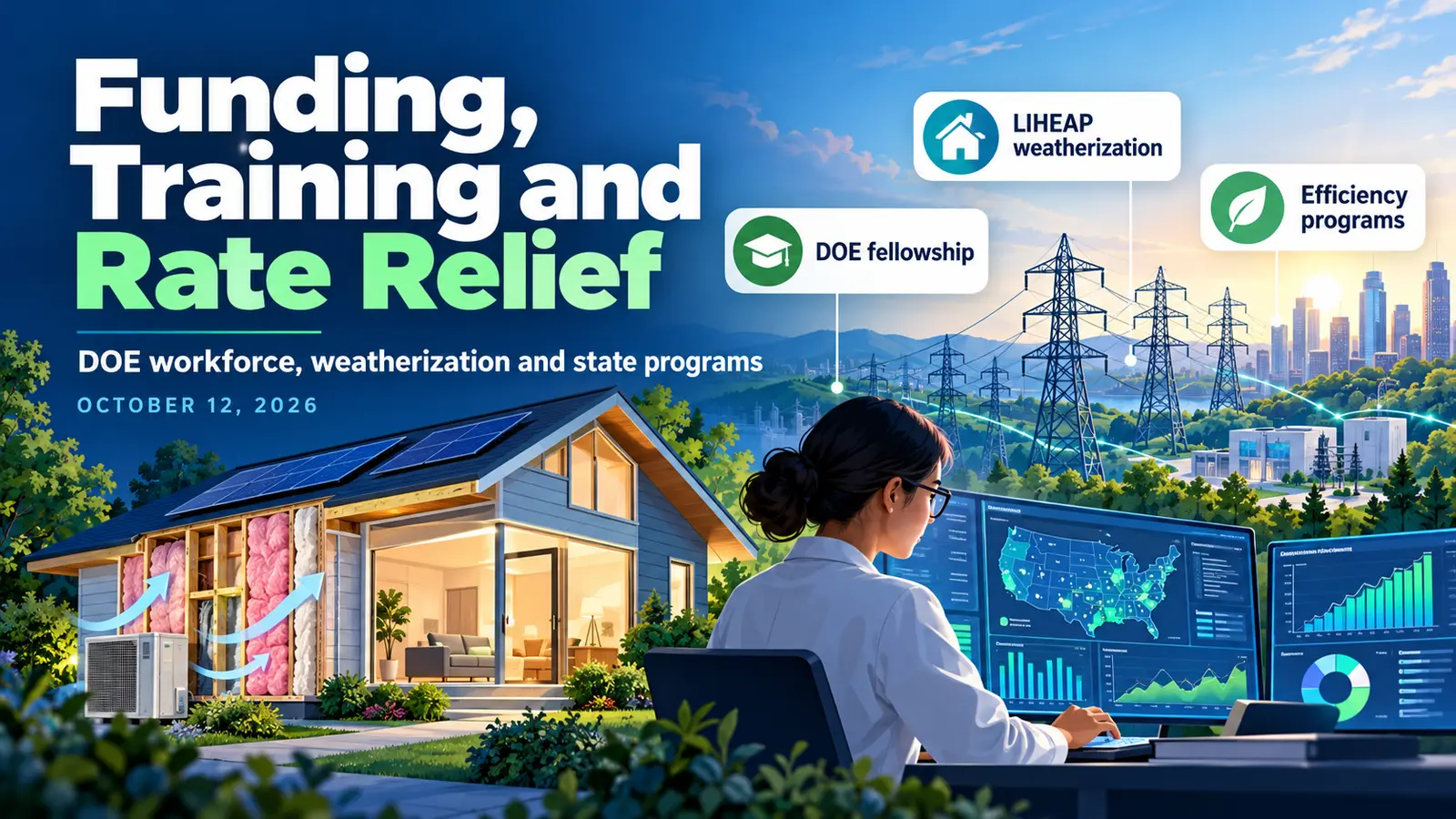
Facts, dates and program status were checked October 12, 2026. “Why it matters” sections are BPMS editorial analysis. The custom cover is a conceptual illustration and does not depict an actual funded project, applicant or government proceeding.
Comments and Reviews
Share what you found helpful and how this article supported your work.
0.0/5from 0 reviews
No reviews yet. Be the first to share your feedback.