Energy News: Virginia Weatherization, DOE Research and New York Grid Planning
Published 10/9/2026
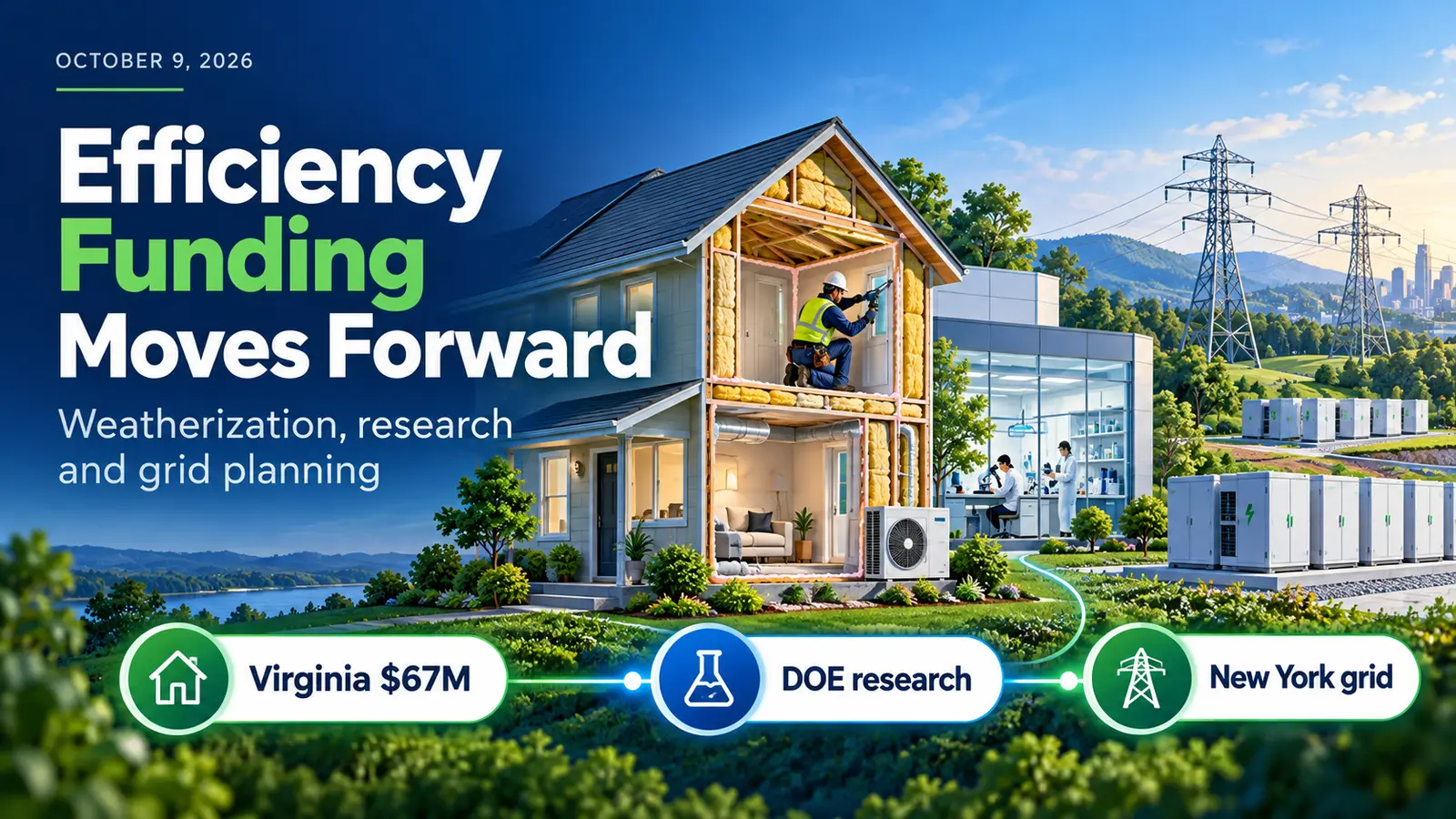
October 9, 2026: Virginia releases $67 million for efficient housing, New York launches grid planning, DOE selects early-career researchers, and ASPECT concept papers are due.
ENERGY INDUSTRY NEWS — OCTOBER 9, 2026
New developments since the October 7 roundup
This update centers on money moving toward weatherization and research, a new planning process for New York’s energy infrastructure, and a federal funding deadline that arrives today. The developments have different legal and program statuses: Virginia released previously withheld funds, DOE announced selections that remain subject to award negotiations, New York announced a planning process rather than project awards, and the ASPECT solicitation remains an open competitive opportunity.
VIRGINIA RELEASES $67 MILLION FOR HOME ENERGY-EFFICIENCY PROJECTS
On October 8, Virginia announced the release of more than $67 million in previously withheld Regional Greenhouse Gas Initiative funds for two housing programs.
Of that total, $15 million is assigned to the Weatherization Deferral Repair program. The program addresses conditions such as leaking roofs, structural defects, electrical or plumbing problems, mold, moisture and water damage that can prevent a home from proceeding through the federal Weatherization Assistance Program. Virginia says this funding will support critical repairs in more than 1,000 homes.
The remaining $52 million goes to the Affordable and Special Needs Housing program to incorporate enhanced energy-efficiency standards into affordable-housing construction, rehabilitation and adaptive reuse.
Eligible Virginians can seek weatherization repair and upgrade assistance through their local weatherization provider. Virginia’s Department of Housing and Community Development administers the repair and federal weatherization programs through 15 providers statewide.
Why it matters: Deferral repairs are a practical bottleneck in weatherization. An auditor may identify insulation and air-sealing opportunities, but unsafe wiring, roof leaks or moisture damage can stop energy work from proceeding. Funding repairs before efficiency measures can allow more homes to complete the full weatherization process.
Source: Virginia Department of Housing and Community Development, October 8, 2026.
https://www.dhcd.virginia.gov/governor-spanberger-announces-67-million-home-energy-efficiency-projects-lower-energy-bills
NEW YORK STARTS A NEW ENERGY INFRASTRUCTURE PLANNING PROCESS
NYSERDA announced on October 8 that the State Energy Planning Board will meet December 9 to begin developing New York’s Energy Infrastructure Development Plan.
This announcement does not award money to individual projects. It starts a coordinated planning process intended to identify generation, transmission, storage, distribution and other infrastructure needs as electricity demand grows. NYSERDA says the process will use existing State Energy Plan, Public Service Commission and NYISO analysis and will examine risks such as fuel-price volatility, extreme weather, siting conflicts and capital-cost increases.
The state expects an interim plan in 2027 and the first comprehensive plan by December 2029. NYSERDA says public and industry engagement opportunities will be included.
Why it matters: Building electrification, heat pumps, electric water heating, EV charging and distributed energy resources ultimately depend on grid capacity and rate impacts. Auditors and contractors will still make decisions building by building, but program administrators and policymakers need infrastructure forecasts that connect those projects to feeder, distribution and bulk-system needs.
Source: NYSERDA, October 8, 2026.
https://www.nyserda.ny.gov/About/Newsroom/2026-Announcements/2026-10-08-NYSERDA-Announces-SEPB-Mtg-Kick-Off-New-Energy-Infrastructure-Dev-Plan-Process
DOE SELECTS 67 EARLY-CAREER RESEARCHERS FOR $96 MILLION
DOE’s Office of Science announced on October 8 that 67 early-career scientists were selected for a combined $96 million through the 2026 Early Career Research Program. The selections span 39 universities, 11 DOE national laboratories and user facilities, and 26 states.
The status requires careful wording. DOE states that selection for award negotiations is not a commitment to issue an award or provide funding. Negotiations must occur before money is issued, and DOE may cancel negotiations or rescind a selection.
DOE describes university awards as approximately $875,000 over five years and national-laboratory or user-facility awards as approximately $2.75 million over five years. Research areas include advanced computing, fusion and quantum science.
Why it matters: This is research-pipeline funding, not a building rebate or contractor grant. Its practical relevance is longer-term: early-stage scientific research can contribute to future materials, controls, computing and energy technologies, while the program also develops technical talent across universities and national laboratories.
Source: U.S. Department of Energy, October 8, 2026.
https://www.energy.gov/articles/us-department-energy-awards-96-million-67-early-career-scientists
DOE ASPECT CONCEPT PAPERS ARE DUE TODAY
DOE’s ASPECT opportunity, DE-FOA-0003647, reaches a required milestone today, October 9. Concept papers are due at 5:00 p.m. Eastern and are required for applicants that want to proceed to the Stage 1 application.
The opportunity offers up to $58 million for research, development and pre-pilot testing of technologies that produce chemicals from alternative and waste feedstocks. DOE lists a Stage 1 application deadline of December 1, 2026 and a Stage 2 deadline of February 12, 2027. The federal listing identifies eligibility as unrestricted, subject to the clarifications in the full notice. This is an open competitive opportunity, not an award announcement.
Why it matters: Organizations that did not submit a compliant concept paper by today’s deadline cannot move into the next application stage. Applicants should rely on the current DOE eXCHANGE documents and modifications, not an older summary, when confirming eligibility, cost share, topic fit and submission requirements.
Sources: U.S. Department of Energy and Simpler.Grants.gov, checked October 9, 2026.
https://www.energy.gov/cmei/fuels/funding-notice-accelerating-scale-and-pre-piloting-emerging-chemical-technologies-aspect
https://simpler.grants.gov/opportunity/c3966c70-b343-4146-9946-608e95c11dff
EDITORIAL NOTE
Facts and program status were checked on October 9, 2026. Practical implications labeled “Why it matters” are BPMS editorial analysis. The cover image is a conceptual illustration and does not depict an actual funded property, award recipient or government event.
Comments and Reviews
Share what you found helpful and how this article supported your work.
0.0/5from 0 reviews
No reviews yet. Be the first to share your feedback.