Energy Auditor Career Outlook: Why Building Performance Could Become One of the Most Important Energy Careers of the Next Decade
Published 8/24/2026
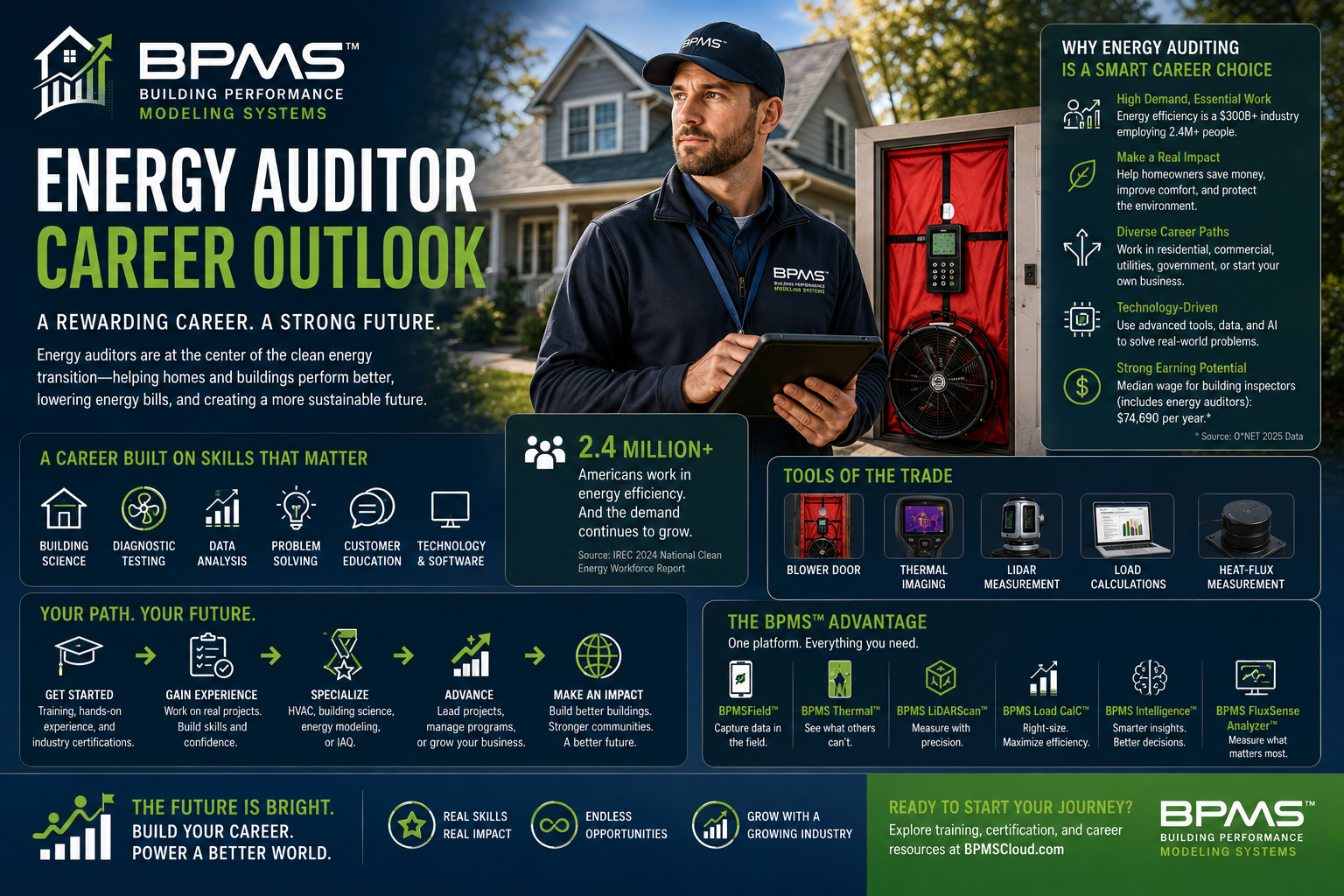
Energy auditing is evolving from a specialized inspection service into a technology-driven building-performance profession. As homeowners, contractors, utilities, weatherization programs, and building owners seek greater efficiency, electrification, better indoor comfort, and measurable energy savings, skilled energy auditors are increasingly positioned at the center of the transition. Explore the career outlook, income opportunities, certifications, skills, technology, business opportunities, and future of the professional energy auditor.
Energy Auditor Career Outlook: Why Building Performance Could Become One of the Most Important Energy Careers of the Next Decade
There is an important transformation taking place inside America’s homes and buildings.
Heating and cooling equipment is changing.
Heat pumps are becoming increasingly common.
Buildings are becoming tighter.
Ventilation requirements are becoming more important.
Energy codes continue to evolve.
Solar energy and battery storage are changing how households think about electricity.
Utilities are paying closer attention to demand and efficiency.
Governments continue investing in weatherization and energy-efficiency programs.
Homeowners are asking why their utility bills are high, why certain rooms are uncomfortable, and whether expensive upgrades will actually solve their problems.
Somebody has to connect all of these pieces.
That professional is increasingly the energy auditor.
The energy auditor of the future will not simply walk through a house with a clipboard and identify missing insulation.
The profession is evolving toward something much broader:
A building-performance specialist who can measure a building, understand the physics controlling it, analyze its energy systems, diagnose inefficiencies, interpret sophisticated data, and translate those findings into practical improvements.
That creates an interesting career opportunity for people entering the energy industry today.
The U.S. clean-energy workforce is already enormous. IREC reports that energy efficiency alone accounted for approximately 2.4 million U.S. workers, making it the largest clean-energy employment segment in its latest reported figures.
Energy auditing sits directly within that larger ecosystem.
So what does the career outlook really look like?
Let’s examine it.
⸻
What Does an Energy Auditor Actually Do?
An energy auditor evaluates how a building uses energy and identifies opportunities to improve its performance.
The U.S. Department of Energy’s Better Buildings Workforce Guidelines describe a building energy auditor as an energy professional who assesses building systems and site conditions and analyzes equipment and performance to identify energy-saving opportunities.
In residential work, that may mean evaluating a home’s building envelope, insulation, air leakage, HVAC equipment, ducts, windows, water heating, ventilation, appliances, utility consumption, moisture conditions, and other factors.
The auditor may use diagnostic equipment such as blower doors, manometers, infrared cameras, moisture meters, airflow instruments, combustion-analysis equipment where applicable, and increasingly digital building-measurement technologies.
But the real job is not simply collecting measurements.
It is answering:
Where is energy being wasted?
Why is it happening?
How significant is the problem?
What should the building owner do about it?
Which improvements should happen first?
That makes energy auditing a combination of building science, technical investigation, data analysis, customer education, and project planning.
⸻
Energy Auditing Is Becoming a Much Broader Profession
Historically, the phrase “energy auditor” might have suggested someone who reviewed utility bills and looked at insulation.
That description is increasingly outdated.
Modern energy auditors can work with:
Building Science + HVAC + Diagnostics + Energy Modeling + Construction + Software + Data Analysis + Customer Consulting
A residential auditor may need to understand pressure relationships and ACH50.
A commercial auditor may evaluate lighting, controls, mechanical systems, schedules, and operational loads.
A weatherization auditor may develop a prioritized scope of work.
An HVAC-focused professional may connect building-envelope performance with heating and cooling loads.
A home-performance consultant may combine energy analysis with comfort, moisture, and indoor-air-quality investigations.
Energy auditing is therefore becoming less like a single task and more like a professional building-performance discipline.
⸻
Is Energy Auditing a Growing Career?
There is an important statistical complication when answering this question.
The U.S. Bureau of Labor Statistics does not currently maintain a dedicated Occupational Outlook Handbook category with a modern standalone projection specifically for “Energy Auditor.” O*NET classifies Energy Auditors separately as occupation 47-4011.01 but uses the broader Construction and Building Inspectors occupation for wage and employment trend data.
For that broader occupation, O*NET reports a 2025 median wage of approximately $74,690 annually, or $35.91 per hour, while BLS projects construction and building inspector employment to decline about 1% from 2024 through 2034 but still expects roughly 14,800 openings per year, mainly from replacement needs.
Those numbers should not be interpreted as a precise forecast for energy auditors.
Energy auditing intersects with several faster-changing industries—including energy efficiency, HVAC, weatherization, building performance, sustainability, and clean energy—that are not captured neatly by one occupational code.
And the surrounding energy-efficiency labor market is substantial.
IREC’s latest workforce reporting describes energy efficiency as employing roughly 2.4 million U.S. workers, with employment increasing approximately 2% from the previous year in the cited data.
That broader context is important when evaluating the long-term opportunity.
⸻
Why Demand for Energy Auditors Exists
Buildings consume energy every day.
Many buildings also waste energy every day.
They experience:
High utility costs.
Air leakage.
Poor insulation.
Improper HVAC sizing.
Duct leakage.
Moisture issues.
Ventilation problems.
Comfort complaints.
Inefficient equipment.
At the same time, property owners are being offered increasingly sophisticated solutions.
Heat pumps.
High-performance windows.
Air sealing.
Weatherization.
Solar.
Battery storage.
Smart controls.
Mechanical ventilation.
The homeowner’s challenge is no longer a lack of products.
It is determining which solution actually makes sense for the building.
That creates a natural role for the energy auditor.
⸻
Energy Auditors Sit at the Beginning of the Improvement Process
Think about a typical home-performance project.
Before somebody installs a $15,000 HVAC system, $25,000 window package, $8,000 insulation project, or $30,000 solar array, it can be valuable to understand the building first.
The energy auditor provides that baseline.
The process becomes:
Measure the building → Diagnose the problem → Prioritize improvements → Implement improvements → Verify results
That makes the energy auditor an important participant at the front of potentially substantial construction and energy investments.
And as homes become more technologically sophisticated, the importance of accurate diagnosis can increase.
⸻
The Weatherization Industry Creates a Major Career Path
One of the established career pathways for residential energy auditors is the Weatherization Assistance Program.
Weatherization programs require professionals who understand building science, diagnostics, health and safety, energy analysis, and retrofit planning.
The federal government has also specifically supported energy-auditor workforce development. DOE materials describing the Energy Auditor Training program state that the initiative supports training workers for placement into energy-auditor jobs and developing pipelines into the profession.
For somebody entering building performance, weatherization can provide structured experience with real homes and real diagnostic procedures.
It can also lead to broader opportunities in home performance, utilities, HVAC, energy consulting, and private auditing businesses.
⸻
Utility Companies Need Building-Performance Professionals
Utilities have long used energy audits as part of efficiency and demand-management programs.
Energy auditors may work directly for:
Utility companies.
Utility implementation contractors.
Energy-efficiency program administrators.
Consulting firms.
Home-performance companies.
Historically, BLS has specifically noted that some energy auditors work full time for utilities that offer energy audits to customers, while others work independently for residential or commercial building owners.
That diversity of employment models remains one of the attractive characteristics of the profession.
An auditor can potentially work for an organization—or build a business.
⸻
HVAC Is Becoming Increasingly Connected to Energy Auditing
HVAC and energy auditing are moving closer together.
A heating or cooling system cannot be properly understood without considering the building it serves.
Heating and cooling loads depend partly on:
Insulation.
Air leakage.
Windows.
Orientation.
Climate.
Internal loads.
Ventilation.
Duct conditions.
This means an HVAC contractor who understands building science has a significant advantage over one who evaluates only the mechanical equipment.
An energy auditor who also understands HVAC can therefore become extremely valuable.
Rather than saying:
“Your equipment needs to be replaced.”
the professional can say:
“Here is how your building envelope, air leakage, duct system, and calculated heating and cooling loads affect the equipment you actually need.”
That is a much stronger professional position.
⸻
The Growth of Heat Pumps Creates Another Opportunity
The transition toward high-efficiency heat pumps reinforces the need for accurate building assessment.
Heat-pump performance depends heavily on proper equipment selection, climate conditions, building loads, distribution systems, and installation quality.
If the building load is misunderstood, equipment selection can suffer.
If the envelope performs poorly, the equipment must compensate.
If duct systems are deficient, the homeowner may still experience poor comfort.
That means energy auditors who understand both building science and HVAC load analysis may become particularly valuable as electrification expands.
⸻
New Construction Creates Another Market
Energy auditing is not limited to existing homes.
Modern energy codes increasingly include building-envelope performance requirements, including air-leakage testing in many jurisdictions.
That creates opportunities for professionals who perform:
Blower door testing.
ACH calculations.
Code-compliance verification.
Diagnostic troubleshooting.
Air-sealing verification.
Final testing.
Documentation for builders and building departments.
This gives energy auditors another potential customer base:
Builders and HVAC contractors.
Instead of relying exclusively on homeowners seeking voluntary energy audits, professionals can participate in construction workflows where performance testing may be required.
⸻
Home Energy Score Creates a Specialized Career Path
The U.S. Department of Energy’s Home Energy Score program provides another pathway into residential energy assessment.
Qualified assessors evaluate home energy assets using a standardized methodology and provide homeowners with a score and recommendations.
Energy professionals who combine Home Energy Score expertise with broader diagnostic auditing may be able to offer a more comprehensive service.
The future of residential energy consulting will likely reward professionals who can provide more than one narrow assessment.
⸻
Professional Credentials Matter
Building science requires real knowledge.
Professional credentials can help demonstrate that knowledge to customers, employers, utilities, and government programs.
The Building Performance Institute currently offers several relevant certification pathways.
The Building Analyst Technician (BA-T) credential is positioned by BPI as an entry point for professionals beginning careers in home performance and focuses on collecting building information and performing diagnostic testing.
The Building Analyst Professional (BA-P) advances into energy modeling, building-system analysis, data evaluation, and prioritized home-performance recommendations.
BPI’s Home Energy Professional Energy Auditor certification is an advanced credential focused on evaluating residential energy efficiency, health, and safety using diagnostic equipment and modeling software to develop prioritized improvement scopes.
DOE also maintains recognized home-energy-auditor certification programs for purposes connected with the federal Energy Efficient Home Improvement Credit.
Credentials do not replace experience.
But they can create a structured pathway for developing professional competence.
⸻
The Modern Energy Auditor Needs More Than Certification
Certification can establish foundational knowledge.
Long-term career growth depends on continuing to learn.
The strongest energy auditors increasingly understand the complete building-performance environment.
That means becoming comfortable with subjects including building-envelope science, airflow, HVAC, moisture, ventilation, diagnostics, energy modeling, reporting, and customer communication.
Technology is adding another layer.
The auditor who can operate diagnostic equipment but cannot work efficiently with modern software may eventually be disadvantaged.
Likewise, an auditor who understands software but lacks fundamental building-science knowledge may produce polished reports without understanding what the measurements mean.
The strongest professionals combine both.
⸻
Blower Door Testing Is Becoming a Core Skill
One of the most recognizable tools in modern residential energy auditing is the blower door.
It allows professionals to quantify building-envelope leakage rather than simply guessing whether a house is “drafty.”
Auditors should understand concepts such as:
CFM50.
ACH50.
Pressure.
Building volume.
Leakage pathways.
Air barriers.
Combustion considerations.
Ventilation implications.
A professional who can perform blower door testing, interpret the results, explain them clearly, and translate the findings into practical recommendations offers substantially more value than someone who simply records a number.
⸻
Thermal Imaging Is Another Valuable Skill
Infrared cameras have become increasingly accessible.
Professional interpretation remains the important part.
Thermal patterns can potentially indicate:
Missing insulation.
Air leakage.
Thermal bridging.
Moisture.
HVAC distribution problems.
But a thermal image does not automatically identify the cause.
Successful energy auditors understand how to combine thermography with visual inspection, pressure testing, moisture measurements, and construction knowledge.
That ability to interpret multiple forms of evidence is one of the skills that separates sophisticated building-performance professionals from basic inspectors.
⸻
LiDAR and Digital Building Measurement Are Changing Fieldwork
Building measurement has traditionally involved:
Tape measures.
Laser distance meters.
Sketches.
Hand calculations.
Those tools remain useful.
But LiDAR-equipped mobile devices are introducing another approach.
Digital geometry can support:
Room dimensions.
Wall areas.
Window and door measurements.
Building volume.
Load calculations.
Energy models.
Work scopes.
The career implication is important.
Tomorrow’s auditor may spend less time manually recreating building geometry and more time analyzing the resulting performance information.
⸻
Software Is Becoming Part of the Professional Skill Set
Energy auditing historically involved substantial paperwork.
A typical professional might have used:
Paper audit forms.
A digital camera.
Spreadsheet calculations.
Separate thermal-image software.
Separate load-calculation software.
Word-processing templates.
PDF reports.
Proposal software.
Accounting software.
The industry is gradually moving toward connected digital workflows.
That means software competency is becoming part of the professional skill set.
Energy auditors who can move efficiently from field data to analysis to customer reporting may be able to complete more projects while maintaining better documentation.
⸻
Artificial Intelligence Will Change the Job—but Probably Not in the Way People Think
Artificial intelligence naturally raises an important question:
Will AI replace energy auditors?
Building performance provides a good example of why the answer is more complicated.
AI can help:
Analyze structured data.
Find missing information.
Draft reports.
Explain measurements.
Identify unusual values.
Compare projects.
Organize photographs.
Surface patterns.
But AI cannot physically enter an attic.
It cannot independently confirm whether insulation is wet.
It cannot safely perform every diagnostic procedure.
It cannot know whether a thermal anomaly is caused by moisture or missing insulation without supporting information.
And it cannot replace responsibility for professional judgment.
Instead, the likely evolution is:
Energy auditors who effectively use AI and advanced software may become more productive than auditors who do not.
The job changes.
It does not disappear.
⸻
The Energy Auditor Becomes a Data Professional
Today’s auditor collects measurements.
Tomorrow’s auditor may manage a complete digital building-performance dataset.
That could contain:
Building geometry.
Air leakage.
Thermal imagery.
HVAC loads.
Utility history.
Insulation characteristics.
Weather.
Indoor conditions.
Moisture readings.
Solar potential.
Heat-flux measurements.
Historical improvements.
The professional’s value increasingly comes from understanding how these data relate.
This moves the occupation toward something closer to:
Building Performance Analyst
rather than simply:
Energy Inspector
⸻
Direct Heat-Flux Measurement Could Add Another Dimension
Traditional audits typically infer envelope performance through known materials, insulation levels, thermal imaging, modeling, and energy consumption.
Emerging field technologies may increasingly add direct sensor data.
Heat-flux measurement, for example, can measure thermal energy moving through an assembly.
This is part of the concept behind the developing BPMS FluxSense Analyzer™.
For future energy auditors, connected measurement devices could make the profession increasingly quantitative.
Instead of relying solely on assumptions about how a wall should perform, professionals may gain more tools for evaluating how assemblies are actually behaving under field conditions.
⸻
Energy Auditor Salary: What Can You Earn?
Compensation varies substantially.
There is no single authoritative national salary specifically representing every type of energy auditor because the profession crosses multiple occupational categories.
As noted earlier, O*NET maps Energy Auditors to the broader Construction and Building Inspectors wage dataset and reports a 2025 median of approximately $74,690 annually. This figure is useful as context, but it should not be interpreted as the exact national median for dedicated energy-auditor positions.
Actual earnings can vary according to:
Geographic region.
Residential versus commercial work.
Certifications.
Years of experience.
Technical specialization.
Employer.
Project volume.
Whether the auditor is an employee or independent contractor.
Advanced professionals who expand into HVAC analysis, commercial auditing, consulting, program management, quality assurance, or business ownership may have different earning potential than entry-level residential auditors.
⸻
Employment vs. Business Ownership
One of the most interesting aspects of energy auditing is the opportunity to choose different career structures.
Some professionals want stable employment.
Others want independence.
Energy auditing can accommodate both.
An employed auditor may work for a utility contractor, weatherization organization, government program, consulting company, HVAC contractor, engineering organization, or home-performance business.
An independent auditor can potentially build relationships with homeowners, builders, HVAC companies, insulation contractors, real-estate professionals, utility programs, and other industry partners.
BLS has historically described both employment and self-employed models within the profession.
For entrepreneurial professionals, the career can therefore evolve into a business.
⸻
Building an Energy Auditing Business
The business model becomes more attractive when the professional stops thinking of the audit as a single isolated service.
Consider the potential customer lifecycle.
A homeowner requests an audit.
The auditor identifies excessive air leakage.
The homeowner needs air sealing.
The auditor identifies inadequate insulation.
The homeowner needs insulation.
The auditor discovers HVAC sizing concerns.
The customer needs load analysis.
The auditor identifies duct leakage.
The customer needs duct improvements.
The homeowner wants solar.
The building’s post-efficiency consumption can be evaluated before sizing the solar project.
An audit can therefore sit near the beginning of a much larger home-performance workflow.
⸻
Potential Energy-Auditor Revenue Streams
A sophisticated building-performance business can potentially offer services including energy audits, blower door testing, ACH and code-compliance reporting, thermal imaging, duct leakage testing, Home Energy Score assessments, HVAC load calculations, weatherization assessments, quality-control inspections, consulting, post-retrofit verification, and building-performance analysis.
Not every professional will offer every service, and qualification requirements vary.
But the broader lesson is important:
The more building-performance problems you are qualified to solve, the more valuable your expertise can become.
⸻
The Energy Auditor as a Trusted Advisor
The strongest career opportunity may ultimately come from positioning the auditor as an independent source of information.
Homeowners are constantly being sold products.
Window companies sell windows.
HVAC companies sell HVAC systems.
Solar companies sell solar panels.
Insulation companies sell insulation.
Each may offer an excellent product.
But the homeowner still needs to know:
Which problem should I solve first?
That is where an energy auditor can provide enormous value.
A professional diagnosis can help the homeowner make better decisions before spending substantial money.
That can create trust.
And trust creates referrals.
⸻
Customer Communication May Become One of the Most Valuable Skills
Building science can become highly technical.
Homeowners usually do not want a lecture about pressure boundaries, latent loads, U-values, stack effect, and vapor diffusion.
They want to know:
Why is the bedroom cold?
Why is the bill high?
What should I fix?
How much could it help?
What should I do first?
A successful energy auditor needs the ability to translate technical information into understandable recommendations.
That skill may become even more valuable as diagnostic technology becomes more sophisticated.
The better the tools become, the more important clear interpretation becomes.
⸻
Where Energy Auditors Can Work
The career is unusually flexible because building performance intersects with many industries.
Potential employers and markets include utility programs, weatherization organizations, HVAC contractors, home-performance companies, engineering and energy-consulting firms, local or state programs, builders, energy-efficiency contractors, sustainability organizations, commercial property organizations, and independent consulting.
DOE’s Better Buildings Workforce Guidelines were created partly to strengthen career pathways around building energy auditing and related energy professions, reflecting the institutional recognition of building-energy expertise as a professional workforce category.
⸻
Residential vs. Commercial Energy Auditing
There are also two broad career directions.
Residential energy auditing focuses on homes.
Professionals may work with:
Blower doors.
Insulation.
HVAC.
Ducts.
Windows.
Moisture.
Home Energy Score.
Weatherization.
Residential energy modeling.
Commercial energy auditing can involve much larger systems.
Professionals may evaluate:
Central plants.
Large HVAC systems.
Lighting.
Controls.
Building automation.
Schedules.
Motors.
Pumps.
Building operations.
Commercial energy use.
Some professionals eventually specialize.
Others progress from residential work into more complex commercial analysis.
⸻
Building Commissioning Is a Potential Career Progression
Energy auditors interested in larger commercial buildings may eventually expand into building commissioning.
Commissioning professionals evaluate whether building systems are installed, controlled, and operating as intended.
DOE’s Better Buildings Workforce Guidelines recognize both Building Energy Auditor and Building Commissioning Professional as key energy-related workforce roles.
That illustrates how energy auditing can serve as a foundation for broader building-performance careers.
⸻
Energy Management Is Another Career Direction
Some professionals eventually move beyond individual audits into ongoing facility energy management.
Instead of evaluating one building once, they may manage energy performance across:
A school district.
Hospital network.
Corporate portfolio.
Government facilities.
Multifamily portfolio.
Industrial facilities.
That work can involve continuous data analysis, operational optimization, benchmarking, equipment upgrades, and capital planning.
Again, building-science and energy-analysis skills create the foundation.
⸻
The Clean-Energy Transition Expands the Context
Energy auditing should also be viewed in the context of the broader clean-energy economy.
IREC’s reporting indicates that energy efficiency remains the largest clean-energy employment sector, while solar and storage together employed hundreds of thousands of U.S. workers in the latest reported period.
Buildings sit at the intersection of these industries.
A homeowner may simultaneously consider:
Envelope improvements.
Heat pumps.
Solar.
Battery storage.
Smart controls.
That makes someone who understands the building as a system particularly valuable.
⸻
Energy Auditors and Solar Professionals Can Work Together
Solar calculates how much energy can be produced.
Energy auditing helps determine how much energy the building actually needs.
Those two disciplines complement one another.
A logical high-performance strategy can be:
Audit → Improve efficiency → Recalculate consumption → Evaluate solar
That can help homeowners better understand the relationship between energy conservation and renewable generation.
An energy auditor who understands solar fundamentals can therefore participate in a broader customer conversation.
⸻
The Future Energy Auditor Will Probably Be More Specialized—and More Versatile
That sounds contradictory.
It isn’t.
Professionals may specialize in areas such as:
Building-envelope diagnostics.
HVAC.
Weatherization.
Commercial buildings.
Indoor environmental quality.
Utility programs.
But they will simultaneously need broader knowledge of the systems surrounding their specialty.
The result could be professionals who are exceptionally strong in one area but still understand the building as a complete system.
That is exactly how many advanced professions evolve.
⸻
Technology Will Increase Auditor Productivity
Imagine two auditors.
The first:
Takes handwritten notes.
Uses a phone camera.
Manually enters everything later.
Recreates calculations in spreadsheets.
Builds reports manually.
The second:
Captures project data directly in the field.
Associates photos with the audit.
Imports thermal information.
Uses LiDAR for building geometry.
Automatically calculates required metrics.
Generates reports from structured data.
Uses AI to review completeness and draft explanations.
The second professional may be able to deliver a substantially more efficient workflow.
Technology therefore affects not only convenience.
It can affect professional capacity and business economics.
⸻
BPMSField™ and the Energy Auditor Career
BPMSField™ represents the mobile side of that transformation.
The goal is to allow auditors to collect building-performance information directly in the field and keep it connected with the appropriate project.
That includes workflows around field documentation, photographs, thermal imagery, LiDAR data, and other audit information.
For an individual professional, this reduces administrative friction.
For a company, it can help standardize how multiple auditors collect project information.
⸻
BPMS Thermal™ and Diagnostic Expertise
Thermal imaging is increasingly valuable in home-performance work.
BPMS Thermal™ is designed to bring infrared information into the same project record as the audit.
The important career lesson isn’t simply learning how to operate a thermal camera.
It is learning how to interpret the image within the context of building science.
That expertise cannot be replaced by simply owning the equipment.
⸻
BPMS LiDARScan™ and the Digital Auditor
BPMS LiDARScan™ is designed around capturing building geometry using compatible LiDAR technology.
For the energy auditor, this represents a broader shift.
The building is becoming digital.
Walls.
Rooms.
Doors.
Windows.
Openings.
Areas.
Volumes.
Once geometry becomes structured data, it can support multiple downstream workflows.
That makes the future auditor increasingly similar to a field data specialist as well as a building scientist.
⸻
BPMS Load CalC™ and the Energy-Auditor/HVAC Connection
An energy auditor who can understand heating and cooling loads has additional value.
BPMS Load CalC™ connects building information with HVAC load analysis.
This helps professionals understand how:
Air leakage.
Insulation.
Windows.
Climate.
Orientation.
Building geometry.
affect HVAC requirements.
As electrification and heat-pump adoption expand, the relationship between building-envelope performance and equipment sizing becomes increasingly important.
⸻
BPMS Intelligence™ and the AI-Assisted Auditor
The amount of information generated during modern audits can be enormous.
BPMS Intelligence™ is intended to help professionals interpret that information.
Potential assistance can include:
Identifying missing data.
Highlighting unusual measurements.
Connecting related findings.
Drafting customer explanations.
Organizing recommendations.
Preparing report summaries.
The auditor remains responsible for professional review.
But AI can reduce repetitive administrative work.
That may allow future auditors to spend proportionally more time on the higher-value portions of the profession:
Testing. Diagnosing. Advising.
⸻
BPMS FluxSense Analyzer™ and the Future of Measurement
The developing BPMS FluxSense Analyzer™ represents another possible evolution.
Traditional audits frequently infer thermal performance.
Direct heat-flux measurement introduces additional field data describing thermal energy flow through assemblies.
If field sensing continues expanding, future auditors may work with much richer datasets than today’s professionals.
The profession could move increasingly from periodic inspection toward measured building-performance intelligence.
⸻
Will Energy Audits Eventually Become Continuous?
Traditionally, an energy audit is a moment in time.
The auditor arrives.
The building is tested.
The report is generated.
The auditor leaves.
But connected sensors could change that model.
Future buildings may continuously monitor:
Temperature.
Humidity.
Energy consumption.
HVAC operation.
Indoor air quality.
Solar generation.
Possibly envelope-performance indicators.
The energy auditor may eventually become the professional who interprets both site diagnostics and ongoing building data.
That could create an entirely new category of service.
⸻
From Energy Auditor to Building Performance Consultant
This may be the clearest description of the profession’s direction.
The future career progression could look something like:
Energy Auditor
↓
Building Performance Specialist
↓
Senior Building Analyst
↓
Building Performance Consultant
↓
Energy Program Manager / Business Owner / Technical Specialist
The title may change.
The fundamental expertise remains valuable.
Understand buildings.
Measure them.
Diagnose them.
Improve them.
Verify the outcome.
⸻
Is Energy Auditing a Good Career for Someone Starting Today?
For the right person, it can be.
Energy auditing may be particularly attractive to someone who enjoys working with both technology and the physical world.
You are not sitting behind a computer all day.
But you are also not performing purely manual construction work.
The career can combine:
Field inspection.
Diagnostic equipment.
Building science.
Software.
Data.
Problem solving.
Customer interaction.
Construction knowledge.
Energy technology.
That combination is relatively unusual.
⸻
Who Makes a Good Energy Auditor?
The profession may appeal to people who naturally ask:
Why is this happening?
rather than simply:
What should I replace?
Strong auditors tend to be curious.
They enjoy troubleshooting.
They are comfortable learning technical concepts.
They pay attention to detail.
They can communicate with homeowners.
They are willing to crawl through attics and mechanical spaces.
They understand that measurements matter.
And they continue learning because building technology never stops changing.
⸻
Challenges of the Career
Energy auditing isn’t perfect.
Fieldwork can involve:
Hot attics.
Cold crawlspaces.
Dust.
Confined spaces.
Ladders.
Driving.
Equipment setup.
Customer scheduling.
Report preparation.
Different buildings can present completely different problems.
Independent professionals also have to manage marketing, insurance, scheduling, equipment costs, software, customer acquisition, and business administration.
But those challenges are part of what makes professional expertise valuable.
Not everyone wants to do this work.
Those who become very good at it can differentiate themselves.
⸻
The Importance of Continued Education
A successful auditor entering the field today should assume that learning never stops.
HVAC technology will evolve.
Codes will evolve.
Utility programs will evolve.
Energy modeling will evolve.
Solar and storage will evolve.
Diagnostic equipment will evolve.
Software and AI will evolve.
But foundational building science remains extremely valuable.
Heat.
Air.
Moisture.
Pressure.
Buildings.
Those principles provide the framework for understanding whatever technology comes next.
⸻
What Will Separate the Best Auditors?
The professionals who thrive over the next decade will likely combine four abilities:
Building-science knowledge.
They understand what the building is doing.
Diagnostic competence.
They know how to measure it.
Technology fluency.
They can efficiently manage and analyze building information.
Communication ability.
They can explain complex findings in language customers understand.
Someone who develops all four becomes more than a technician.
They become a trusted building-performance professional.
⸻
The Opportunity for a New Generation of Energy Auditors
The industry also needs new professionals.
Workforce development has become a recognized priority across energy efficiency and clean energy. DOE has funded energy-auditor training initiatives, while organizations such as IREC operate workforce programs focused on improving clean-energy education, training, and job placement pathways.
This creates an opportunity for younger professionals, HVAC technicians, home inspectors, construction workers, engineers, veterans, career changers, and entrepreneurs to enter the field.
The pathway does not necessarily require becoming an engineer.
But it does require serious learning.
⸻
The Career Is Becoming More Professionalized
Professionalization matters.
Homeowners may make tens of thousands of dollars in decisions based partly on an auditor’s recommendations.
Utilities and government programs rely on accurate data.
Builders rely on test results.
HVAC contractors rely on load information.
That means the industry increasingly benefits from recognized credentials, standardized testing procedures, professional software, strong documentation, and quality assurance.
BPI describes its mission as advancing the home-performance industry through nationally recognized standards and credentials designed around comfort, health, safety, durability, and energy efficiency.
That kind of professional infrastructure can strengthen the long-term credibility of the occupation.
⸻
The Bigger Career Opportunity: Owning the Customer Relationship
For entrepreneurial auditors, one of the strongest opportunities is becoming the person customers contact before they purchase energy improvements.
Consider how powerful that position is.
The homeowner is considering HVAC.
Call the energy auditor.
Considering insulation?
Call the energy auditor.
Considering windows?
Call the energy auditor.
Considering solar?
Call the energy auditor.
Experiencing high bills?
Call the energy auditor.
Comfort problem?
Call the energy auditor.
That transforms the relationship from a one-time inspection into long-term building-performance consulting.
⸻
The Future of the Profession
The future energy auditor may walk into a home carrying a remarkably different toolkit from professionals of the past.
Yesterday:
Clipboard. Tape Measure. Calculator.
Today:
Blower Door. Manometer. Thermal Camera. Moisture Meter. Mobile App.
Tomorrow:
LiDAR + Connected Sensors + Heat-Flux Measurement + Cloud Building Model + AI-Assisted Analysis
Yet the fundamental job remains remarkably consistent:
Understand how the building is performing and help the customer make better decisions.
That is why technology can strengthen the profession rather than eliminate it.
⸻
Energy Auditor Career Outlook: The Bigger Picture
No single government employment statistic fully captures the future of energy auditing.
The profession sits at the intersection of multiple industries:
Energy efficiency.
Construction.
HVAC.
Weatherization.
Utilities.
Building science.
Clean energy.
Home performance.
Solar.
Electrification.
The broader energy-efficiency workforce is already measured in the millions of workers, and DOE continues to maintain workforce guidelines and training initiatives specifically addressing building-energy professionals.
That does not guarantee that every person entering energy auditing will build a successful career.
No profession offers that guarantee.
But it does suggest that building-performance expertise sits inside a substantial and strategically important segment of the U.S. energy economy.
⸻
Why the Career Matters Beyond Employment
There is another reason this profession matters.
Every building wastes energy differently.
Some homes need better insulation.
Some need air sealing.
Some need duct repairs.
Some need HVAC improvements.
Some need moisture corrections before efficiency work begins.
Some need almost nothing.
The energy auditor helps determine the difference.
That means auditors influence how billions of dollars of home-improvement spending can ultimately be directed.
Good diagnosis can prevent waste.
It can improve comfort.
It can reduce energy use.
It can help homeowners make better investments.
And collectively, those decisions influence the energy footprint of entire communities.
⸻
Where BPMS™ Fits Into the Future Energy-Auditor Career
As the profession becomes more sophisticated, professionals will need technology capable of supporting the complete workflow.
That is the larger purpose behind Building Performance Modeling Systems (BPMS™).
The BPMS™ ecosystem is designed to connect:
Customer
↓
Audit
↓
Field Data
↓
Photos
↓
Thermal
↓
LiDAR
↓
Diagnostics
↓
Load Calculations
↓
Analysis
↓
Recommendations
↓
Reports
↓
Work Scopes
↓
Proposals
↓
Invoices
Instead of forcing energy professionals to assemble their business from disconnected software applications, BPMS™ is designed around a unified building-performance workflow.
For someone building a career—or eventually building a company—that can become increasingly important.
⸻
The Energy Auditor of Tomorrow
Imagine an auditor arriving at a home.
BPMSField™ opens the customer project.
LiDAR captures the building geometry.
The blower door establishes ACH50.
BPMS Thermal™ documents envelope anomalies.
HVAC information is collected.
BPMS Load CalC™ analyzes building loads.
Future BPMS FluxSense Analyzer™ measurements add direct heat-flow information.
BPMS Intelligence™ reviews the project, detects incomplete data, connects findings, and assists with explanations.
The auditor verifies the analysis.
A professional report is generated.
The homeowner receives prioritized recommendations.
A work scope follows.
That is no longer simply:
Energy auditing software.
It is a professional building-performance ecosystem.
And professionals who know how to use technology like this effectively may have a significant advantage in the emerging building-performance workforce.
⸻
Final Thoughts
The career outlook for energy auditors cannot be summarized by one employment percentage.
The more important story is what is happening around the profession.
Buildings are becoming more efficient.
HVAC is becoming more sophisticated.
Heat pumps are expanding.
Energy codes are evolving.
Weatherization remains important.
Solar and storage are becoming increasingly connected to household energy decisions.
Diagnostic technology continues improving.
Software is becoming more integrated.
Artificial intelligence is entering building-performance analysis.
And customers increasingly need professionals who can tell them what all of this means for their actual building.
That is the opportunity.
The energy auditor of the future is not simply somebody who fills out an inspection form.
The energy auditor becomes:
A building scientist.
A diagnostic technician.
A data analyst.
An energy consultant.
A customer educator.
A technology professional.
And potentially:
A business owner.
For people willing to learn the science, master the diagnostic tools, embrace new technology, and communicate clearly with customers, energy auditing can provide a pathway into one of the most interesting corners of the evolving energy economy.
The tools will change.
The software will change.
The energy systems will change.
But buildings will always need people who understand how they actually perform.
The future needs more than energy auditors. It needs building-performance professionals.
And that may make the career more valuable than ever.
BPMS™ — Building the technology for the next generation of energy professionals.
Comments and Reviews
Share what you found helpful and how this article supported your work.
0.0/5from 0 reviews
No reviews yet. Be the first to share your feedback.