BPMS™ vs. Traditional Energy Audit Software: Why the Future of Building Performance Requires More Than a Digital Audit Form
Published 8/7/2026
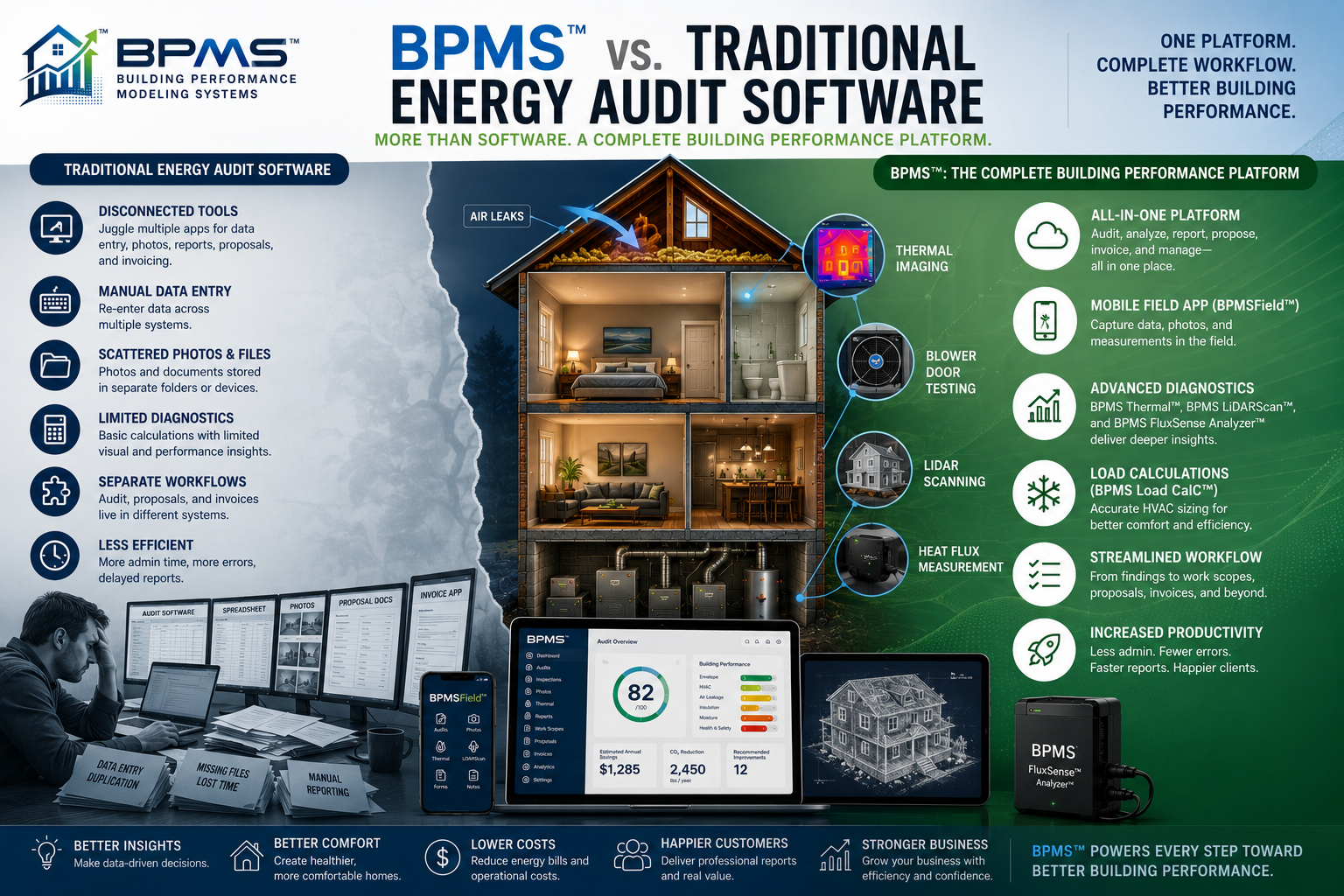
Traditional energy audit software helped move the industry away from paper forms and spreadsheets, but today’s building performance professionals need much more. Explore how BPMS™ approaches energy auditing as a connected business and building-performance workflow—bringing field data, diagnostics, thermal imaging, LiDAR, load calculations, reporting, work scopes, proposals, invoicing, and emerging heat-flux technology into one ecosystem.
BPMS™ vs. Traditional Energy Audit Software: Why the Future of Building Performance Requires More Than a Digital Audit Form
Introduction
Energy auditing has changed dramatically.
There was a time when an auditor could arrive at a property with a clipboard, tape measure, calculator, camera, and several paper forms. Building measurements were recorded manually. Photographs were stored separately. Calculations might be completed later in spreadsheets. Reports were assembled back at the office, and proposals, invoices, and project documents were often produced in entirely different systems.
Software improved this process.
But digitizing a paper form was only the beginning.
Today’s energy auditor may work with blower door measurements, thermal images, utility histories, HVAC equipment data, insulation characteristics, photographs, building geometry, moisture observations, load calculations, renewable-energy opportunities, work scopes, proposals, invoices, and customer communications.
The question is no longer simply:
“What software can I use to write an energy audit?”
A better question is:
“What technology can support the complete building-performance workflow from the first site visit through analysis, reporting, improvements, and customer delivery?”
That distinction represents one of the fundamental ideas behind Building Performance Modeling Systems—BPMS™.
This article examines how the traditional energy-audit software model differs from the broader BPMS™ approach and why connected building-performance technology may become increasingly important to energy auditors, HVAC contractors, weatherization professionals, and home-performance companies.
⸻
What Is Traditional Energy Audit Software?
Traditional energy audit software generally focuses on one or several specific parts of an audit.
Depending on the product, that might include:
* Property information
* Building dimensions
* Insulation levels
* HVAC equipment
* Utility consumption
* Energy modeling
* Recommended improvements
* Savings estimates
* Audit reports
These capabilities can be extremely useful.
The problem isn’t that traditional energy-audit applications don’t work.
The challenge is that an energy auditor’s actual workflow is often much larger than the audit calculation itself.
An auditor may need one application for the audit, another for photographs, another for thermal imaging, another for load calculations, another for customer management, another for estimates and proposals, accounting software for invoicing, cloud storage for documents, and spreadsheets for anything that doesn’t fit neatly into those systems.
Each tool may solve an individual problem.
But together they can create a fragmented workflow.
⸻
The Fragmentation Problem
Consider a typical residential energy audit.
An auditor arrives at the property and collects:
* Customer information
* Exterior photographs
* Interior photographs
* Building dimensions
* Insulation levels
* Window information
* Door information
* HVAC specifications
* Water-heating information
* Appliance information
* Utility consumption
* Blower door readings
* Thermal images
* Moisture observations
* Health and safety findings
* Recommended improvements
The auditor then returns to the office.
Now the information must be transformed into something useful.
Photographs must be organized.
Measurements must be entered.
Calculations must be performed.
Thermal images must be matched with locations.
Recommendations must be written.
A report must be generated.
A work scope may need to be prepared.
A proposal may need to be created.
An invoice may eventually need to be issued.
Customer communication must continue.
This creates an important distinction:
The energy audit isn’t a document. It is a workflow.
BPMS™ is being developed around that principle.
⸻
Traditional Software vs. a Building Performance Platform
Traditional software commonly begins with the audit form.
BPMS™ begins with the building-performance project.
That means the property, customer, field observations, diagnostic measurements, photographs, calculations, recommendations, and business documents can become parts of the same project record.
Instead of treating each task as an independent activity, the objective is to create a connected information chain:
Customer → Property → Audit → Field Data → Diagnostics → Analysis → Recommendations → Report → Work Scope → Proposal → Invoice
This difference may appear subtle, but operationally it can be significant.
⸻
1. Field Data Collection
The Traditional Approach
Energy auditors frequently collect information using combinations of:
* Paper forms
* Tablets
* Phone notes
* Camera rolls
* Spreadsheets
* Individual software applications
The information then has to be transferred into the final audit system.
That creates opportunities for:
* Duplicate data entry
* Missing information
* Incorrect property assignments
* Lost photographs
* Transcription errors
* Delayed report completion
The BPMS™ Approach
BPMSField™ is designed as the field companion to the BPMS™ web platform.
The goal is for information collected at the property to remain associated with the correct customer and audit.
Field personnel can capture audit-related information and photographs and synchronize that information with the broader BPMS™ environment.
The objective is simple:
Capture information once and continue using it throughout the workflow.
⸻
2. Photographic Documentation
Photographs are increasingly important in professional energy audits.
They provide evidence of:
* Insulation deficiencies
* Air leakage locations
* Equipment condition
* Moisture problems
* Duct deficiencies
* Building-envelope issues
* Health and safety concerns
Traditional Workflow
Photos may remain in the auditor’s phone or camera until someone manually downloads, renames, categorizes, and attaches them to a report.
For a company performing hundreds of audits, this becomes a substantial administrative task.
BPMS™
BPMSField™ is designed to associate field photographs directly with an audit.
That provides a foundation for better organization and easier reporting while reducing the dependence on manually sorting large photo libraries after the site visit.
⸻
3. Thermal Imaging
Infrared thermography has become an important building-performance diagnostic tool.
Thermal cameras can reveal surface-temperature patterns that may indicate:
* Missing insulation
* Thermal bridging
* Air leakage
* Moisture anomalies
* HVAC distribution issues
Traditional workflows often require thermal images to be exported from a camera, stored separately, and later imported into reporting software.
BPMS Thermal™ is designed to bring thermal imagery into the same audit environment as the building information and other field observations.
This creates a more connected diagnostic record.
⸻
4. Blower Door and Air-Leakage Analysis
Blower door testing gives energy auditors measurable information about building airtightness.
Common metrics include:
* CFM50
* ACH50
* Building volume
* Pressure readings
Traditional software may allow these values to be entered into an audit.
But the actual investigation can involve considerably more information.
The auditor may also identify specific leakage pathways around:
* Attic hatches
* Plumbing penetrations
* Recessed lighting
* Chimney chases
* Windows
* Doors
* Rim joists
* Duct penetrations
A connected platform allows measurements, photographs, thermal evidence, observations, and recommendations to become part of the same audit record.
⸻
5. Building Geometry
Accurate building geometry influences many calculations.
Auditors need information such as:
* Floor area
* Ceiling height
* Building volume
* Wall area
* Window area
* Door area
* Orientation
* Room dimensions
Traditional methods depend heavily on tape measures, laser distance meters, sketches, and manual calculations.
Those tools remain useful, but newer spatial technologies are creating additional possibilities.
⸻
6. BPMS LiDARScan™
BPMS LiDARScan™ is designed to use compatible LiDAR-equipped devices to capture building geometry digitally.
Potential applications include documenting:
* Walls
* Doors
* Windows
* Openings
* Room dimensions
* Building geometry
The larger goal isn’t simply to create a 3D scan.
It is to connect spatial information with the building-performance workflow.
Geometry collected in the field can potentially support other processes instead of requiring professionals to repeatedly recreate the same measurements.
⸻
7. HVAC Load Calculations
Energy auditing and HVAC design are closely connected.
If improvements reduce:
* Air leakage
* Conductive heat loss
* Solar gains
* Duct losses
the building’s heating and cooling requirements may change.
This becomes especially important when HVAC equipment is being replaced.
Oversized equipment can contribute to comfort, humidity, cycling, and efficiency problems.
Traditional Workflow
An auditor may complete the audit in one system and then move building information into separate HVAC load-calculation software.
That often means entering many of the same characteristics again.
BPMS Load CalC™
BPMS Load CalC™ is designed to bring load-analysis workflows into the broader BPMS™ ecosystem.
The strategic advantage is data continuity.
Building information already collected for the project can become part of additional analyses rather than remaining isolated inside one audit report.
⸻
8. From Findings to Recommendations
Collecting measurements isn’t the final purpose of an energy audit.
The customer ultimately needs to know:
What should I do?
A professional recommendation may involve:
* Air sealing
* Attic insulation
* Wall insulation
* Rim-joist treatment
* Duct sealing
* HVAC improvements
* Ventilation
* Window improvements
* Water-heating upgrades
* Controls
* Solar energy
Traditional software frequently ends with the recommendation section.
For contractors and integrated home-performance businesses, however, that may only be the halfway point.
⸻
9. Work Scope Development
Once recommendations are approved, somebody must define the actual work.
That may require:
* Materials
* Quantities
* Installation requirements
* Areas to treat
* Safety requirements
* Contractor notes
* Subcontractor pricing
BPMS™ is designed to connect audit findings with downstream work-scope development.
That reduces the conceptual gap between:
“We found this problem.”
and:
“Here is exactly what should be done about it.”
⸻
10. Proposal Generation
For contractors, an energy audit can also become the beginning of a sales process.
A customer may want pricing for:
* Air sealing
* Insulation
* HVAC replacement
* Duct improvements
* Other efficiency measures
If audit findings exist in one system while proposals are created somewhere else, information must be transferred manually.
BPMS™ is designed to connect these stages so that findings can move more naturally toward actionable project proposals.
⸻
11. Invoicing and Business Operations
Traditional energy-audit software often treats the completed report as the end of the process.
For the business performing the audit, it isn’t.
The company still has to manage:
* Customers
* Team members
* Proposals
* Invoices
* Branding
* Integrations
* Project records
BPMS™ is therefore designed not only around building analysis but around the company performing the work.
This is one of the most important distinctions between an audit application and a broader building-performance platform.
⸻
12. One Customer Record
Fragmented software can create fragmented customer information.
A customer’s:
* Audit
* Photos
* Proposal
* Invoice
* Building information
* Reports
may exist in different locations.
BPMS™ is designed around keeping these records connected within the organization and project workflow.
For growing energy-audit companies, this can become increasingly important.
⸻
13. Team Management
A one-person auditing business can sometimes manage fragmented software manually.
The challenge becomes greater as the organization grows.
Consider a company with:
* Energy auditors
* Field technicians
* HVAC professionals
* Office staff
* Sales representatives
* Managers
Everyone needs access to the appropriate information.
A centralized platform can provide a more consistent operating environment for the entire organization.
⸻
14. Integrations
BPMS™ is also being designed to connect with external business systems where appropriate.
Examples include integrations supporting:
* Email workflows
* Accounting
* Cloud services
* Mapping and location data
The objective isn’t to replace every specialized business application.
It is to reduce unnecessary separation between the systems professionals already rely on.
⸻
15. Reporting
A professional energy report must convert complex building-science information into something the homeowner can understand.
A strong report may contain:
* Property information
* Executive summary
* Building-envelope findings
* HVAC findings
* Blower door results
* Thermal images
* Photographs
* Energy observations
* Health and safety findings
* Recommendations
* Supporting calculations
BPMS™ is designed to organize these data sources into a consistent reporting workflow.
The goal is not simply to generate a PDF.
The goal is to create a report whose conclusions can be traced back to actual field observations and measurements.
⸻
16. The Emerging Role of Direct Heat-Flux Measurement
Traditional energy audits commonly evaluate thermal performance using:
* Known insulation characteristics
* R-values
* Surface temperatures
* Building construction
* Energy models
* Utility consumption
BPMS™ is exploring another diagnostic layer through the BPMS FluxSense Analyzer™.
The developing device is intended to measure heat flux through building assemblies.
Combined with indoor and outdoor temperature information, heat-flux measurements may provide professionals with additional evidence about how an assembly is performing under actual conditions.
This should be viewed as an additional diagnostic capability rather than an automatic replacement for standardized insulation testing, code requirements, or established program protocols.
⸻
17. From Static Audit to Building Performance Model
This leads to perhaps the largest philosophical difference.
Traditional software often produces a snapshot.
The auditor visits the home.
Measurements are taken.
The report is generated.
The project is completed.
But buildings are dynamic.
Their performance changes with:
* Weather
* Occupancy
* Equipment operation
* Maintenance
* Renovations
* Insulation improvements
* Air sealing
* HVAC replacement
* Solar installation
The long-term BPMS™ vision is broader than producing a single report.
It is about building a structured performance record that can evolve as the building changes.
⸻
BPMS™ vs. Traditional Energy Audit Software
Capability
Traditional Audit Software
BPMS™ Approach
Energy audit data
✓
✓
Customer/property records
Often
✓
Mobile field workflow
Varies
BPMSField™
Field photographs
Varies
Integrated workflow
Thermal imaging
Often separate
BPMS Thermal™
Blower door documentation
Often
✓
LiDAR building capture
Uncommon
BPMS LiDARScan™
HVAC load analysis
Often separate
BPMS Load CalC™
Work scopes
Varies
Integrated workflow
Proposal generation
Often separate
Integrated workflow
Invoicing
Often separate
Integrated workflow
Team administration
Varies
✓
Business integrations
Varies
✓
Heat-flux diagnostics
Uncommon
BPMS FluxSense Analyzer™ development
Unified building record
Varies
Core platform objective
The comparison is intentionally general because traditional energy-audit products vary substantially. Some competing platforms offer several of these capabilities. The important difference is the BPMS™ design philosophy of connecting the workflow rather than treating each function as an isolated tool.
⸻
Why Fewer Disconnected Systems Matter
Every additional software system can introduce another point where information must be:
* Exported
* Imported
* Copied
* Re-entered
* Renamed
* Reorganized
* Reconciled
That consumes administrative time and increases opportunities for errors.
The objective of BPMS™ isn’t necessarily to eliminate every external application.
It is to reduce unnecessary workflow fragmentation.
⸻
What This Means for a Solo Energy Auditor
For an independent auditor, BPMS™ can provide a structured workflow from field inspection through final reporting.
Instead of building an operating system from spreadsheets, phone photographs, cloud folders, report templates, and separate business applications, the auditor can work from a more centralized project environment.
That allows more attention to remain where it belongs:
understanding the building and serving the customer.
⸻
What This Means for Growing Energy Companies
The benefits of standardization can become even more significant as a company adds employees.
A business needs repeatable processes.
Auditor A shouldn’t document a home completely differently from Auditor B.
Managers need consistent records.
Office staff need access to project information.
Technicians need clear work scopes.
Customers need professional deliverables.
A centralized system can help establish those standards.
⸻
What This Means for HVAC Contractors
HVAC contractors increasingly operate in a market where equipment efficiency alone doesn’t tell the entire story.
Building-envelope conditions directly influence HVAC loads.
A high-performance HVAC workflow therefore benefits from understanding:
* Insulation
* Air leakage
* Windows
* Orientation
* Building geometry
* Ducts
* Occupancy
* Internal loads
Connecting energy auditing with load calculations can help contractors move toward a whole-building approach.
⸻
What This Means for Weatherization Professionals
Weatherization projects often involve extensive documentation.
Professionals may need to manage:
* Initial inspections
* Diagnostic measurements
* Health and safety observations
* Photographs
* Energy-conservation measures
* Work scopes
* Quality-control documentation
* Final testing
A connected platform can help maintain continuity across those stages.
Actual program requirements, approved software, calculation procedures, forms, and reporting obligations remain determined by the applicable state, utility, federal, or local program.
⸻
Technology Should Support the Auditor—not Replace the Auditor
There is an important point that can be lost in discussions about automation.
Energy auditing requires professional judgment.
A thermal camera doesn’t diagnose a building by itself.
A blower door doesn’t explain why the home leaks.
LiDAR doesn’t determine the best retrofit.
Software doesn’t replace building-science knowledge.
These technologies provide evidence.
The energy professional interprets that evidence.
BPMS™ is therefore intended to enhance the capabilities of the professional rather than remove the professional from the process.
⸻
The Future of Energy Audit Software
The next generation of building-performance software will likely become increasingly connected.
We can expect continued development around:
* Mobile field collection
* Automated data synchronization
* Advanced building geometry
* Thermal diagnostics
* Connected sensors
* Utility-data analysis
* Weather integration
* Renewable-energy analysis
* Automated reporting
* AI-assisted analysis
* Predictive maintenance
* Digital building models
The distinction between an “energy audit application” and a “building-performance operating platform” may become increasingly important.
⸻
Where BPMS™ Fits
BPMS™ is being developed around a simple but ambitious idea:
Building-performance professionals should not have to assemble their entire business workflow from disconnected software systems.
The BPMS™ ecosystem is designed to bring together capabilities such as:
BPMSField™ — mobile field data and photographic documentation.
BPMS Thermal™ — thermal-imaging workflows.
BPMS LiDARScan™ — digital building-geometry capture.
BPMS Load CalC™ — HVAC load-analysis workflows.
BPMS FluxSense Analyzer™ — developing direct heat-flux measurement technology.
Alongside these technologies, the broader BPMS™ platform supports the business and project workflow surrounding the audit.
The result is a different way of thinking about energy-audit software.
⸻
From Software Tool to Professional Ecosystem
Traditional energy-audit software solved an important problem:
It digitized the audit.
The next challenge is larger:
Connect the entire building-performance process.
That means connecting:
People.
Buildings.
Measurements.
Diagnostics.
Analysis.
Recommendations.
Reports.
Projects.
Business operations.
The value of a platform is not determined solely by how many features it contains.
The greater opportunity comes from making those features work together.
⸻
Final Thoughts
Traditional energy-audit software played an important role in moving the industry away from paper-based workflows.
But the building-performance industry is becoming more complex.
Today’s energy professional may be expected to understand building science, HVAC performance, airtightness, thermal behavior, moisture, ventilation, utility consumption, renewable energy, and increasingly sophisticated diagnostic technologies.
The software supporting that professional must evolve as well.
BPMS™ approaches this challenge by treating the energy audit not as an isolated document but as the center of a larger building-performance workflow.
From BPMSField™ in the field to BPMS Thermal™, BPMS LiDARScan™, BPMS Load CalC™, integrated project and business workflows, and the developing BPMS FluxSense Analyzer™, the objective is to give building-performance professionals a connected environment in which information can move from initial inspection to meaningful action.
Traditional software asks:
“How can we digitize the energy audit?”
BPMS™ asks a broader question:
“How can we connect the entire building-performance lifecycle?”
That difference may define the next generation of energy-audit technology.
Comments and Reviews
Share what you found helpful and how this article supported your work.
0.0/5from 0 reviews
No reviews yet. Be the first to share your feedback.