BPMS FluxSense Analyzer™: Revolutionizing Building Performance Through Direct Heat Flux Measurement
Published 7/9/2026
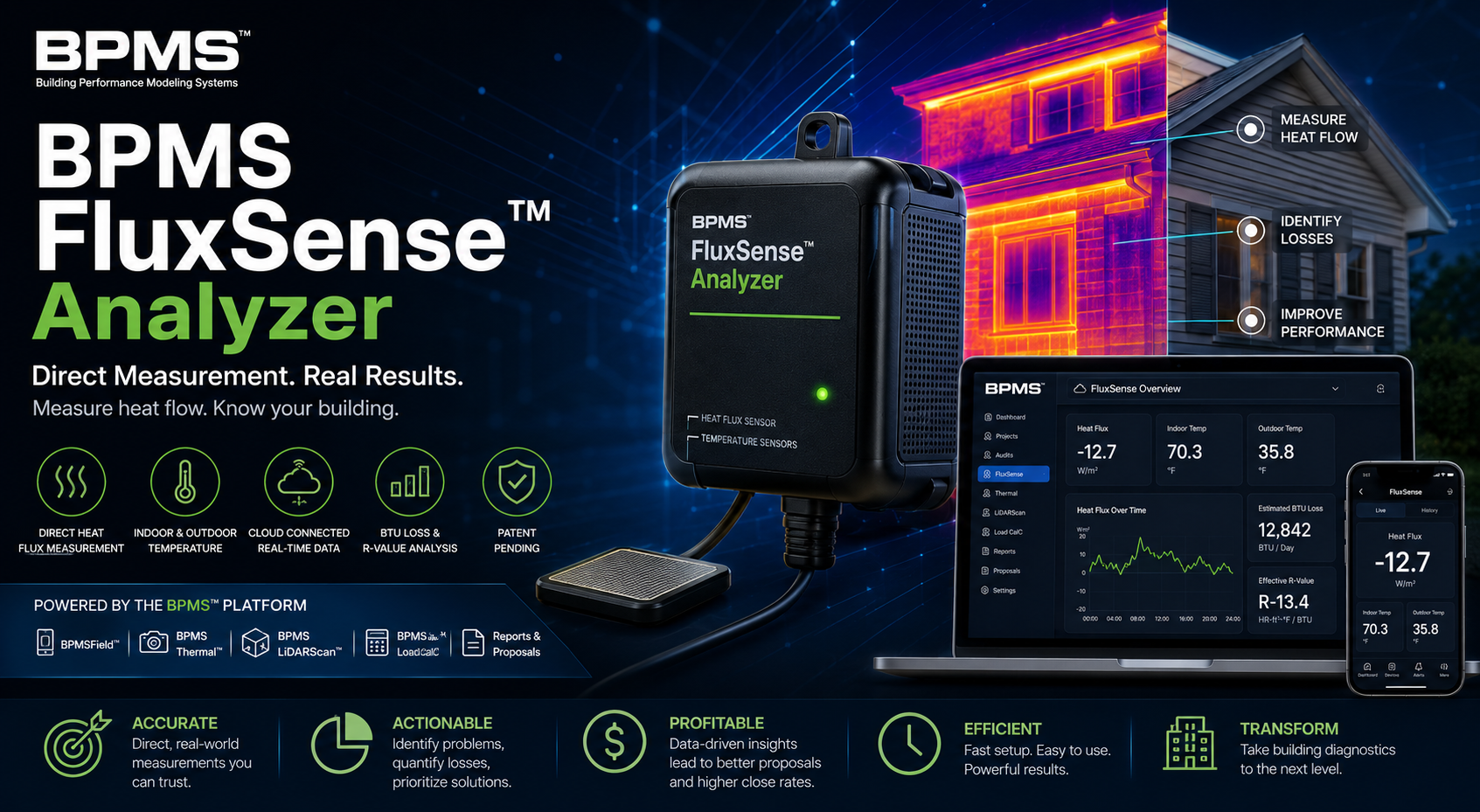
Discover how the patent-pending BPMS FluxSense Analyzer™ is transforming building diagnostics by directly measuring heat transfer through walls, ceilings, floors, and building assemblies. Learn the science, technology, methodology, and real-world applications behind one of the most innovative advancements in building performance analysis.
BPMS FluxSense Analyzer™: Revolutionizing Building Performance Through Direct Heat Flux Measurement
Introduction
For decades, building performance professionals have relied on indirect methods to estimate heat loss through building assemblies.
Energy audits traditionally depend on:
* Utility bill analysis
* Visual inspections
* Thermal imaging
* Assumed material properties
* Estimated insulation values
* Modeled building geometry
* HVAC performance assumptions
While these approaches provide valuable information, they often require significant assumptions about the actual thermal behavior of the building.
The BPMS FluxSense Analyzer™ was conceived to address one fundamental question:
What if we could directly measure how much heat is actually moving through a wall, ceiling, floor, roof, or building component in real time?
This simple but powerful idea became the foundation for one of the most innovative technologies being developed within the BPMS™ ecosystem.
⸻
The Problem with Traditional Energy Analysis
Most building energy assessments estimate performance indirectly.
For example:
An auditor may observe:
* Wall construction type
* Insulation thickness
* Window specifications
* Building dimensions
* Thermal imaging patterns
Software then estimates:
* R-values
* U-factors
* Heat loss rates
* HVAC loads
* Annual energy consumption
Although these methods are widely accepted, actual building performance often differs from design assumptions due to:
* Installation defects
* Settled insulation
* Moisture intrusion
* Air leakage
* Thermal bridging
* Material degradation
* Unknown renovations
As a result, modeled performance and actual performance may not always align.
⸻
The Vision Behind BPMS FluxSense Analyzer™
The BPMS FluxSense Analyzer™ was developed with a different philosophy.
Rather than estimating thermal performance, the system seeks to directly measure thermal energy flow through building assemblies.
The objective is to provide building professionals with measurable, real-world data regarding:
* Heat loss
* Heat gain
* Thermal resistance
* Energy transfer rates
* Building envelope performance
By collecting direct thermal flux measurements, BPMS FluxSense Analyzer™ introduces a new layer of diagnostic intelligence that can complement traditional energy auditing methods.
⸻
What Is Heat Flux?
Heat flux is the rate of thermal energy transfer through a surface.
It represents how much heat moves through a building component over time.
Measured in:
Watts per square meter (W/m²)
Heat flux is one of the most fundamental indicators of building envelope performance.
When indoor and outdoor temperatures differ, heat naturally flows through:
* Walls
* Roofs
* Floors
* Windows
* Doors
* Structural framing
The greater the heat flow, the greater the energy loss.
Directly measuring this heat transfer can provide valuable insight into actual building performance.
⸻
The Core Technology
At the heart of the BPMS FluxSense Analyzer™ is a precision heat flux sensing system designed to be temporarily attached to building surfaces.
The device collects data from multiple sensors including:
Heat Flux Sensor
Measures thermal energy moving through the building assembly.
Indoor Temperature Sensor
Measures conditioned interior temperature.
Outdoor Temperature Sensor
Measures exterior environmental conditions.
Environmental Sensors
Optional environmental measurements may include:
* Humidity
* Pressure
* Dew point conditions
Wireless Communications
Collected data can be transmitted to the BPMS™ cloud platform using:
* Wi-Fi
* Bluetooth
* Future IoT connectivity
⸻
How the System Works
The operating methodology is straightforward but powerful.
Step 1: Sensor Placement
The heat flux sensor is placed against:
* Exterior walls
* Interior walls
* Ceilings
* Floors
* Roof assemblies
The sensor establishes thermal contact with the surface being analyzed.
⸻
Step 2: Temperature Monitoring
Indoor and outdoor temperatures are continuously measured.
The system calculates temperature differentials across the building assembly.
⸻
Step 3: Heat Flux Measurement
The heat flux sensor directly measures thermal energy passing through the assembly.
Rather than estimating heat transfer, actual heat flow is recorded.
⸻
Step 4: Data Transmission
Sensor readings are transmitted to BPMS™ cloud servers.
Measurements may be collected:
* Every minute
* Every five minutes
* Hourly
* Custom intervals
⸻
Step 5: Cloud Analysis
The BPMS™ platform processes collected data to generate advanced diagnostics.
Potential calculations include:
* Heat loss rates
* Heat gain rates
* Dynamic R-values
* U-factors
* BTU loss calculations
* Thermal performance trends
⸻
Dynamic R-Value Determination
Traditional energy audits typically rely on assumed insulation values.
BPMS FluxSense Analyzer™ introduces the concept of dynamic thermal resistance estimation.
Using measured heat flux and temperature differentials, the platform can estimate effective thermal performance under actual operating conditions.
This may provide insight into:
* Insulation effectiveness
* Thermal degradation
* Moisture impacts
* Air leakage influences
* Thermal bridging effects
⸻
Integration with BPMS Thermal™
Thermal imaging reveals where temperature differences exist.
Heat flux measurement helps explain how thermal energy is moving.
Together they create a more complete diagnostic picture.
Thermal imaging identifies:
* Thermal anomalies
* Missing insulation
* Air leakage pathways
FluxSense data provides:
* Quantified heat transfer measurements
* Performance validation
* Energy loss calculations
This combination can significantly enhance diagnostic confidence.
⸻
Integration with BPMS LiDARScan™
BPMS LiDARScan™ captures building geometry.
FluxSense measurements provide thermal performance data.
When combined:
* Surface areas can be quantified
* Thermal losses can be correlated to geometry
* Building energy models can be refined
This integration enables advanced building-performance analysis workflows.
⸻
Real-Time BTU Loss Analysis
One of the most exciting capabilities under development is direct BTU loss analysis.
Using:
* Heat flux measurements
* Surface area calculations
* Temperature data
The BPMS™ platform can estimate thermal energy transfer over time.
Potential outputs include:
* Hourly BTU losses
* Daily BTU losses
* Seasonal energy transfer estimates
* Assembly-specific performance metrics
This provides building professionals with actionable information rather than generalized estimates.
⸻
Benefits for Energy Auditors
Energy auditors can use BPMS FluxSense Analyzer™ to:
* Validate insulation performance
* Investigate thermal anomalies
* Improve audit accuracy
* Support retrofit recommendations
* Enhance customer confidence
Measured data often creates stronger client engagement than theoretical calculations alone.
⸻
Benefits for HVAC Professionals
HVAC contractors may benefit from:
* Improved load analysis
* Enhanced envelope diagnostics
* Better equipment sizing decisions
* Identification of hidden thermal losses
More accurate building performance information can support better HVAC design decisions.
⸻
Benefits for Home Performance Contractors
Home performance professionals can leverage FluxSense technology to:
* Prioritize improvements
* Verify retrofit effectiveness
* Demonstrate project impact
* Quantify thermal performance changes
This can help support data-driven decision making.
⸻
Cloud-Based Intelligence
Unlike standalone measurement devices, BPMS FluxSense Analyzer™ is designed as part of a connected ecosystem.
All collected measurements can become part of the building’s permanent digital record within BPMS™.
Users can:
* Review historical trends
* Compare measurements over time
* Generate reports
* Analyze multiple projects
* Integrate findings into proposals and recommendations
⸻
Future Development Roadmap
Future capabilities under exploration include:
* AI-assisted diagnostics
* Predictive building performance analytics
* Automated anomaly detection
* Building performance scoring
* Continuous monitoring applications
* Utility program integrations
* Advanced thermal modeling
* Digital twin integration
These innovations are intended to further enhance the value of direct thermal measurement technologies.
⸻
Why BPMS FluxSense Analyzer™ Matters
The building performance industry has traditionally relied on estimates, assumptions, and modeled calculations.
BPMS FluxSense Analyzer™ introduces a complementary approach based on direct measurement of heat transfer.
By combining:
* Heat flux sensing
* Temperature monitoring
* Thermal imaging
* LiDAR geometry capture
* Cloud analytics
the system aims to provide building professionals with deeper insight into how buildings actually perform in the real world.
⸻
Conclusion
The BPMS FluxSense Analyzer™ represents a significant step toward a more data-driven future for building diagnostics.
By directly measuring thermal energy movement through building assemblies and integrating those measurements with the broader BPMS™ ecosystem, building professionals gain access to powerful new tools for understanding, analyzing, and improving building performance.
As the industry continues to evolve, technologies that move beyond assumptions and toward real-world measurement will play an increasingly important role in delivering more accurate, efficient, and actionable building performance insights.
BPMS FluxSense Analyzer™ is designed with that future in mind.
Comments and Reviews
Share what you found helpful and how this article supported your work.
0.0/5from 0 reviews
No reviews yet. Be the first to share your feedback.