BPMS™ ACH Calculator & Blower Door Compliance Reporting: Helping Contractors Meet Code and Obtain the Certificate of Occupancy
Published 8/17/2026
BPMS™ simplifies blower door testing by providing a dedicated Air Changes Per Hour (ACH) calculator and automatically generating a professional code compliance report that can be submitted to local building departments as part of the Certificate of Occupancy (CO) process. Learn how energy auditors, HVAC contractors, HERS raters, and builders can use BPMS™ to streamline compliance documentation, reduce paperwork, and deliver professional results.
BPMS™ ACH Calculator & Blower Door Compliance Reporting: Helping Contractors Meet Code and Obtain the Certificate of Occupancy
As residential energy codes continue to evolve, blower door testing has become a standard requirement for many newly constructed homes before a Certificate of Occupancy (CO) can be issued. Builders, HVAC contractors, energy auditors, and home performance professionals are increasingly expected to provide accurate air-tightness testing and professional documentation demonstrating that a home complies with the applicable energy code.
To support this need, Building Performance Modeling Systems (BPMS™) includes a dedicated ACH (Air Changes per Hour) Calculator and an automated Blower Door Code Compliance Report designed to streamline the testing, calculation, and reporting process.
Instead of relying on spreadsheets or manually creating compliance reports, BPMS™ allows professionals to enter field measurements, calculate the home’s air leakage rate, and generate a polished report that can accompany permit documentation submitted to the local building department.
For contractors, this creates an additional professional service offering.
For builders, it helps simplify the path toward final inspection.
For homeowners, it provides confidence that the home has been tested and documented using recognized building-performance practices.
⸻
Why Blower Door Testing Matters
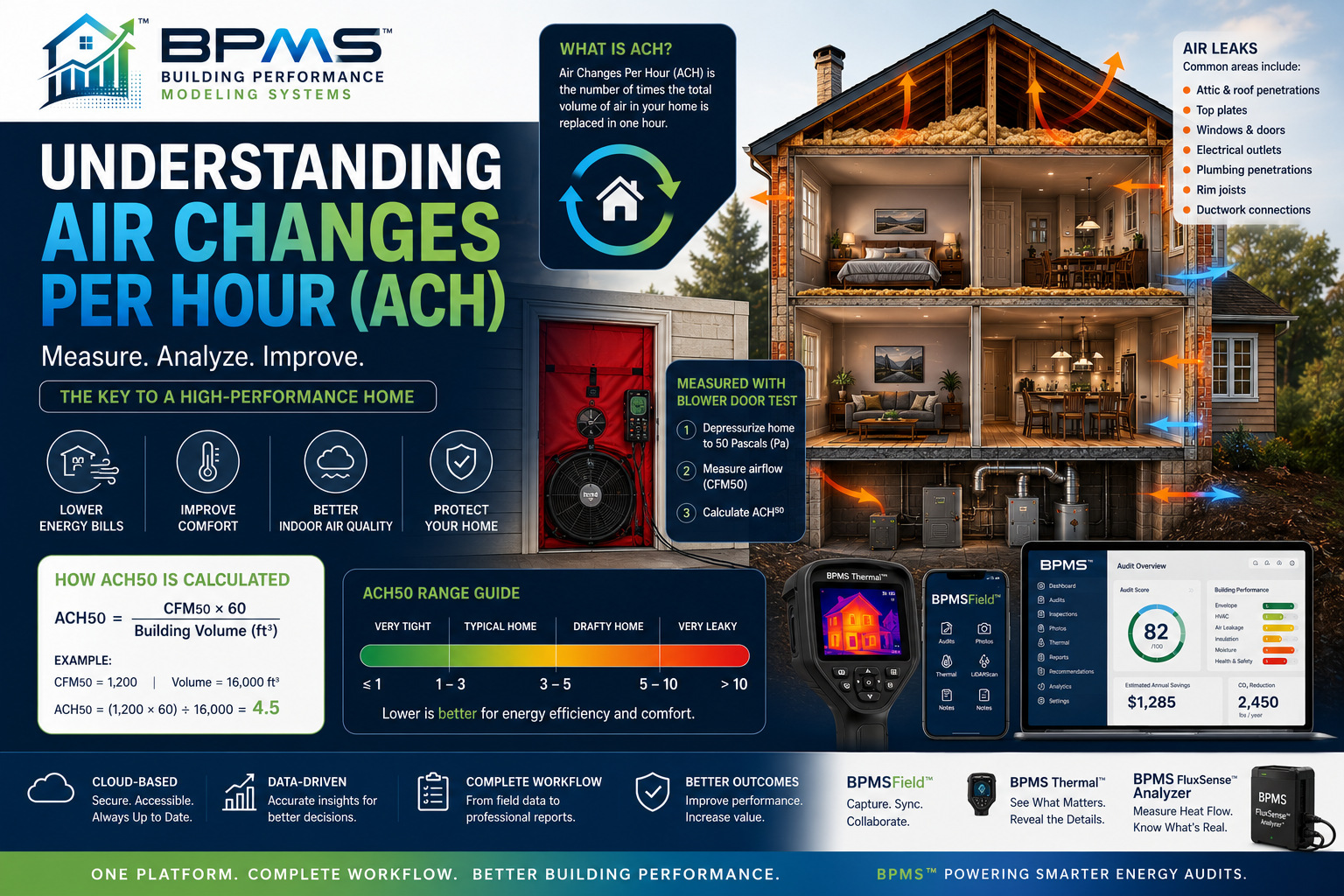
A blower door test measures the air leakage of a building by installing a calibrated fan in an exterior doorway and creating a pressure difference—typically 50 Pascals—between the inside and outside of the home.
The test measures the airflow required to maintain that pressure, expressed as:
CFM50 (Cubic Feet per Minute at 50 Pascals)
Using the building’s conditioned volume, the result is converted into:
ACH50 (Air Changes per Hour at 50 Pascals)
This value represents the building’s air-tightness under standardized test conditions and is commonly used to demonstrate compliance with modern residential energy codes.
Lower ACH values generally indicate a tighter building envelope, although required limits vary by jurisdiction and adopted energy code.
⸻
Why Building Departments Require Blower Door Reports
Modern energy codes are intended to reduce unnecessary energy waste while improving building comfort and performance.
Excessive uncontrolled air leakage can increase:
* Heating costs
* Cooling costs
* HVAC runtime
* Moisture migration
* Drafts
* Indoor comfort issues
Because of these impacts, many jurisdictions require documented blower door testing before issuing a Certificate of Occupancy.
A code official typically wants to verify that:
* The test was completed.
* The building was tested using recognized procedures.
* The measured air leakage complies with the adopted code.
* The documentation is complete and professional.
A standardized report helps satisfy those requirements.
⸻
The BPMS™ ACH Calculator
Within BPMS™, users have access to a dedicated ACH Calculator designed specifically for building-performance professionals.
The calculator allows users to enter essential project information, including:
* Property information
* Builder information
* Testing date
* Tester information
* Building volume
* Blower door equipment
* CFM50 result
* Test pressure
* Indoor and outdoor conditions
* Comments
* Jurisdiction information
Once the required values are entered, BPMS™ automatically performs the ACH calculation using the standard equation:
ACH50 = (CFM50 × 60) ÷ Conditioned Building Volume
The calculated value is immediately available for inclusion in the compliance report.
This eliminates manual calculations and reduces the risk of mathematical errors.
⸻
Automatic Code Compliance Evaluation
After calculating ACH50, BPMS™ compares the result against the selected code requirements configured within the platform.
Depending on company settings and jurisdiction, the report can indicate whether the tested home:
* Meets the required air-tightness criteria
* Requires additional air sealing
* Should be retested after improvements
This gives contractors immediate feedback before submitting documentation to the building department.
⸻
A Professional Blower Door Compliance Report
One of the strongest features of BPMS™ is its ability to automatically generate a professional report suitable for project documentation.
The report may include:
Property Information
* Property address
* Permit information
* Builder
* Owner
* Municipality
Test Information
* Test date
* Technician
* Equipment used
* Test pressure
Building Characteristics
* Conditioned floor area
* Building volume
* Number of stories
* Construction type
Measured Results
* CFM50
* ACH50
* Pass/Fail status (based on configured criteria)
* Comments
Compliance Summary
A concise statement explaining whether the building met the configured air-tightness requirement.
Technician Certification
Space for technician information, company branding, and signature.
Company Branding
BPMS™ allows companies to incorporate:
* Company logo
* Contact information
* License numbers
* Professional branding
The result is a report that reflects the contractor’s professionalism while providing the documentation often requested during the final inspection process.
⸻
Supporting the Certificate of Occupancy Process
While local building departments determine what documentation is required for a Certificate of Occupancy, many jurisdictions require blower door test results as part of the final inspection package for homes subject to current residential energy codes.
BPMS™ helps contractors prepare this documentation in a consistent and professional format, making it easier to submit the necessary information alongside other permit and inspection records.
Users should always confirm the specific requirements of their local jurisdiction, as codes and documentation requirements vary.
⸻
A Valuable Service for HVAC Contractors
Many HVAC contractors already perform load calculations, equipment installation, startup, and commissioning.
Adding blower door testing and compliance reporting can expand the services they provide.
Instead of referring homeowners or builders to another company, contractors can offer:
* Blower door testing
* ACH calculations
* Air leakage documentation
* Compliance reporting
* Air-sealing recommendations
* Retesting after improvements
This creates an additional revenue opportunity while strengthening relationships with builders and homeowners.
⸻
Expanding Opportunities for Energy Auditors
Energy auditors are already trained to understand building performance and air leakage.
BPMS™ allows auditors to extend that expertise into new construction and code-compliance projects.
Services may include:
* New construction blower door testing
* Code compliance reporting
* Builder consultations
* Air-sealing verification
* Final inspection documentation
* Building performance consulting
Many builders prefer working with professionals who can provide both diagnostic expertise and the required documentation in one visit.
⸻
Faster Workflows with BPMS™
Traditionally, contractors often complete blower door testing using multiple tools:
* Blower door software
* Calculator
* Spreadsheet
* Word processor
* PDF editor
BPMS™ combines these tasks into a single workflow.
Create Project
↓
Enter Property Information
↓
Record Blower Door Results
↓
Calculate ACH
↓
Generate Code Compliance Report
↓
Deliver PDF to Builder or Building Department
This integrated process saves time while reducing repetitive data entry.
⸻
Integration with the BPMS™ Ecosystem
The ACH Calculator is only one part of the larger BPMS™ platform.
Information can be connected with:
BPMSField™
Capture blower door photographs, GPS-tagged documentation, and field notes directly from the job site.
BPMS Thermal™
Include infrared images showing areas of significant air leakage for customer education and quality assurance.
BPMS LiDARScan™
Use LiDAR-generated building dimensions to improve conditioned-volume calculations and project documentation.
BPMS Load CalC™
Evaluate how reduced air leakage influences heating and cooling loads for more informed HVAC design.
BPMS Intelligence™
Receive AI-assisted summaries, quality checks, and customer-friendly explanations of blower door results.
⸻
Improving Customer Education
Many homeowners have never heard the term Air Changes per Hour.
BPMS™ helps contractors communicate results in plain language.
Instead of simply providing a number, the report can explain:
* What ACH means
* Why air leakage matters
* How excessive leakage affects utility bills
* How air sealing can improve comfort
* Why meeting code requirements is important
This transforms the blower door report into both a compliance document and an educational tool.
⸻
Professional Branding Matters
Builders and homeowners judge contractors by the quality of their documentation.
BPMS™ allows every compliance report to include:
* Company logo
* Company colors
* Contact information
* Technician information
* Professional formatting
A polished report reinforces confidence in the contractor and helps distinguish their business from competitors using generic forms.
⸻
Benefits for Builders
Builders benefit from receiving organized documentation that can support the final inspection process.
Advantages include:
* Faster access to professionally formatted reports
* Easier project documentation
* Reduced paperwork
* Better communication with inspectors
* Support for energy-code compliance
⸻
Benefits for Building Departments
Although each jurisdiction establishes its own review procedures, standardized documentation can make it easier for code officials to review submitted information.
Professional reports typically improve:
* Readability
* Consistency
* Record keeping
* Project documentation
⸻
Benefits for Homeowners
Even after construction is complete, the blower door report remains valuable.
It documents:
* Air-tightness testing
* Building performance
* Energy-code compliance
* Initial building condition
It also provides a useful baseline should future renovations or performance improvements be considered.
⸻
Why BPMS™ Is Different
Many applications can calculate ACH.
Few integrate the entire process.
BPMS™ combines:
* Customer management
* Project management
* ACH calculations
* Blower door reporting
* Thermal imaging
* Field documentation
* LiDAR
* HVAC load calculations
* Home Energy Score workflows
* HPXML generation
* Work scopes
* Proposals
* Invoices
This creates one connected workflow instead of multiple disconnected applications.
⸻
Looking Toward the Future
Building codes continue to evolve toward higher-performance buildings.
As homes become tighter and more energy efficient, accurate testing and professional documentation will become increasingly important.
Future enhancements to BPMS™ may further integrate blower door testing with:
* Advanced analytics
* AI-assisted compliance reviews
* Building performance dashboards
* Digital project records
* Heat-flux analysis using the developing BPMS FluxSense Analyzer™
* Automated workflow tracking
* Enterprise reporting
The goal is to help contractors spend less time on paperwork and more time delivering value to their clients.
⸻
Final Thoughts
Blower door testing is no longer simply a specialized service—it has become an important part of demonstrating compliance with many modern residential energy codes.
By providing an integrated ACH Calculator and an automated Code Compliance Report, BPMS™ helps energy auditors, HVAC contractors, builders, and home-performance professionals streamline one of the most important steps in the new construction process.
Instead of juggling multiple programs, manual calculations, and custom report templates, professionals can perform the test, calculate ACH, generate a polished report, and provide builders with the documentation often needed for the final inspection and Certificate of Occupancy process.
Whether you are an energy auditor expanding your services, an HVAC contractor supporting new construction, or a builder looking for a more efficient workflow, BPMS™ delivers one platform that simplifies blower door compliance from the field to the final report.
BPMS™ — One Platform. One Workflow. Complete Building Performance.
Comments and Reviews
Share what you found helpful and how this article supported your work.
0.0/5from 0 reviews
No reviews yet. Be the first to share your feedback.