Solar Readiness Before Solar Panels: Energy Audits, Roof Shading, Load Planning, and the 2026 Incentive Reality
Published 10/9/2026
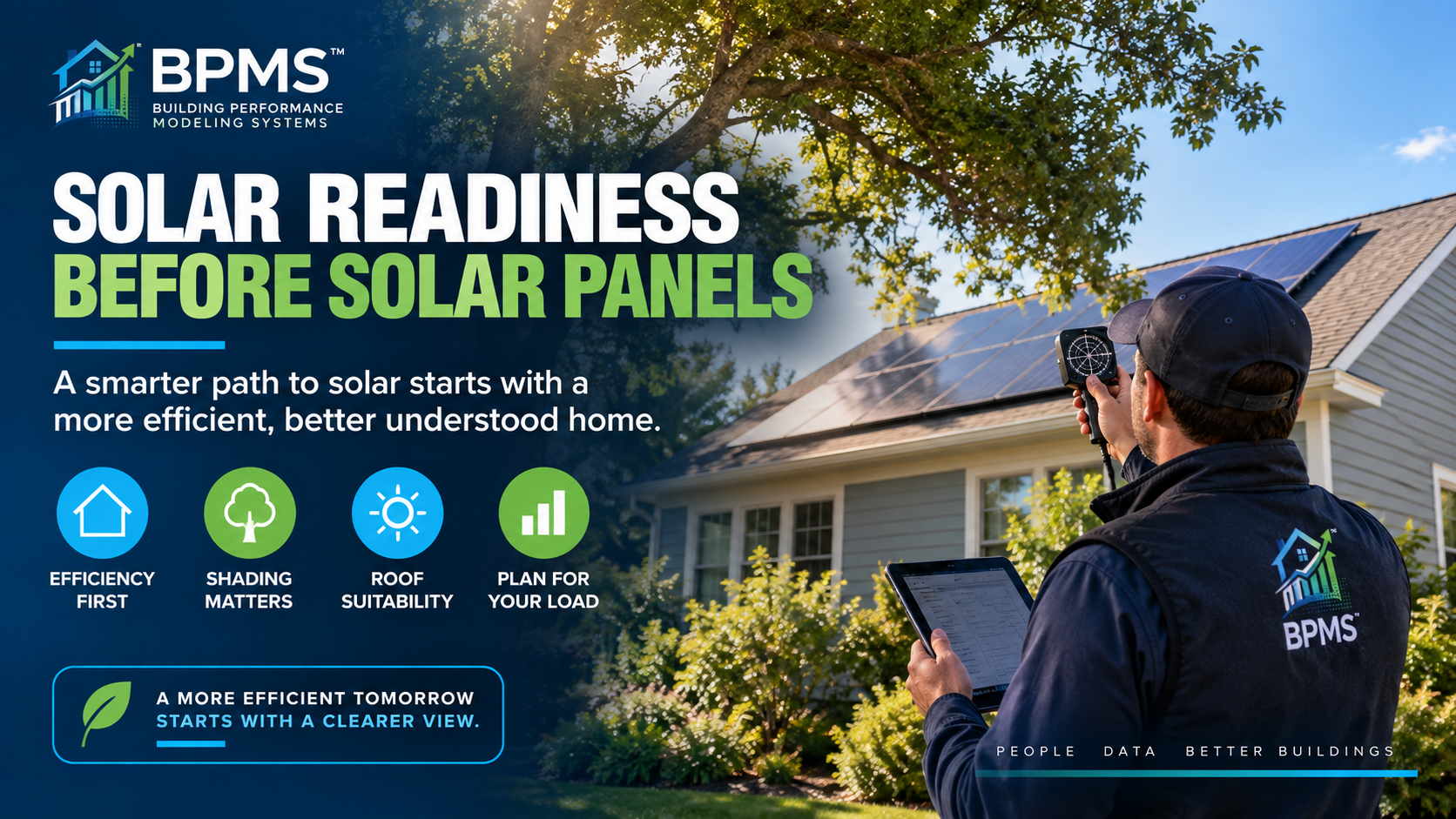
A successful residential solar project starts before panels are selected. Learn how energy audits, electricity-use analysis, roof condition, shading, orientation, future electrification loads, electrical capacity, utility rates, storage, and the post-2025 federal tax-credit landscape should shape solar planning in 2026.
Solar Readiness Before Solar Panels: Energy Audits, Roof Shading, Load Planning, and the 2026 Incentive Reality
Residential solar conversations often begin with a surprisingly simple question:
“How many solar panels can fit on the roof?”
That is an important question—but it should not be the first one.
A better building-performance approach begins with a broader set of questions:
How much electricity does the home currently use?
How efficient is the building?
Will the home add heat pumps, electric water heating, induction cooking, EV charging, or other electrical loads?
Is the roof structurally and physically suitable?
How much shade reaches the roof throughout the year?
What are the roof orientation and pitch?
Is the electrical service ready for the proposed system?
How does the utility compensate exported electricity?
Would battery storage serve a useful purpose?
What state, local, utility, or program incentives actually exist now?
Solar is not simply an equipment purchase.
It is part of the building's energy system.
That is why a strong solar project should begin with solar readiness.
What Does Solar Readiness Mean?
Solar readiness is the process of evaluating whether a building, its electrical system, its energy consumption, and its site are well positioned for a photovoltaic installation.
It is not the same as simply confirming that the roof receives sunlight.
A complete solar-readiness assessment may consider:
Historic electricity consumption
Planned energy-efficiency improvements
Future electrification
Roof age and condition
Roof geometry
Structural considerations
Roof orientation
Roof pitch
Tree shading
Chimneys and roof obstructions
Electrical panel capacity
Utility interconnection requirements
Local permitting requirements
Battery-storage objectives
Utility rate design
Export compensation
Financial incentives
DOE advises homeowners considering solar to evaluate roof condition, geographic location, orientation to the sun, shading, and electricity needs before installation.
The objective is not merely to determine whether solar panels can be installed.
The objective is to determine how solar fits into the building's long-term energy strategy.
Start With the Building's Energy Use
Before designing generation, understand consumption.
DOE's solar guidance recommends reviewing previous electricity bills to understand annual and seasonal electricity demand. DOE also specifically recommends considering a home energy audit during the solar-planning process so homeowners can identify energy-saving improvements before finalizing the system.
That sequence matters.
Imagine two otherwise identical homes.
The first has:
Significant attic air leakage
Inadequate insulation
Leaky ducts
Inefficient lighting
Aging HVAC equipment
The second has already addressed many of those deficiencies.
The electricity requirements of those homes may be very different.
If a PV system is intended to offset a meaningful portion of annual electricity consumption, reducing avoidable loads before finalizing system size can change the project.
A useful workflow is:
ENERGY AUDIT → EFFICIENCY PLAN → FUTURE LOAD PLAN → SOLAR ANALYSIS
DOE similarly describes an energy evaluation as a useful first step for identifying specific measures that can make a home or building more energy efficient.
Efficiency Before Solar Does Not Mean “Solar Later”
“Efficiency first” is sometimes misunderstood.
It does not necessarily mean that every possible efficiency measure must be completed before anyone can discuss photovoltaics.
It means that the building's energy use should be understood before generation is designed around it.
Efficiency and solar can be planned together.
For example, an energy audit may identify:
A major attic air-leakage problem
Duct leakage
An inefficient refrigerator
Electric resistance heating scheduled for replacement
A future heat-pump water heater
Planned EV charging
Some improvements will reduce future electrical use.
Others—particularly electrification—may increase electrical consumption while reducing fossil-fuel consumption.
The solar design should account for both.
Future Electrification Can Change the Load
One of the biggest mistakes in solar planning is designing entirely around today's electric bill when the building is about to change.
A homeowner may plan to add:
An air-source heat pump
A heat-pump water heater
An induction range
An electric clothes dryer
One or more electric vehicles
Battery storage
Those changes can materially alter the home's future electricity profile.
If a homeowner installs solar today and converts major fuel-fired equipment to electricity next year, the historical utility bills used for the original PV analysis may no longer represent future consumption.
That is why solar planning and electrification planning increasingly belong in the same conversation.
A better question is:
“What will this home's electricity demand look like after the planned upgrades?”
Shade Can Change the Entire Solar Analysis
A large roof is not automatically a good solar roof.
Trees, neighboring buildings, chimneys, dormers, roof peaks, and other obstructions can reduce solar exposure.
DOE notes that excessive tree shading may make rooftop solar less suitable and specifically identifies shading, roof shape, roof slope, and orientation as important considerations.
Shade is also dynamic.
The solar path changes throughout:
The day
The season
The year
A roof that appears fully exposed at noon in July may experience meaningful shading during winter mornings or afternoons.
Professional solar analysis may therefore include tools or modeling that evaluates solar access across different times and conditions.
The takeaway is simple:
Do not judge solar potential from a single visual observation.
Orientation Matters—but It Is Not the Only Factor
In the Northern Hemisphere, south-facing roofs are commonly associated with strong annual solar production.
DOE states that solar panels typically perform best on unshaded south-facing roofs with slopes between roughly 15 and 40 degrees, while orientations between southeast and southwest can also perform well.
That does not mean every roof outside those parameters is unsuitable.
Solar production depends on a combination of:
Geographic location
Orientation
Tilt
Shade
Equipment
Array layout
Weather
System losses
An east-west roof may still support a strong project depending on electricity-use patterns, local rates, site constraints, and project objectives.
Solar design should be modeled rather than reduced to one rule.
Roof Condition Comes Before Panel Installation
Solar panels are long-lived equipment.
DOE notes that residential silicon modules are generally expected to last 25 years or more, while still producing a large portion of their original output over that period.
That makes roof condition extremely important.
If a roof is approaching the end of its useful life, installing solar first and replacing the roof shortly afterward can create unnecessary removal and reinstallation work.
Solar readiness should therefore review:
Roof age
Surface condition
Signs of leakage
Flashing
Roof penetrations
Structural concerns
Available installation area
A roofing professional or structural professional may be necessary where conditions warrant.
The energy auditor should not exceed the scope of their qualifications.
Roof Area Is Not the Same as Usable Solar Area
A roof may have a large gross area but a much smaller usable area.
Potential constraints include:
Chimneys
Plumbing vents
Skylights
Dormers
Fire-access pathways
Roof edges
Equipment
Mechanical clearances
Shading zones
Structural limitations
Applicable setbacks and access requirements vary by jurisdiction and code.
That means a preliminary solar assessment should distinguish between:
Total roof area
and
Solar-usable roof area
LiDAR and other building-measurement technologies can be helpful in documenting roof geometry, but permitting and final installation design should still follow applicable professional and jurisdictional requirements.
Electrical Capacity Is Part of Solar Readiness
Solar panels do not operate in isolation.
The system ultimately connects to the building's electrical infrastructure.
A solar-readiness review may need to consider:
Main service rating
Main electrical panel
Available breaker positions
Busbar limitations
Existing electrical equipment
Interconnection method
Planned EV charging
Heat pumps
Electric water heating
Battery storage
In some projects, the existing panel may be adequate.
In others, modifications or upgrades may be necessary.
The required analysis should be performed by appropriately qualified electrical and solar professionals under applicable electrical codes, utility requirements, and permitting rules.
Solar planning should identify these questions early.
Finding an electrical constraint after the PV system has already been sold is not an ideal project workflow.
Solar Production Must Be Compared With Consumption
Solar-system design is fundamentally about the relationship between two quantities:
Energy produced
and
Energy consumed
DOE advises homeowners to review monthly electricity consumption when evaluating potential solar savings.
That analysis should ideally consider more than one annual total.
Monthly or interval data can help reveal:
Summer cooling peaks
Winter heating loads
EV charging
Seasonal occupancy
Time-of-use demand
Daytime versus nighttime consumption
A house that consumes most electricity after sunset interacts with solar differently from one with substantial daytime demand.
That leads naturally to another question.
Does Battery Storage Make Sense?
Battery storage can provide value in some homes, but it is not automatically necessary for every PV project.
DOE identifies several situations where storage may deserve consideration, including concerns about outage resilience, time-of-use pricing, demand charges, or utility export rules that make self-consumption more valuable.
Possible battery objectives include:
Backup power
Increased solar self-consumption
Time-of-use management
Reduced grid imports during high-price periods
Those goals should be defined before equipment is selected.
A homeowner seeking backup power during outages has a different design problem than one simply trying to maximize annual solar production.
Utility Rates Can Change Project Economics
The value of one kilowatt-hour of solar electricity is not necessarily constant.
Solar economics can be affected by:
Retail electricity rates
Time-of-use pricing
Demand charges
Export compensation
Net-metering policies
Fixed charges
Seasonal rates
DOE notes that potential solar savings depend in part on the utility's compensation for excess electricity exported to the grid, and those rules vary among utilities.
This means two identical PV systems installed on identical houses in different utility territories can produce different financial outcomes.
Solar-sales claims should therefore be based on the actual rate environment—not a universal savings assumption.
The 2026 Federal Solar Tax-Credit Reality
This is especially important for solar content published in 2026.
Many older articles still state that the federal Residential Clean Energy Credit would remain available into the 2030s.
That information is now outdated.
Current IRS guidance states that the Residential Clean Energy Credit under Section 25D is not available for expenditures made after December 31, 2025. The IRS also confirms that if qualifying property was installed after December 31, 2025, paying for it before that date does not preserve the credit because the expenditure is generally treated as made when original installation is completed.
Similarly, the federal Energy Efficient Home Improvement Credit under Section 25C is not available for qualifying property placed in service after December 31, 2025.
For 2026 projects, professionals should therefore not advertise the previous 30% federal residential solar credit as though it remains generally available for new installations.
State, utility, local, tribal, financing, or other program incentives may still exist, but they must be verified for:
Location
Customer eligibility
Equipment
Installation date
Program funding
Utility territory
Incentive verification should happen when the project is being evaluated—not from an old marketing article.
Solar Readiness Is Also a Documentation Problem
A strong solar-readiness workflow can generate a significant amount of project information:
Address
Building geometry
Utility history
Electricity consumption
Roof photographs
Shading observations
Thermal findings
HVAC equipment
Planned electrification
Electrical-panel information
Recommendations
Proposed measures
Estimated future loads
When those data points are scattered among photographs, spreadsheets, handwritten notes, emails, and separate software products, important context can be lost.
That is where a connected building-performance workflow becomes valuable.
Where BPMS™ Can Support the Workflow
BPMS™ is built around the idea that field information should remain connected to the building record.
A solar-readiness assessment can fit into a broader workflow that includes:
FIELD DATA → BUILDING ASSESSMENT → ENERGY USE → IMPROVEMENTS → FUTURE LOADS → SOLAR READINESS → REPORTING
Depending on the project, BPMS™ tools can help organize building information alongside:
Energy-audit data
Photographs
Building-envelope observations
HVAC equipment
Electrical information
Utility data
Proposed efficiency measures
WorkScopes
Reports
BPMSField™ can support field collection and documentation.
BPMS Thermal™ may help document thermal anomalies where infrared investigation is relevant to the energy assessment.
BPMS LiDARScan™ can support building-measurement workflows where appropriate.
BPMS Load CalC™ can support load-calculation workflows when HVAC electrification is part of the project.
The goal is not to turn an energy auditor into a solar engineer.
The goal is to keep the building-performance information organized enough that the next professional can make better decisions.
A Practical Solar-Readiness Workflow
A professional solar-readiness process can follow a logical sequence.
1. Collect Utility History
Review enough electricity-use history to understand annual and seasonal patterns.
2. Perform the Building Assessment
Document the envelope, HVAC, water heating, appliances, electrical conditions, and other relevant loads.
3. Identify Efficiency Opportunities
Determine whether significant avoidable energy use should be addressed before system sizing.
4. Model Future Loads
Account for planned heat pumps, heat-pump water heating, EV charging, and other electrification.
5. Evaluate Roof Suitability
Review roof condition, usable area, orientation, pitch, shading, and obstructions.
6. Review Electrical Infrastructure
Determine whether the existing service and panel can support the planned system, subject to qualified electrical analysis.
7. Estimate Solar Production
Use appropriate solar modeling tools and realistic system assumptions.
8. Compare Production and Consumption
Understand how the proposed system aligns with current and future demand.
9. Evaluate Utility Economics
Review current rate schedules, export compensation, and interconnection rules.
10. Verify Incentives
Check current federal, state, local, tribal, and utility programs rather than relying on older marketing material.
11. Document the Plan
Create a clear record showing assumptions, measurements, recommendations, and unresolved questions.
The Better Question Is Not “How Many Panels?”
Residential solar works best when treated as part of a larger energy strategy.
The roof matters.
Shade matters.
Electricity consumption matters.
The envelope matters.
Electrification matters.
Electrical capacity matters.
Utility rates matter.
And current incentive rules matter.
The best solar project is not necessarily the one with the greatest number of panels.
It is the project designed around the actual building, actual site, actual energy use, actual future plans, and actual program environment.
That is building performance applied to renewable energy.
For energy auditors, solar professionals, HVAC contractors, weatherization providers, electrification contractors, utilities, and building owners, solar readiness creates a better starting point:
UNDERSTAND THE BUILDING → UNDERSTAND THE LOAD → UNDERSTAND THE SITE → THEN DESIGN THE SOLUTION
Explore BPMSCloud.com to learn more about connected building-performance workflows with BPMS™.
Comments and Reviews
Share what you found helpful and how this article supported your work.
0.0/5from 0 reviews
No reviews yet. Be the first to share your feedback.