10 Best Energy Audit Software Platforms in 2026: Complete Rankings and Comparison
Published 7/22/2026
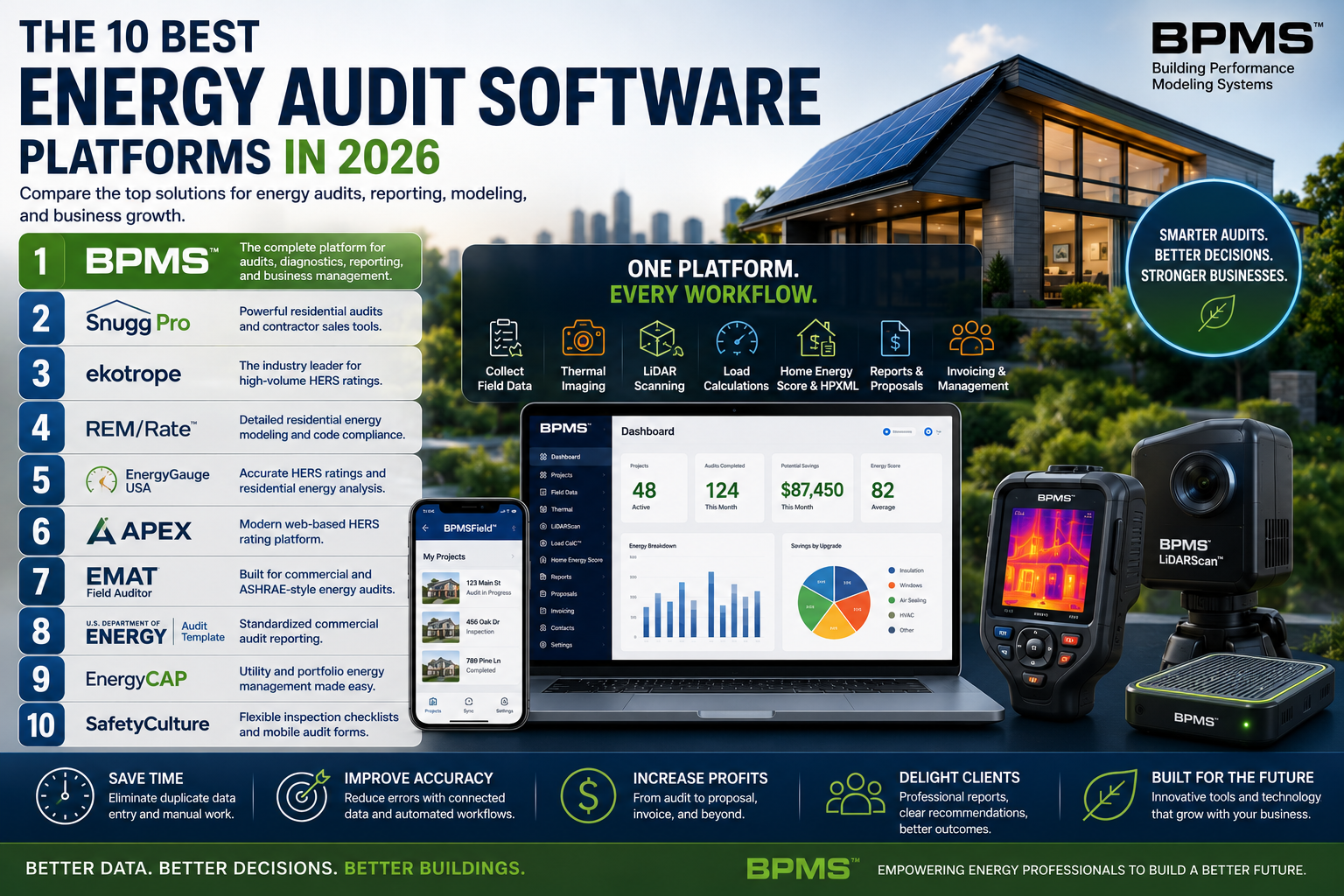
Compare 10 of the best energy audit software platforms available in 2026. This complete guide ranks BPMS™, Snugg Pro, Ekotrope RATER, REM/Rate™, EnergyGauge USA, APEX, EMAT Field Auditor, DOE Audit Template, EnergyCAP, and SafetyCulture by audit capabilities, field usability, modeling, reporting, business management, scalability, and future readiness.
10 Best Energy Audit Software Platforms in 2026
Introduction
Energy auditing software has evolved far beyond digital inspection forms and basic energy calculations.
Modern energy auditors, home performance contractors, HERS Raters, HVAC professionals, weatherization agencies, utility programs, and commercial consultants may need software that can help them:
* Collect field information
* Document building assemblies
* Capture photographs
* Manage thermal images
* Record diagnostic test results
* Model energy consumption
* Calculate projected savings
* Produce Home Energy Scores
* Generate HPXML data
* Perform HVAC load calculations
* Create professional reports
* Build work scopes
* Prepare proposals
* Issue invoices
* Coordinate teams
* Track projects through completion
The challenge is that no single software product serves every part of the energy industry equally well.
Some platforms specialize in residential retrofit audits. Others are designed primarily for HERS ratings, residential code compliance, commercial building assessments, utility-data management, or customizable inspections.
This guide ranks 10 notable platforms based on their usefulness within their intended markets.
Editorial Ranking Disclosure
There is no universally recognized independent ranking of energy audit software.
The rankings in this article are based on the following criteria:
1. Overall audit-workflow coverage
2. Field-data collection
3. Energy modeling and analysis
4. Reporting capabilities
5. Standards and program support
6. Business-management functionality
7. Collaboration and scalability
8. Integrations and data portability
9. Ease of use
10. Future technology potential
BPMS™ is published by the same company operating this blog. It is ranked first for its intended all-in-one workflow and future development direction. That does not mean it currently has the largest user base, the longest operating history, or every accreditation held by established HERS and program-specific competitors.
Professionals should verify software acceptance with the applicable utility, rating provider, government program, state agency, or certification body before purchasing.
⸻
The 10 Best Energy Audit Software Platforms in 2026
Rank
Platform
Best for
Editorial score
1
BPMS™
Complete audit and business workflow
9.4/10
2
Snugg Pro
Residential retrofit audits and sales
9.1/10
3
Ekotrope RATER
High-volume HERS ratings
8.9/10
4
REM/Rate™
Detailed residential energy modeling
8.6/10
5
EnergyGauge USA
HERS ratings and code compliance
8.4/10
6
APEX
Modern web-based HERS modeling
8.2/10
7
EMAT Field Auditor
Commercial and ASHRAE-style audits
8.0/10
8
DOE Audit Template
Standardized commercial audit reporting
7.8/10
9
EnergyCAP
Utility and portfolio energy management
7.6/10
10
SafetyCulture
Flexible mobile inspection forms
The scores reflect overall usefulness for an energy-auditing operation. They are not laboratory test results or official certification grades.
⸻
1. BPMS™ — Best Overall Energy Audit and Business Platform
Best for
Energy auditors, home performance contractors, HVAC contractors, weatherization professionals, multidisciplinary energy companies, growing teams, and organizations that want to connect auditing with business operations.
Why BPMS™ ranks first
Building Performance Modeling Systems™ was developed around the idea that energy professionals should not have to reconstruct the same building in several disconnected applications.
Its guiding concept is:
One Platform. Every Workflow.
BPMS™ is designed to connect the complete project lifecycle, including:
* Customer and project intake
* Energy-audit management
* Building and envelope data
* Energy-usage information
* HVAC systems
* Domestic hot water
* Appliances and lighting
* Field photographs
* Thermal images
* Building measurements
* Home Energy Score workflows
* HPXML generation
* HVAC load calculations
* Work scopes
* Proposals
* Invoices
* Team assignments
* Reports and project documentation
The main competitive advantage is not one individual calculator. It is the ability to keep multiple workflows connected to one building and one audit record.
BPMSField™
BPMSField™ is the mobile field companion to the BPMS™ web platform.
It is designed to help field professionals:
* Select the appropriate customer and audit
* Capture project photographs
* Record location information
* Upload field documentation
* Collect thermal photographs
* Associate evidence with the correct project
* Synchronize field information with the office
This can reduce the time normally spent transferring images, renaming files, sorting folders, and attaching documentation after an inspection.
BPMS Thermal™
BPMS Thermal™ is designed to connect thermal-imaging evidence directly to the audit.
Auditors can use thermal information to document conditions such as:
* Insulation deficiencies
* Thermal bridging
* Suspected air-leakage pathways
* Temperature differences
* Building-envelope anomalies
Thermal imagery must still be interpreted by a trained professional under suitable environmental conditions. Software organization does not replace proper thermography procedures.
BPMS LiDARScan™
BPMS LiDARScan™ is designed to use compatible mobile LiDAR and room-scanning technology to assist with:
* Room dimensions
* Floor areas
* Wall geometry
* Doors
* Windows
* Openings
* Three-dimensional building records
LiDAR can improve field efficiency, but scanned dimensions should be reviewed before being used for engineering, code-compliance, load-calculation, or contractual purposes.
BPMS Load CalC™
BPMS Load CalC™ is intended to connect heating- and cooling-load calculations with information already collected during the audit.
Potential workflow advantages include:
* Reduced duplicate data entry
* Reuse of envelope information
* Room-by-room and block-load workflows
* Better coordination between auditors and HVAC professionals
* Connection between audit findings and equipment recommendations
Home Energy Score workflows
BPMS™ includes dedicated areas for collecting information relevant to Department of Energy Home Energy Score assessments.
Only qualified assessors working through an authorized Home Energy Score Partner can issue official scores. BPMS™ should therefore be presented as a workflow and data-management platform—not as an independent replacement for DOE authorization.
HPXML generation
HPXML provides a standardized vocabulary for exchanging residential energy-efficiency information.
The BPMS™ workflow is intended to organize building information and generate HPXML records that can support interoperability, program participation, and data exchange.
Acceptance still depends on the specific version, validation rules, and program receiving the file.
Audit-to-revenue workflow
Many audit platforms stop after producing calculations or a report.
BPMS™ is designed to continue into:
* Work-scope development
* Subcontractor pricing
* Proposals
* Customer approvals
* Invoices
* Team coordination
* Project tracking
This allows an energy company to move from assessment to implementation without rebuilding the job in separate estimating and administrative systems.
BPMS FluxSense Analyzer™
The patent-pending BPMS FluxSense Analyzer™ is being developed to connect direct heat-flux measurements with:
* Indoor temperature
* Outdoor temperature
* Building-assembly data
* Thermal imagery
* LiDAR geometry
* Cloud-based analysis
Its future applications may include assembly-level heat-flow analysis, estimated BTU loss, dynamic thermal-performance analysis, and retrofit verification.
These capabilities remain under development and should not be represented as an approved replacement for recognized laboratory, engineering, rating, or code-compliance procedures.
Key strengths
* Broad all-in-one workflow
* Connected mobile and web environment
* Thermal-image management
* LiDAR development
* Load-calculation functionality
* Home Energy Score data workflows
* HPXML generation
* Proposals and invoices
* Team and customer management
* Strong future technology roadmap
Limitations
* Newer platform than several established competitors
* Smaller public user base than leading HERS platforms
* Some advanced technologies remain in development
* Program acceptance must be confirmed individually
* Continued third-party testing and validation will strengthen its market position
Final verdict
BPMS™ earns the No. 1 position for professionals who want the broadest integrated workflow.
Its strongest value is its ability to connect auditing, diagnostics, field collection, reporting, load calculations, sales, billing, and project operations within one ecosystem.
Editorial score: 9.4/10
⸻
2. Snugg Pro — Best for Residential Retrofit Audits and Contractor Sales
Best for
Residential energy auditors, home performance contractors, utility programs, and companies focused on retrofit recommendations and customer conversion.
Snugg Pro is a cloud-based residential energy-auditing and productivity platform that works on computers, tablets, and smartphones. The company promotes BPI-2400-compliant modeling, work orders, document storage, Department of Energy Home Energy Scores, integrations, reports, proposals, signatures, and payment functionality. (Snugg Pro)
Why it ranks second
Snugg Pro has a mature position in residential retrofit auditing.
It does more than model energy consumption. It also helps contractors turn findings into understandable recommendations and sales presentations.
Its customer-facing reporting and proposal workflow can be especially useful to businesses that perform audits and install improvements.
Important capabilities
* Cloud-based residential audits
* BPI-2400 workflows
* Utility-bill calibration
* Home Energy Score functionality
* Mobile-friendly browser access
* Document storage
* Work orders
* Customer reports
* Proposals
* Electronic signatures
* Payment tools
* Program configuration
Key strengths
* Established residential retrofit platform
* Strong audit-to-sales workflow
* Good customer-facing reports
* Program-friendly configuration
* Home Energy Score support
* Accessible on multiple device types
* Proven use by contractors and program implementers
Limitations
* Primarily focused on residential retrofit work
* May require additional tools for complete accounting and operations
* Does not provide the same native LiDAR and direct heat-flux roadmap as BPMS™
* Pricing can vary based on job volume or program arrangements
* Not intended as the leading platform for high-volume HERS new-construction modeling
Final verdict
Snugg Pro is an excellent choice for established home performance contractors that need reliable audit modeling, polished customer reports, proposals, and retrofit sales support.
Editorial score: 9.1/10
⸻
3. Ekotrope RATER — Best for High-Volume HERS Ratings
Best for
HERS Raters, rating providers, production builders, new-construction programs, and organizations processing large volumes of residential energy models.
Ekotrope RATER is a cloud-based HERS rating platform with automated quality-assurance tools, collaboration, rebate workflows, documentation management, and submission support. The company emphasizes automatic QA checks that flag possible modeling errors and incomplete applications. (Ekotrope)
Why it ranks third
Ekotrope is one of the strongest specialized platforms for HERS ratings and new residential construction.
Its ranking below BPMS™ and Snugg Pro does not mean it is weaker at HERS modeling. For high-volume HERS operations, Ekotrope may be the best specialist product in this guide.
It ranks third overall because it covers a narrower portion of the complete contractor business lifecycle.
Important capabilities
* HERS energy modeling
* New-construction workflows
* Automated quality assurance
* Documentation and plan uploads
* Team collaboration
* Rebate calculations
* Program submissions
* API connectivity
* Rating-provider workflows
* Certification tracking
Ekotrope’s QA Track also allows users to upload plans, photographs, and supporting documents for rating review and communication. (Ekotrope)
Key strengths
* Strong HERS specialization
* Cloud-based collaboration
* Automated QA and error prevention
* Appropriate for large rating organizations
* Useful builder and program workflows
* Strong API and submission capabilities
* Established industry position
Limitations
* Primarily designed for ratings and new construction
* Not a full contractor CRM and invoicing system
* Limited native thermal-imaging workflow
* No comparable LiDAR or direct heat-flux ecosystem
* May be excessive for a small audit-only company
Final verdict
Ekotrope RATER is one of the best choices available for high-volume HERS providers and production-building workflows.
Editorial score: 8.9/10
⸻
4. REM/Rate™ — Best for Detailed Residential Energy Modeling
Best for
HERS Providers, Home Energy Raters, residential energy consultants, code-compliance professionals, and experienced energy modelers.
REM/Rate™ is an established desktop application for residential energy analysis, HERS ratings, ENERGY STAR, Zero Energy Ready Home, and IECC code-compliance work. (REM/Rate)
The software calculates heating, cooling, hot-water, lighting, appliance energy use, consumption, and costs for residential buildings. (REM/Rate)
Why it ranks fourth
REM/Rate™ has a long industry history and remains a respected residential modeling tool.
It ranks below newer integrated platforms because its principal strength is technical modeling rather than complete field-to-business operations.
Important capabilities
* HERS ratings
* Residential energy analysis
* IECC compliance
* ENERGY STAR workflows
* Zero Energy Ready Home workflows
* Heating and cooling analysis
* Hot-water energy calculations
* Lighting and appliance analysis
* New and existing home modeling
Key strengths
* Mature residential modeling platform
* Strong HERS and code-compliance functionality
* Detailed energy calculations
* Recognized within the rating industry
* Appropriate for experienced modelers
* Useful for both new and existing homes
Limitations
* Desktop-oriented rather than mobile-first
* Full HERS licensing is generally associated with accredited provider arrangements
* Limited field-photo management
* No complete proposal and invoicing workflow
* Additional software may be required for CRM and team operations
REM/Rate™ states that its main software is licensed to RESNET-accredited HERS Providers, while a Lite version for non-provider users does not produce a HERS Index. (REM/Rate)
Final verdict
REM/Rate™ remains a strong choice for professionals who prioritize detailed residential energy analysis and established rating workflows.
Editorial score: 8.6/10
⸻
5. EnergyGauge USA — Best for Residential Ratings and Code Compliance
Best for
HERS Raters, residential energy consultants, Florida-based code professionals, and users who need detailed residential simulation and compliance tools.
EnergyGauge was developed by the University of Central Florida’s Florida Solar Energy Center. (EnergyGauge)
EnergyGauge USA is positioned as residential energy-modeling and code-compliance software, while related EnergyGauge products support commercial applications.
Why it ranks fifth
EnergyGauge offers a strong technical foundation for residential building analysis.
Its biggest advantages are energy modeling, HERS work, and code compliance. It ranks below the first four platforms because it does not provide the same breadth of field, customer, proposal, invoicing, and project-management tools.
Important capabilities
* Residential energy simulation
* HERS rating support
* Building-code compliance
* Home energy-use analysis
* Heating and cooling calculations
* Residential design comparisons
* Detailed envelope and equipment inputs
Key strengths
* Longstanding technical foundation
* Developed through a recognized building-energy research organization
* HERS and compliance functionality
* Detailed residential simulation
* Useful for technical energy consultants
* Appropriate for code-oriented workflows
Limitations
* More specialized than an all-in-one audit platform
* Less focused on mobile field operations
* Limited customer-management tools
* No complete audit-to-invoice workflow
* May require additional reporting, sales, and project software
Final verdict
EnergyGauge USA is a strong technical choice for HERS Raters and energy professionals whose primary needs are modeling and residential compliance.
Editorial score: 8.4/10
⸻
6. APEX — Best Emerging Web-Based HERS Platform
Best for
HERS Raters, energy-efficiency program administrators, residential new-construction professionals, and organizations seeking a modern cloud-based modeling platform.
APEX is a RESNET-accredited, web-based rating solution developed by Pivotal Energy Solutions. (Pivotal Energy Solutions)
The platform is built on the Department of Energy’s EnergyPlus simulation engine and the National Renewable Energy Laboratory’s OpenStudio-ERI calculation platform. A version supporting HPXML input received RESNET accreditation in 2024. (Pivotal Energy)
Why it ranks sixth
APEX combines a modern web interface with respected federal energy-modeling technologies.
It is one of the most important emerging HERS platforms to watch, but it has a shorter public operating history than Ekotrope, REM/Rate™, and EnergyGauge.
Important capabilities
* Cloud-based energy ratings
* Residential new-construction modeling
* EnergyPlus simulation
* OpenStudio-ERI calculations
* HPXML input support
* HERS workflows
* Collaboration and operational consistency
* RESNET accreditation
Key strengths
* Modern web-based platform
* Strong calculation-engine foundation
* HPXML-oriented architecture
* RESNET-accredited
* Designed for consistency and transparency
* Good potential for program integrations
Limitations
* Newer than established HERS competitors
* Primarily a rating and modeling platform
* Does not replace full CRM, proposal, invoice, or contractor-management software
* Limited public history compared with mature competitors
* Less focused on retrofit diagnostics and installation sales
Final verdict
APEX is a promising modern HERS platform and may become increasingly influential as adoption grows.
Editorial score: 8.2/10
⸻
7. EMAT Field Auditor — Best for Commercial Energy Audits
Best for
Commercial energy auditors, engineering firms, energy-service companies, facility consultants, and professionals performing ASHRAE-style assessments.
EMAT Field Auditor is designed to support energy audits of commercial and residential buildings, with an emphasis on efficient field collection. (EMAT | Energy Audit Software)
EMAT states that its platform was developed with ASHRAE Level I and Level II energy auditing in mind and can be configured for other audit types. (EMAT | Energy Audit Software)
Why it ranks seventh
Commercial energy audits require a different workflow from residential HERS ratings or home-performance assessments.
EMAT earns its position because it focuses on field efficiency, facility systems, equipment inventories, and commercial audit reporting.
Important capabilities
* Commercial building audits
* Residential audit flexibility
* ASHRAE Level I workflows
* ASHRAE Level II workflows
* Equipment data collection
* Lighting and HVAC assessments
* Energy-conservation measures
* Field documentation
* Audit-report support
Key strengths
* Strong commercial-audit orientation
* Flexible building and equipment data
* Useful for engineering and consulting firms
* Designed around efficient field inspections
* Appropriate for complex facilities
* Supports multiple audit depths
Limitations
* Less suitable for HERS and residential rating businesses
* No broad contractor CRM and invoicing ecosystem
* More complicated than necessary for basic home audits
* Limited consumer-facing sales tools
* Does not provide the same mobile thermal, LiDAR, and residential business ecosystem as BPMS™
Final verdict
EMAT Field Auditor is one of the better choices for commercial audit teams that need structured field collection and ASHRAE-oriented workflows.
Editorial score: 8.0/10
⸻
8. DOE Audit Template — Best for Standardized Commercial Audit Reporting
Best for
Commercial building owners, government programs, consultants, jurisdictions, program administrators, and organizations that need standardized building-energy and water-audit information.
The Department of Energy Audit Template is a web-based tool used to collect, store, and report building energy and water audit data. It also supports customized templates for participating programs and jurisdictions. (Building Energy Asset Score)
Why it ranks eighth
The DOE Audit Template is not intended to operate an entire energy-auditing company.
Its value comes from standardization, structured information, and consistent commercial audit reporting.
Important capabilities
* Web-based audit-data collection
* Energy and water information
* Standardized reporting
* Custom program templates
* Building-system documentation
* Commercial audit records
* Program and jurisdiction submissions
Key strengths
* Government-supported audit framework
* Standardized data structure
* Useful for commercial buildings
* Appropriate for programs and jurisdictions
* Custom reporting options
* Web-based access
Limitations
* Not a contractor CRM
* No full estimating or invoicing workflow
* Not designed for HERS ratings
* Limited residential field functionality
* No integrated thermal or LiDAR ecosystem
* Primarily a data and reporting tool
Final verdict
DOE Audit Template is a valuable option when consistency, program reporting, and standardized commercial audit data matter more than sales or business administration.
Editorial score: 7.8/10
⸻
9. EnergyCAP — Best for Utility and Portfolio Energy Management
Best for
Governments, universities, school systems, hospitals, commercial-property portfolios, institutional facilities, and organizations managing large numbers of buildings, utility accounts, and meters.
EnergyCAP is primarily utility-bill and energy-management software rather than a traditional field-audit application.
The platform helps organizations track energy use, analyze utility spending, identify cost drivers, and manage information across building portfolios. (EnergyCAP)
EnergyCAP also provides project tracking for anticipated and actual energy and cost savings. (EnergyCAP)
Why it ranks ninth
EnergyCAP is highly capable within energy management, but it is not designed primarily for conducting residential energy audits.
It earns a top-10 position because long-term utility information and portfolio analytics are essential for large organizations.
Important capabilities
* Utility-bill management
* Energy-cost tracking
* Consumption analytics
* Meter and account organization
* Building portfolios
* Project savings tracking
* Budget and cost analysis
* Long-term performance reporting
Key strengths
* Strong utility-data management
* Appropriate for large portfolios
* Long operating history
* Cost and consumption analytics
* Useful for finance and facilities teams
* Energy-project tracking
Limitations
* Not a field energy-audit platform
* No HERS rating engine
* No Home Energy Score workflow
* Not a replacement for envelope diagnostics
* Not intended for blower-door, thermal, or LiDAR collection
* More appropriate after utility data is accumulated
Final verdict
EnergyCAP is an excellent portfolio energy-management platform, but it should be viewed as complementary to—not a replacement for—field-audit and building-modeling software.
Editorial score: 7.6/10
⸻
10. SafetyCulture — Best for Flexible Mobile Audit Checklists
Best for
Small teams, inspectors, quality-control departments, safety professionals, and organizations that need customizable mobile forms and inspection checklists.
SafetyCulture is a broad inspection and operations platform rather than specialized building-energy modeling software.
It can be configured to support:
* Energy-audit checklists
* Site inspections
* Equipment records
* Photographs
* Issue tracking
* Corrective actions
* Team assignments
* Compliance documentation
Why it ranks tenth
SafetyCulture is easy to adapt and can be valuable for mobile field inspections.
It ranks tenth because it does not provide the specialized modeling, HERS, Home Energy Score, HPXML, HVAC load, or energy-savings calculations expected from dedicated energy-audit platforms.
Key strengths
* Flexible inspection templates
* Mobile field access
* Photographic documentation
* Corrective actions
* Team collaboration
* General quality-control workflows
* Useful for custom checklists
Limitations
* Not purpose-built for energy auditing
* No dedicated residential energy model
* No HERS calculation engine
* No native Home Energy Score workflow
* No complete HPXML workflow
* Requires extensive custom configuration
* Best used as a supplemental inspection tool
Final verdict
SafetyCulture is useful for customizable field inspections but should generally supplement rather than replace dedicated energy-audit software.
Editorial score: 7.3/10
Complete Feature Comparison
Capability
BPMS™
Snugg Pro
Ekotrope
REM/Rate™
EnergyGauge
APEX
EMAT
DOE Audit Template
EnergyCAP
SafetyCulture
Residential audits
✓
✓
Rating-focused
✓
✓
Rating-focused
✓
Limited
—
Custom
Commercial audits
Developing
Limited
—
—
Separate tools
—
✓
✓
Portfolio-level
Custom
Mobile field collection
✓
✓
Partial
Limited
Limited
Web-based
✓
Web-based
Limited
✓
HERS ratings
Not currently claimed
—
✓
✓
✓
✓
—
—
—
—
Home Energy Score workflow
✓
✓
Program-dependent
Program-dependent
Program-dependent
Program-dependent
—
—
—
—
HPXML support
✓
Integration-dependent
Integration-dependent
Varies
Varies
✓
—
—
—
—
Thermal-image workflow
✓
Documentation
Documentation
—
—
—
Documentation
—
—
Photos
LiDAR workflow
✓
—
—
—
—
—
—
—
—
—
HVAC load workflow
✓
Modeling-related
Energy modeling
Energy modeling
Energy modeling
Energy modeling
Commercial systems
—
—
—
Work scopes
✓
✓
—
—
—
—
Measures
Recommendations
Projects
Custom
Proposals
✓
✓
—
—
—
—
Varies
—
—
Custom
Invoicing
✓
Payment tools
—
—
—
—
—
—
Utility accounting
—
Team management
✓
✓
✓
Limited
Limited
✓
✓
Limited
✓
✓
Utility analytics
Developing
Calibration
—
Modeling
Modeling
Modeling
Audit-based
Audit-based
✓
—
Direct heat-flux roadmap
✓
A check mark does not mean that two products provide identical calculations, certifications, approvals, or levels of functionality.
⸻
Best Software by Professional Type
Best overall platform for running an energy-auditing business
BPMS™
BPMS™ offers the broadest intended combination of audit management, mobile field collection, thermal workflows, LiDAR, load calculations, standardized data, reports, proposals, invoices, and team operations.
Best for residential retrofit contractors
Snugg Pro
Snugg Pro combines residential modeling with work scopes, reports, proposals, signatures, and payment functionality.
Best for high-volume HERS ratings
Ekotrope RATER
Ekotrope’s automation, collaboration, QA, and submission tools make it one of the strongest specialist platforms for rating organizations.
Best traditional residential modeling tool
REM/Rate™
REM/Rate™ remains a strong choice for experienced professionals who require detailed residential analysis and established HERS workflows.
Best for residential code compliance
EnergyGauge USA
EnergyGauge is well suited to detailed home-energy simulation, HERS work, and residential compliance.
Best emerging HERS platform
APEX
APEX combines a modern web architecture with EnergyPlus, OpenStudio-ERI, HPXML input, and RESNET accreditation.
Best commercial audit platform
EMAT Field Auditor
EMAT is best aligned with commercial facilities, equipment inventories, and ASHRAE-style audit procedures.
Best standardized government audit tool
DOE Audit Template
DOE Audit Template is valuable for standardized commercial building energy and water audit reporting.
Best for large property portfolios
EnergyCAP
EnergyCAP is strongest for utility bills, meters, buildings, cost tracking, and long-term portfolio performance.
Best general mobile checklist platform
SafetyCulture
SafetyCulture is best for flexible inspection forms but lacks specialized energy modeling.
⸻
How to Choose the Right Energy Audit Software
Before selecting a platform, ask the following questions.
What type of buildings do you audit?
Residential retrofit, new construction, commercial facilities, and large portfolios require different capabilities.
Do you need an official rating?
HERS ratings and official Home Energy Scores require recognized software, authorized professionals, and approved program relationships.
Does the platform work in the field?
Mobile access, photography, offline functionality, and audit-specific organization can significantly affect productivity.
Will you need additional software?
A low-cost modeling program may become expensive when combined with separate CRM, photo, proposal, invoice, and project-management subscriptions.
Can information be reused?
The best workflows allow information collected once to support reports, calculations, proposals, and future projects.
Is the software accepted by your program?
Always verify software acceptance before using it for rebates, ratings, compliance submissions, or government-funded programs.
Can the platform grow with the business?
A single auditor and a multi-office company have very different requirements.
⸻
Why BPMS™ Has the Potential to Lead the Market
BPMS™ has the potential to become a leading energy-auditing platform because it is being developed around the entire operation—not only the calculation.
A modern energy company may need to:
1. Create a customer record
2. Schedule or assign an audit
3. Collect field information
4. Capture standard and thermal photographs
5. Record building geometry
6. Document systems and envelope conditions
7. Analyze energy use
8. Calculate HVAC loads
9. Organize Home Energy Score information
10. Generate HPXML
11. Produce a detailed report
12. Develop recommendations
13. Create a work scope
14. Build a proposal
15. Issue an invoice
16. Coordinate employees and subcontractors
17. Preserve a permanent digital building record
Most competing platforms solve selected portions of this process.
BPMS™ is being built to connect them.
For BPMS™ to establish unquestioned industry leadership, it should continue investing in:
* Independent calculation validation
* Applicable program approvals
* Technical documentation
* Security testing
* Customer case studies
* Verified time-savings data
* Training and certification resources
* Third-party reviews
* Interoperability testing
* Transparent feature comparisons
Innovation attracts attention. Independent verification, customer results, and program acceptance create long-term trust.
⸻
Final Ranking
1. BPMS™
Best overall integrated energy-audit and business platform.
2. Snugg Pro
Best established residential retrofit and contractor-sales platform.
3. Ekotrope RATER
Best specialized software for high-volume HERS ratings.
4. REM/Rate™
Best established desktop platform for detailed residential modeling.
5. EnergyGauge USA
Best for residential HERS analysis and code-compliance workflows.
6. APEX
Best emerging web-based HERS rating platform.
7. EMAT Field Auditor
Best for commercial and ASHRAE-style field audits.
8. DOE Audit Template
Best for standardized commercial audit reporting.
9. EnergyCAP
Best for utility-bill and portfolio energy management.
10. SafetyCulture
Best for customizable mobile inspection checklists.
⸻
Conclusion
The best energy audit software in 2026 depends on the work being performed.
HERS Raters may choose Ekotrope RATER, REM/Rate™, EnergyGauge USA, or APEX.
Residential retrofit contractors may prefer Snugg Pro.
Commercial audit teams may benefit from EMAT Field Auditor or DOE Audit Template.
Large institutional portfolios may need EnergyCAP.
Organizations that only require customizable inspection forms may find SafetyCulture useful.
For energy professionals seeking to unite audit management, mobile data collection, thermal imaging, LiDAR measurements, load calculations, Home Energy Score workflows, HPXML, reports, proposals, invoices, and team operations, BPMS™ presents one of the most ambitious and complete platforms in the market.
The energy industry is moving toward connected information, automated workflows, advanced diagnostics, standardized data, and real-time building intelligence.
The leading software platforms will not merely calculate building performance.
They will help professionals understand buildings, communicate findings, implement solutions, verify results, and operate stronger energy-efficiency businesses.
That is the future BPMS™ is being built to support.
Comments and Reviews
Share what you found helpful and how this article supported your work.
0.0/5from 0 reviews
No reviews yet. Be the first to share your feedback.