From Energy Conservation to Intelligent Buildings: The Evolution of Energy Efficiency and the Future of Building Performance
Published 7/10/2026
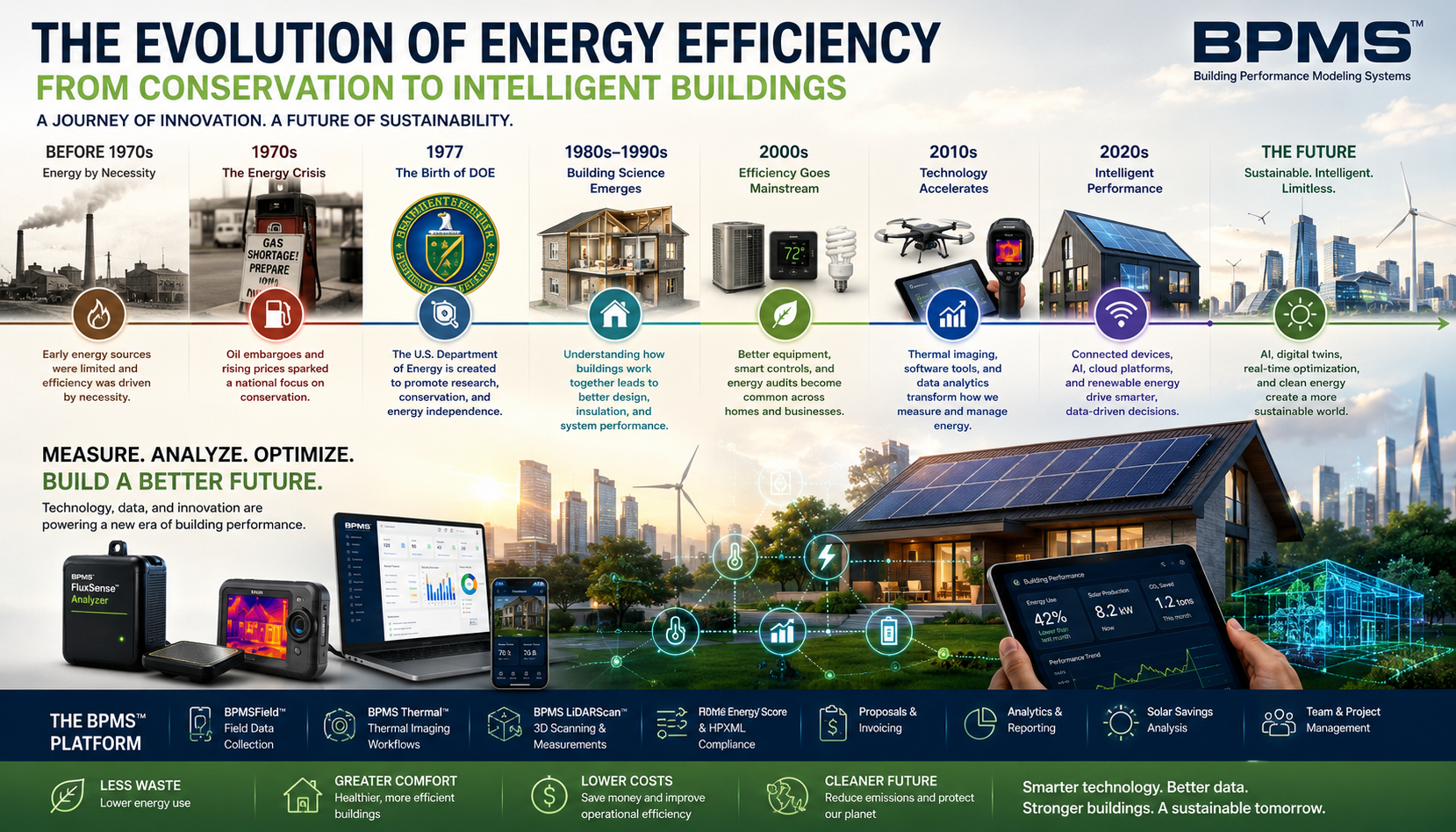
Explore the history of energy conservation from the energy crises of the 1970s through the creation of the U.S. Department of Energy, the rise of building science, smart technologies, solar energy adoption, and the modern software platforms transforming how we reduce energy consumption today. Discover what the future holds for energy efficiency, building performance, and data-driven sustainability.
From Energy Conservation to Intelligent Buildings: The Evolution of Energy Efficiency and the Future of Building Performance
Introduction
Energy has shaped civilization for centuries. From wood-burning stoves and coal-fired factories to modern solar arrays and intelligent buildings, the pursuit of energy efficiency has become one of the most important technological movements in modern history.
Today, homeowners, businesses, governments, utilities, and building professionals all share a common goal:
Use less energy, reduce costs, improve comfort, and minimize environmental impact.
The path to this goal has been decades in the making.
The story of energy conservation is one of innovation, policy, science, and technology. It is a story that continues to evolve as advanced software platforms, artificial intelligence, smart sensors, thermal imaging, LiDAR, and renewable energy systems reshape the way we understand building performance.
This article explores the history of energy conservation, the creation of the U.S. Department of Energy, major technological milestones, where the industry stood a decade ago, where it stands today, and what the future may hold.
⸻
The Early Days of Energy Conservation
For much of human history, energy conservation was driven primarily by necessity.
Before modern power grids, energy sources included:
* Wood
* Coal
* Animal labor
* Windmills
* Water wheels
Efficiency was important because fuel was expensive, difficult to obtain, or labor-intensive to produce.
However, the Industrial Revolution dramatically increased energy consumption. Coal-powered factories, railroads, and later oil-based transportation fueled unprecedented economic growth.
For decades, energy was viewed as abundant and inexpensive.
Conservation was rarely a priority.
⸻
The Energy Crisis That Changed Everything
The modern energy conservation movement gained momentum during the 1970s.
Two major events transformed how governments viewed energy:
1973 Oil Embargo
The Organization of Petroleum Exporting Countries (OPEC) imposed an oil embargo that caused severe fuel shortages and skyrocketing prices.
1979 Energy Crisis
Political instability in the Middle East led to another surge in energy prices and concerns about national energy security.
These events exposed America’s dependence on foreign energy supplies and highlighted the need for greater energy independence.
For the first time, energy conservation became a national priority.
⸻
The Birth of the U.S. Department of Energy
In 1977, the United States established the Department of Energy (DOE).
United States Department of Energy
The DOE was created to:
* Improve national energy security
* Advance energy research
* Promote conservation programs
* Develop renewable energy technologies
* Support scientific innovation
The agency became responsible for many programs that continue to influence building performance and energy efficiency today.
These efforts helped launch decades of innovation in:
* Insulation technologies
* HVAC systems
* Building science
* Renewable energy
* Energy-efficient appliances
⸻
The Rise of Building Science
Throughout the 1980s and 1990s, researchers began viewing buildings as interconnected systems rather than collections of individual components.
This new discipline became known as:
Building Science
Building science examines how:
* Heat moves
* Air moves
* Moisture moves
* Occupants interact with buildings
Researchers discovered that improving one aspect of a building could affect others.
For example:
* Adding insulation impacts HVAC performance.
* Air sealing affects indoor air quality.
* Window upgrades influence comfort and solar heat gain.
This systems-based approach transformed the building industry.
⸻
The First Generation of Energy Efficiency Technologies
By the early 2000s, energy efficiency technologies had become more common.
Popular upgrades included:
* Double-pane windows
* High-efficiency furnaces
* Improved insulation
* Compact fluorescent lighting (CFL)
* Programmable thermostats
* Air sealing techniques
Energy audits also became more sophisticated.
Auditors increasingly used:
* Blower door testing
* Duct leakage testing
* Infrared thermography
These tools provided deeper insights into building performance.
⸻
Where We Were 10 Years Ago
Around 2015–2016, the building performance industry looked very different than it does today.
Most energy audits relied heavily on:
* Manual measurements
* Paper forms
* Digital cameras
* Spreadsheet calculations
* Desktop software
Thermal imaging was available but often required expensive standalone systems.
Many workflows involved:
* Multiple software applications
* Duplicate data entry
* Manual report creation
* Separate proposal tools
Solar adoption was growing but had not yet achieved today’s scale.
While technology was improving, many processes remained labor-intensive.
⸻
The Transformation of the Last Decade
The past ten years have brought extraordinary advancements.
Building professionals now have access to technologies that were once limited to research laboratories.
These innovations include:
Thermal Imaging
Modern thermal cameras provide:
* Higher resolution
* Faster diagnostics
* Mobile integration
* Improved affordability
Thermal imaging has become a standard tool for identifying:
* Missing insulation
* Air leakage
* Moisture issues
* Thermal bridging
⸻
LiDAR Technology
LiDAR has revolutionized building measurement.
Professionals can now:
* Scan rooms
* Measure structures
* Capture geometry
* Generate digital models
in a fraction of the time required by traditional methods.
⸻
Cloud Computing
Cloud platforms have transformed collaboration.
Data can now be:
* Stored centrally
* Accessed remotely
* Shared instantly
* Updated in real time
This has dramatically improved operational efficiency.
⸻
Smart Home Technology
Modern homes increasingly utilize:
* Smart thermostats
* Connected HVAC systems
* Energy monitoring devices
* Occupancy sensors
These technologies provide unprecedented visibility into energy consumption.
⸻
The Solar Energy Revolution
Perhaps no energy technology has advanced more rapidly than solar power.
Ten years ago:
* Solar installations were significantly more expensive.
* Adoption rates were lower.
* Energy storage solutions were limited.
Today:
* Solar costs have dropped dramatically.
* Battery storage is more accessible.
* Net-zero homes are increasingly common.
* Solar awareness is at an all-time high.
Homeowners can now monitor:
* Production
* Consumption
* Battery storage
* Grid interaction
in real time.
⸻
The Rise of Energy Efficiency Software
As buildings become more sophisticated, software has become equally important.
Modern building performance platforms help professionals:
* Conduct energy audits
* Generate reports
* Analyze building performance
* Create proposals
* Calculate HVAC loads
* Manage projects
* Generate compliance documentation
Software has evolved from simple calculation tools into comprehensive building intelligence platforms.
⸻
Enter BPMS™: The Next Generation of Building Performance Technology
The next phase of building performance requires more than isolated software tools.
It requires a connected ecosystem.
BPMS™ (Building Performance Modeling Systems™) was developed to bring multiple workflows together into a unified platform.
Rather than relying on separate systems for:
* Audits
* Field data collection
* Thermal imaging
* Load calculations
* Proposals
* Invoicing
* Reporting
BPMS™ integrates these functions into a single environment.
⸻
BPMSField™: Modernizing Field Data Collection
BPMSField™ enables professionals to:
* Capture photos
* Record field observations
* Upload thermal images
* Synchronize project information
* Connect field and office workflows
This reduces administrative overhead and improves data accuracy.
⸻
BPMS Thermal™ and BPMS LiDARScan™
Advanced diagnostic technologies are becoming increasingly integrated into everyday workflows.
BPMS Thermal™ helps organize and manage thermal imaging data.
BPMS LiDARScan™ leverages modern LiDAR capabilities to:
* Capture dimensions
* Create digital building models
* Improve measurement accuracy
These technologies support faster and more informed decision-making.
⸻
BPMS FluxSense Analyzer™: A New Frontier
One of the most exciting developments on the horizon is direct heat flux measurement.
The patent-pending BPMS FluxSense Analyzer™ is being developed to help measure actual thermal energy transfer through building assemblies.
Rather than relying solely on estimates, this technology seeks to provide:
* Direct heat flow measurements
* Dynamic thermal performance analysis
* Enhanced building diagnostics
* Improved retrofit validation
This represents an emerging category of building performance technology.
⸻
What the Future Holds
The future of energy efficiency is likely to be driven by four major trends.
1. Artificial Intelligence
AI will increasingly assist with:
* Energy analysis
* Fault detection
* Building optimization
* Retrofit recommendations
⸻
2. Real-Time Building Intelligence
Buildings will continuously monitor:
* Energy usage
* Thermal performance
* HVAC operation
* Occupant comfort
allowing proactive optimization rather than reactive maintenance.
⸻
3. Greater Renewable Integration
Solar energy, battery storage, and smart grid technologies will continue to expand.
Buildings will increasingly become both energy consumers and energy producers.
⸻
4. Digital Twins and Predictive Modeling
Digital representations of buildings will allow professionals to simulate:
* Upgrades
* Equipment changes
* Occupancy patterns
* Energy savings
before investments are made.
⸻
The Future of Building Performance
The building industry is entering a new era.
What began as basic energy conservation efforts decades ago has evolved into a sophisticated ecosystem of science, technology, renewable energy, and data analytics.
Today’s building professionals have access to:
* Thermal imaging
* LiDAR scanning
* Smart sensors
* Cloud computing
* Solar analytics
* Advanced building performance software
Tomorrow’s professionals will leverage:
* Artificial intelligence
* Predictive diagnostics
* Digital twins
* Real-time thermal monitoring
* Autonomous building optimization
The goal remains the same as it was nearly fifty years ago:
Reduce energy waste, improve building performance, increase comfort, lower operating costs, and create a more sustainable future.
As technology continues to advance, platforms like BPMS™, BPMSField™, BPMS Thermal™, BPMS LiDARScan™, BPMS Load CalC™, and the BPMS FluxSense Analyzer™ are helping lead the industry toward a future where building performance is measured, managed, and optimized with greater precision than ever before.
Comments and Reviews
Share what you found helpful and how this article supported your work.
0.0/5from 0 reviews
No reviews yet. Be the first to share your feedback.